Anthropic launches Claude Opus 5 with stronger cyber safeguards and enterprise pricing pressure
Anthropic released Claude Opus 5 and said it comes close to Fable 5’s capabilities in many domains, with better complex coding performance. The company emphasized stronger cybersecurity safeguards than Opus 4.8, said Opus 5 is the least susceptible to being tricked into misuse, and offered it at th…
Anthropic released Claude Opus 5 and said it comes close to Fable 5’s capabilities in many domains, with better complex coding performance. The company emphasized stronger cybersecurity safeguards than Opus 4.8, said Opus 5 is the least susceptible to being tricked into misuse, and offered it at the same per-token price as its predecessor while positioning it as cheaper than Fable 5 and slightly cheaper than OpenAI’s GPT-5.6. [2]
Why it matters: This release shows how AI labs are now competing on capability, safety controls, and pricing at the same time. Anthropic is also signaling that advanced models may increasingly ship with built-in restrictions, fallback behavior, and government-facing testing baked into the product lifecycle. [2]
Key insights: Anthropic framed the model as enterprise-friendly, especially for knowledge work, biology, and coding, while still reserving Fable 5 for the hardest long-horizon agent work. [2] | The company explicitly tied the launch to heightened cybersecurity scrutiny, saying Opus 5 has more safeguards than the previous Opus model. [2] | Anthropic said it continues to work with government partners on independent testing of Opus 5, indicating ongoing regulatory involvement in model releases. [2] | The launch also reflects pricing and product pressure: Anthropic kept Opus 5 at $5 input / $25 output per million tokens and added Fast mode plus automatic fallback options when safeguards block requests. [2]
Cheatsheet facts: What changed: Anthropic released Claude Opus 5 with more cyber safeguards, enterprise targeting, and new usage options like Fast mode and automatic fallback. [2] | Why now: The release follows recent government scrutiny of frontier AI models and arrives amid broader industry security concerns. [2] | Watch next: Monitor whether Anthropic expands government testing details, how users adopt Fast mode, and whether safeguard-triggered fallbacks become a standard product feature. [2]
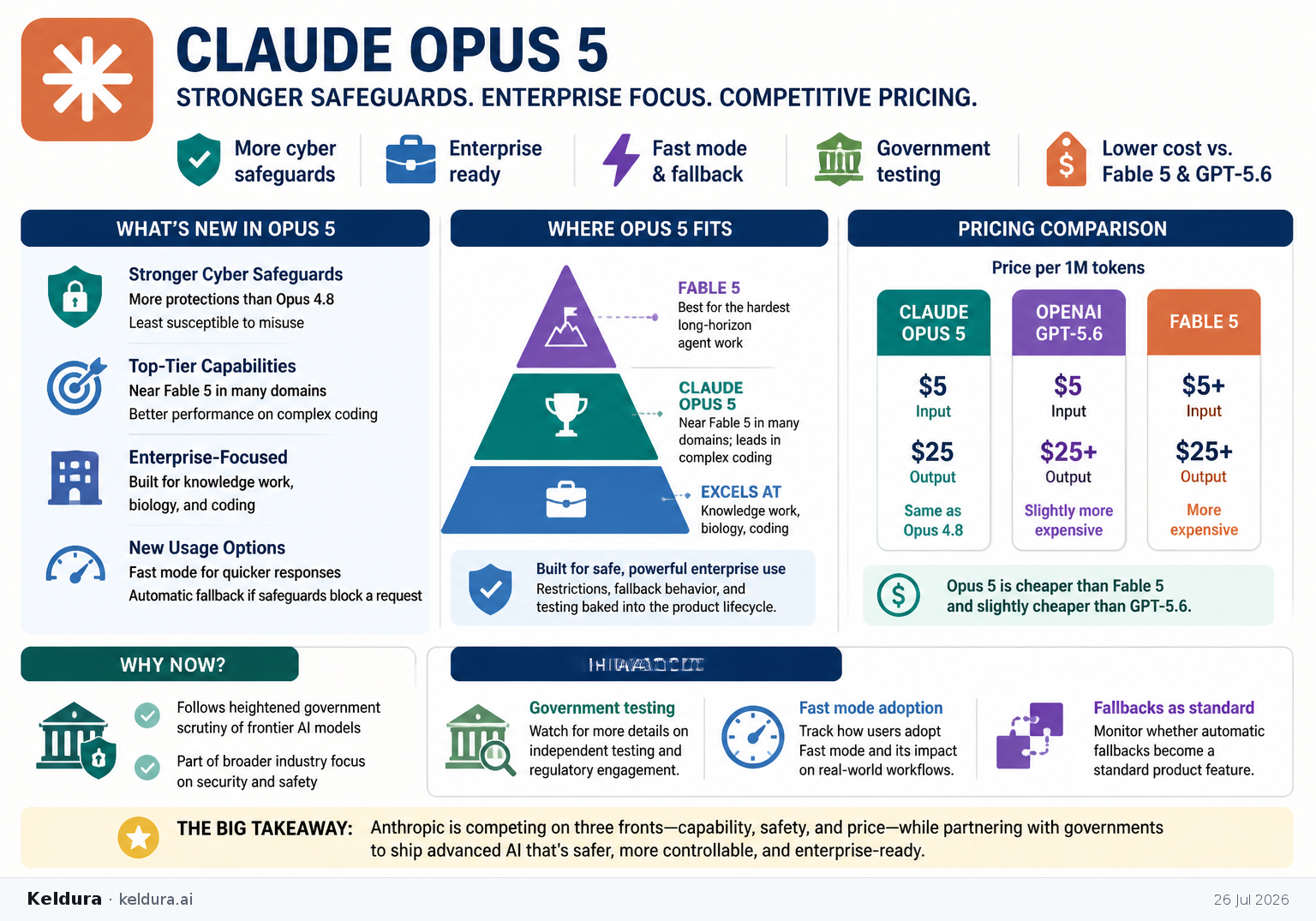
Anthropic released Claude Opus 5 and said it comes close to Fable 5’s capabilities in many domains, with better complex coding performance. The company emphasized stronger cybersecurity safeguards than Opus 4.8, said Opus 5 is the least susceptible to being tricked into misuse, and offered it at the same per-token price as its predecessor while positioning it as cheaper than Fable 5 and slightly cheaper than OpenAI’s GPT-5.6. [2]
Why it matters: This release shows how AI labs are now competing on capability, safety controls, and pricing at the same time. Anthropic is also signaling that advanced models may increasingly ship with built-in restrictions, fallback behavior, and government-facing testing baked into the product lifecycle. [2]
Key insights: Anthropic framed the model as enterprise-friendly, especially for knowledge work, biology, and coding, while still reserving Fable 5 for the hardest long-horizon agent work. [2] | The company explicitly tied the launch to heightened cybersecurity scrutiny, saying Opus 5 has more safeguards than the previous Opus model. [2] | Anthropic said it continues to work with government partners on independent testing of Opus 5, indicating ongoing regulatory involvement in model releases. [2] | The launch also reflects pricing and product pressure: Anthropic kept Opus 5 at $5 input / $25 output per million tokens and added Fast mode plus automatic fallback options when safeguards block requests. [2]
Cheatsheet facts: What changed: Anthropic released Claude Opus 5 with more cyber safeguards, enterprise targeting, and new usage options like Fast mode and automatic fallback. [2] | Why now: The release follows recent government scrutiny of frontier AI models and arrives amid broader industry security concerns. [2] | Watch next: Monitor whether Anthropic expands government testing details, how users adopt Fast mode, and whether safeguard-triggered fallbacks become a standard product feature. [2]
X copy pack
Edition complete
You've reached the end of this edition.