Probabilistic cyclone forecasts are expanding, but most services still need training and public-warning integration
WMO says weather services are expanding probabilistic tropical cyclone forecasting to improve early warnings and disaster preparedness. The evidence shows a clear move beyond simple track cones toward products such as dynamic cones, strike probability maps, wind-speed probabilities and storm-surge…
WMO says weather services are expanding probabilistic tropical cyclone forecasting to improve early warnings and disaster preparedness. The evidence shows a clear move beyond simple track cones toward products such as dynamic cones, strike probability maps, wind-speed probabilities and storm-surge tools, but many forecast centres have not yet adopted them operationally. [2]
Why it matters: Probabilistic forecasts can support better decisions because they show a range of possible outcomes and impacts, not just one predicted path. That matters for cyclone preparedness because the real challenge is not only forecasting where a storm may go, but making uncertainty usable for local governments, emergency services and the public. [2]
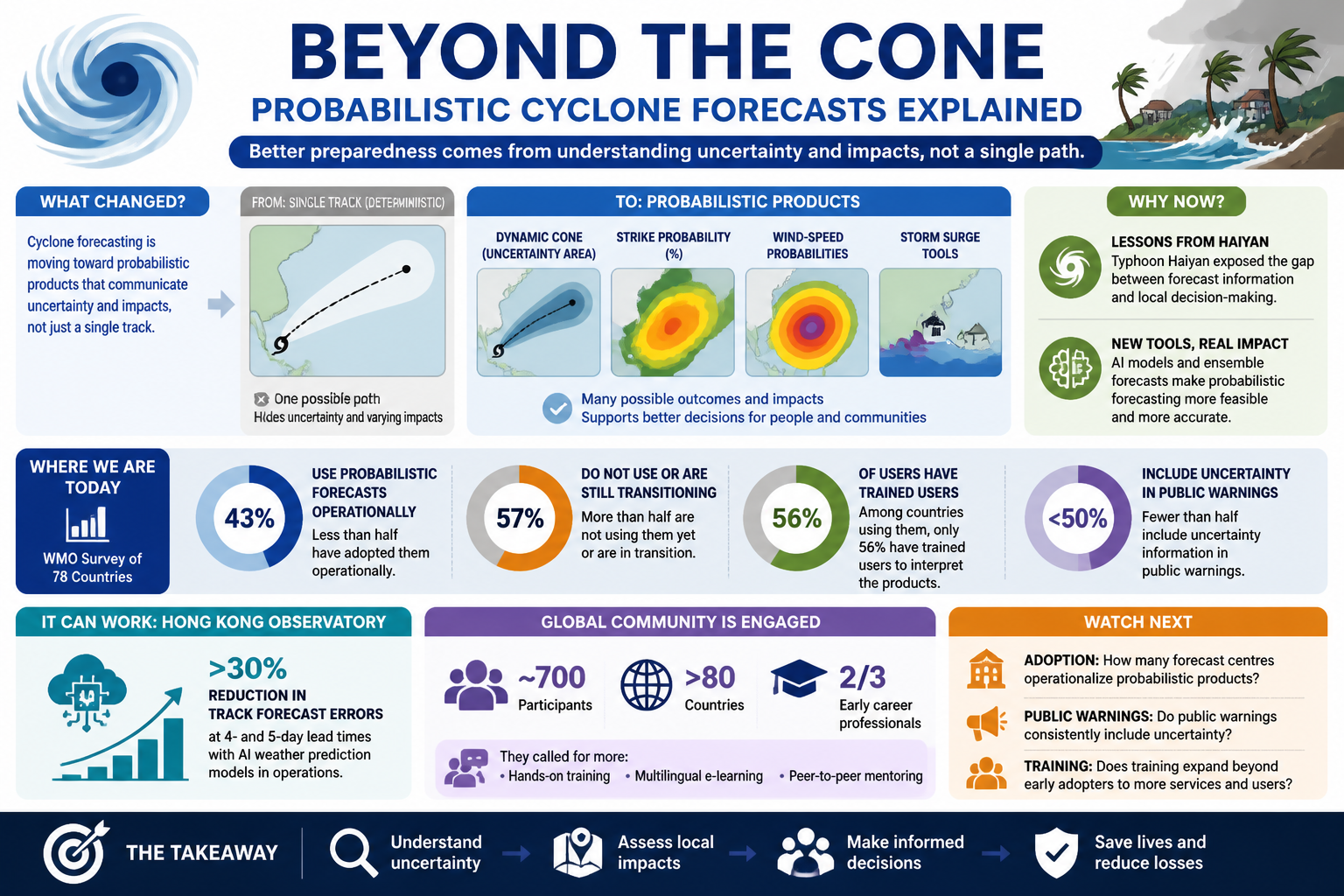
Key insights: A WMO survey of 78 countries found only 43% of respondents currently use probabilistic forecasts operationally, while more than half either do not use them at all or are still transitioning. [2] | Among countries already using probabilistic forecasts, only 56% have trained users to interpret them, and fewer than half include uncertainty information in public warnings. [2] | The Hong Kong Observatory reduced tropical cyclone track forecast errors by more than 30% at four- and five-day lead times after introducing AI weather prediction models into operational forecasting. [2] | The workshop drew nearly 700 participants from more than 80 countries, and two thirds were early career professionals, who called for more hands-on training, multilingual e-learning and peer-to-peer mentoring. [2]
Cheatsheet facts: What changed: Cyclone forecasting is moving toward probabilistic products that communicate uncertainty and impacts, not just a single forecast track. [2] | Why now: Typhoon Haiyan showed the gap between forecast information and local decision-making, and new AI and ensemble tools are making probabilistic forecasting more feasible. [2] | Watch next: Track how many forecast centres operationalize probabilistic products, whether public warnings include uncertainty, and whether training expands beyond early adopters. [2]
WMO says weather services are expanding probabilistic tropical cyclone forecasting to improve early warnings and disaster preparedness. The evidence shows a clear move beyond simple track cones toward products such as dynamic cones, strike probability maps, wind-speed probabilities and storm-surge tools, but many forecast centres have not yet adopted them operationally. [2]
Why it matters: Probabilistic forecasts can support better decisions because they show a range of possible outcomes and impacts, not just one predicted path. That matters for cyclone preparedness because the real challenge is not only forecasting where a storm may go, but making uncertainty usable for local governments, emergency services and the public. [2]
Key insights: A WMO survey of 78 countries found only 43% of respondents currently use probabilistic forecasts operationally, while more than half either do not use them at all or are still transitioning. [2] | Among countries already using probabilistic forecasts, only 56% have trained users to interpret them, and fewer than half include uncertainty information in public warnings. [2] | The Hong Kong Observatory reduced tropical cyclone track forecast errors by more than 30% at four- and five-day lead times after introducing AI weather prediction models into operational forecasting. [2] | The workshop drew nearly 700 participants from more than 80 countries, and two thirds were early career professionals, who called for more hands-on training, multilingual e-learning and peer-to-peer mentoring. [2]
Cheatsheet facts: What changed: Cyclone forecasting is moving toward probabilistic products that communicate uncertainty and impacts, not just a single forecast track. [2] | Why now: Typhoon Haiyan showed the gap between forecast information and local decision-making, and new AI and ensemble tools are making probabilistic forecasting more feasible. [2] | Watch next: Track how many forecast centres operationalize probabilistic products, whether public warnings include uncertainty, and whether training expands beyond early adopters. [2]