Saudi Arabia, the Houthis, and the US intensify maritime conflict risks in the Red Sea and Hormuz
Saudi Arabia launched airstrikes on Houthi targets in Hodeida and a nearby island after the Iran-backed group announced a maritime blockade and attacked Saudi ships, while Saudi authorities later issued emergency alerts for Jizan after the Houthis claimed a missile attack there [1]. At the same tim…
Saudi Arabia launched airstrikes on Houthi targets in Hodeida and a nearby island after the Iran-backed group announced a maritime blockade and attacked Saudi ships, while Saudi authorities later issued emergency alerts for Jizan after the Houthis claimed a missile attack there [1]. At the same time, the US military said it fired on and disabled a tanker in the Gulf of Oman that was trying to evade the American blockade on Iranian ports, marking the second commercial ship disabled since the blockade was reimposed [1]. Separate BBC reporting says Houthi attacks on shipping in the Red Sea are threatening the Bab el-Mandeb Strait and raising fears of wider conflict and economic damage [6].
Why it matters: This is a direct threat to two of the world’s most sensitive shipping corridors, the Bab el-Mandeb and the Strait of Hormuz, with implications for oil, gas, fertiliser, and container traffic [1][6]. The reporting also shows the conflict is no longer isolated: Saudi, Houthi, US, and Iran-linked actions are overlapping, which increases the risk of miscalculation and supply-chain disruption [1][6].
Key insights: The Houthis are not just launching symbolic attacks; BBC says they have already pushed ships back from the Bab el-Mandeb route and disrupted Red Sea trade [6]. | The US says it has now disabled a second commercial ship since reimposing its blockade, indicating a sustained enforcement posture in the Gulf of Oman [1]. | BBC reports Brent crude briefly moved back above $100 a barrel this week on concern over Red Sea threats, underscoring immediate market sensitivity [1]. | The London conference the BBC says the US and UK plan to hold next week on the Strait of Hormuz is a concrete sign governments are treating the situation as a broader maritime security crisis [1].
Cheatsheet facts: What changed: Saudi-Houthi exchanges of fire escalated, and the US disabled another tanker near Hormuz while Red Sea shipping threats persisted [1][6]. | Why now: The Houthis’ maritime blockade claims, US strikes on Iranian-linked shipping, and reported attacks on Saudi targets are converging at the same time [1][6]. | Watch next: Look for whether shipping continues to divert through Bab el-Mandeb/Hormuz, and whether the London conference produces any new security coordination or naval measures [1][6].
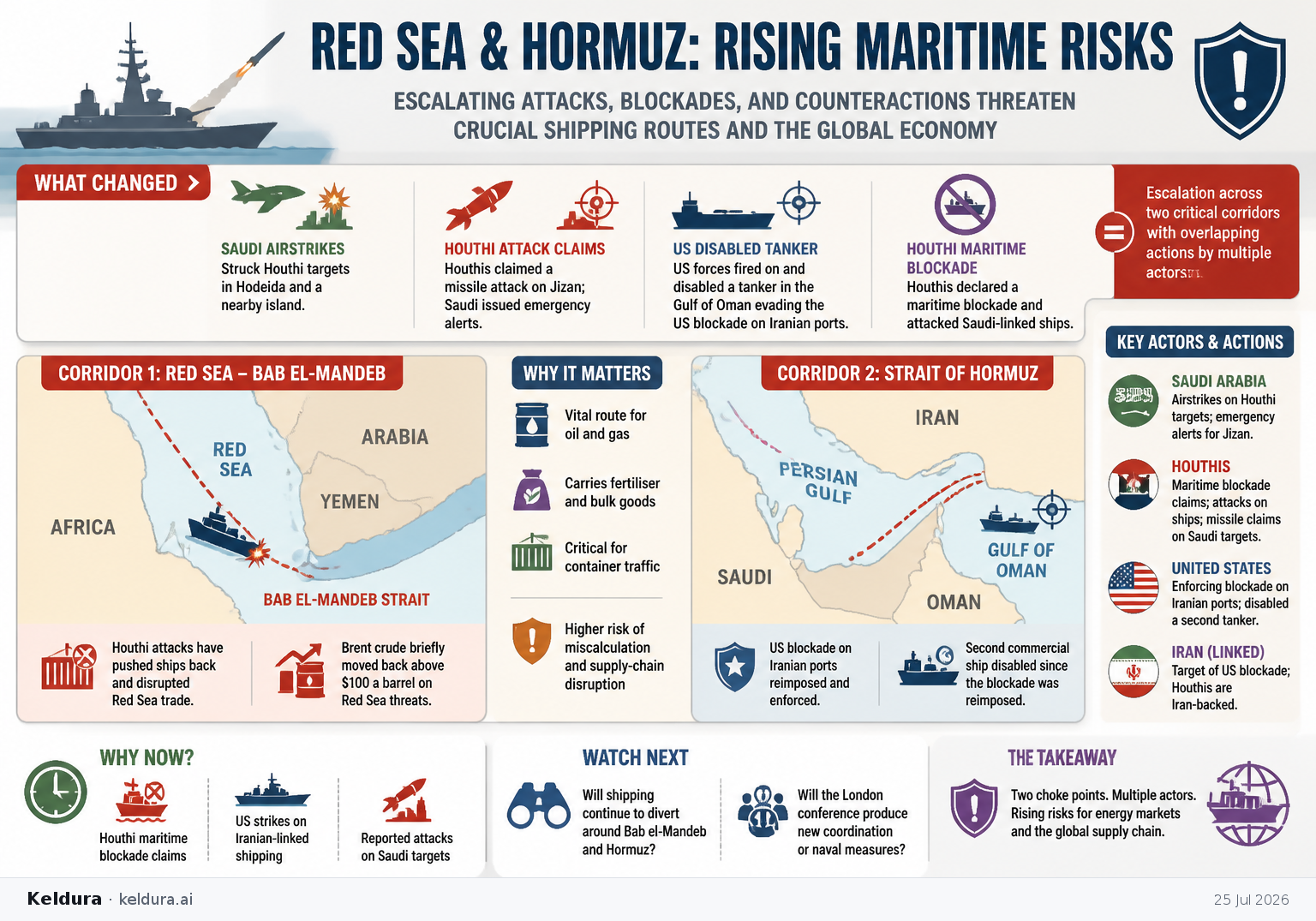
Saudi Arabia launched airstrikes on Houthi targets in Hodeida and a nearby island after the Iran-backed group announced a maritime blockade and attacked Saudi ships, while Saudi authorities later issued emergency alerts for Jizan after the Houthis claimed a missile attack there [1]. At the same time, the US military said it fired on and disabled a tanker in the Gulf of Oman that was trying to evade the American blockade on Iranian ports, marking the second commercial ship disabled since the blockade was reimposed [1]. Separate BBC reporting says Houthi attacks on shipping in the Red Sea are threatening the Bab el-Mandeb Strait and raising fears of wider conflict and economic damage [6].
Why it matters: This is a direct threat to two of the world’s most sensitive shipping corridors, the Bab el-Mandeb and the Strait of Hormuz, with implications for oil, gas, fertiliser, and container traffic [1][6]. The reporting also shows the conflict is no longer isolated: Saudi, Houthi, US, and Iran-linked actions are overlapping, which increases the risk of miscalculation and supply-chain disruption [1][6].
Key insights: The Houthis are not just launching symbolic attacks; BBC says they have already pushed ships back from the Bab el-Mandeb route and disrupted Red Sea trade [6]. | The US says it has now disabled a second commercial ship since reimposing its blockade, indicating a sustained enforcement posture in the Gulf of Oman [1]. | BBC reports Brent crude briefly moved back above $100 a barrel this week on concern over Red Sea threats, underscoring immediate market sensitivity [1]. | The London conference the BBC says the US and UK plan to hold next week on the Strait of Hormuz is a concrete sign governments are treating the situation as a broader maritime security crisis [1].
Cheatsheet facts: What changed: Saudi-Houthi exchanges of fire escalated, and the US disabled another tanker near Hormuz while Red Sea shipping threats persisted [1][6]. | Why now: The Houthis’ maritime blockade claims, US strikes on Iranian-linked shipping, and reported attacks on Saudi targets are converging at the same time [1][6]. | Watch next: Look for whether shipping continues to divert through Bab el-Mandeb/Hormuz, and whether the London conference produces any new security coordination or naval measures [1][6].