China’s growth is still being propped up by exports and high-tech investment
The World Bank’s July 2026 China Economic Update says China maintained solid growth at the start of the year, with high-tech investment and exports offsetting subdued consumption [7]. It also says momentum softened in the second quarter after a global energy supply shock, though the effect was miti…
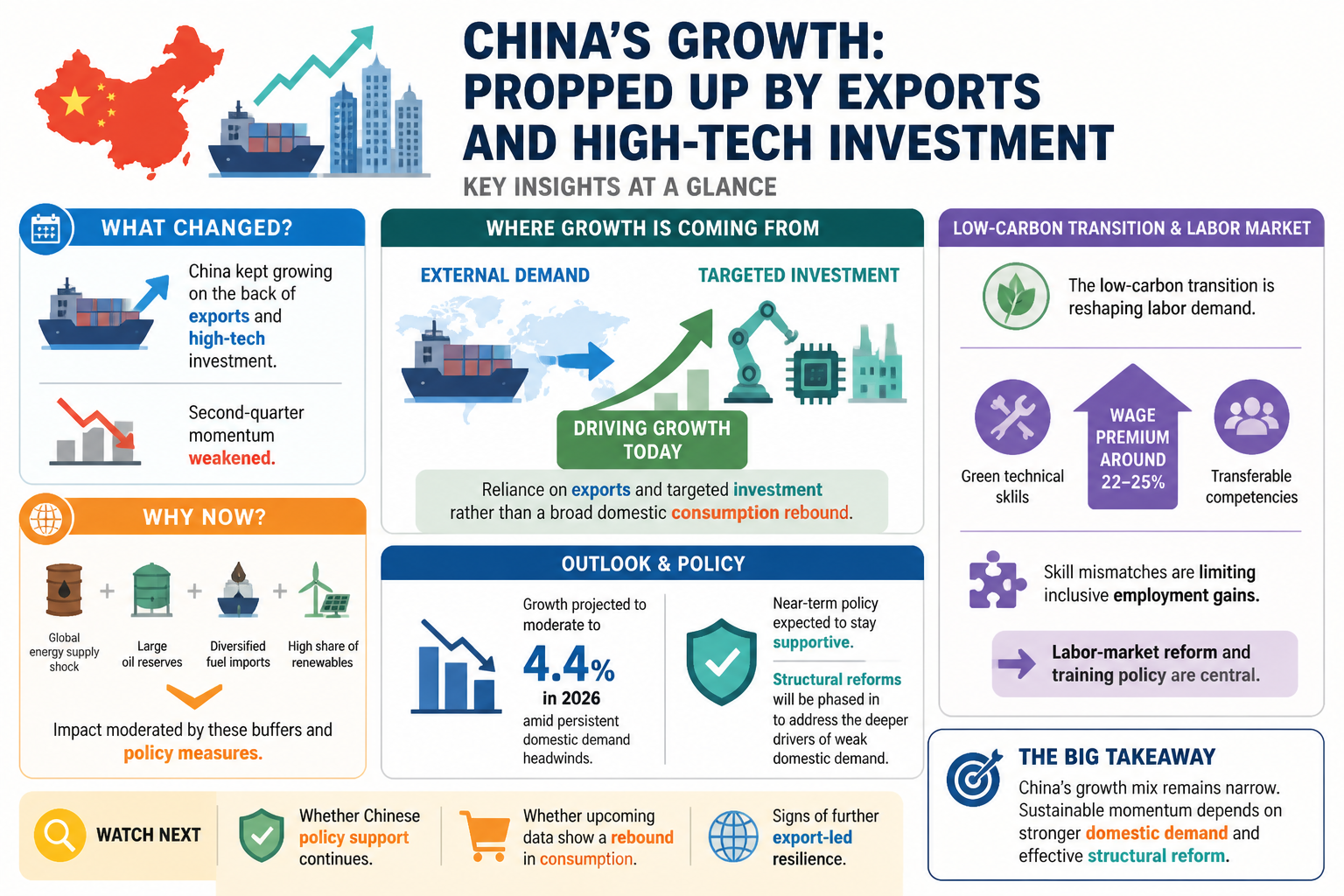
The World Bank’s July 2026 China Economic Update says China maintained solid growth at the start of the year, with high-tech investment and exports offsetting subdued consumption [7]. It also says momentum softened in the second quarter after a global energy supply shock, though the effect was mitigated by large oil reserves, diversified fuel imports, a high share of renewables, and policy measures [7].
Why it matters: This matters because it shows China’s economy is relying on external demand and targeted investment rather than a broad domestic consumption rebound [7]. That has implications for global trade flows, commodity demand, and how sustainable China’s growth mix may be if household demand remains weak [7].
Key insights: The World Bank projects China’s growth will moderate to 4.4 percent in 2026 amid persistent domestic demand headwinds [7]. | Near-term policy is expected to stay supportive while structural reforms are phased in to address the deeper drivers of weak domestic demand [7]. | The update also says China’s low-carbon transition is reshaping labor demand, with green technical skills and transferable competencies seeing wage premiums of around 22 to 25 percent [7]. | Skill mismatches are limiting inclusive employment gains, implying that labor-market reform and training policy remain central to the transition [7].
Cheatsheet facts: What changed: China kept growing on the back of exports and high-tech investment, but second-quarter momentum weakened [7]. | Why now: The latest World Bank update ties the slowdown to a global energy supply shock and persistent domestic demand weakness [7]. | Watch next: Watch for whether Chinese policy support continues, and whether upcoming data show any rebound in consumption or further export-led resilience [7].
The World Bank’s July 2026 China Economic Update says China maintained solid growth at the start of the year, with high-tech investment and exports offsetting subdued consumption [7]. It also says momentum softened in the second quarter after a global energy supply shock, though the effect was mitigated by large oil reserves, diversified fuel imports, a high share of renewables, and policy measures [7].
Why it matters: This matters because it shows China’s economy is relying on external demand and targeted investment rather than a broad domestic consumption rebound [7]. That has implications for global trade flows, commodity demand, and how sustainable China’s growth mix may be if household demand remains weak [7].
Key insights: The World Bank projects China’s growth will moderate to 4.4 percent in 2026 amid persistent domestic demand headwinds [7]. | Near-term policy is expected to stay supportive while structural reforms are phased in to address the deeper drivers of weak domestic demand [7]. | The update also says China’s low-carbon transition is reshaping labor demand, with green technical skills and transferable competencies seeing wage premiums of around 22 to 25 percent [7]. | Skill mismatches are limiting inclusive employment gains, implying that labor-market reform and training policy remain central to the transition [7].
Cheatsheet facts: What changed: China kept growing on the back of exports and high-tech investment, but second-quarter momentum weakened [7]. | Why now: The latest World Bank update ties the slowdown to a global energy supply shock and persistent domestic demand weakness [7]. | Watch next: Watch for whether Chinese policy support continues, and whether upcoming data show any rebound in consumption or further export-led resilience [7].