Wastewater model infers pathogen transmission in real time
Researchers introduced EpiSewer, a Bayesian semi-mechanistic wastewater model that estimates effective reproduction number and epidemic growth rate directly from raw concentration and flow data. In multi-pathogen surveillance across 6–14 treatment plants in Switzerland from November 2022 to May 202…
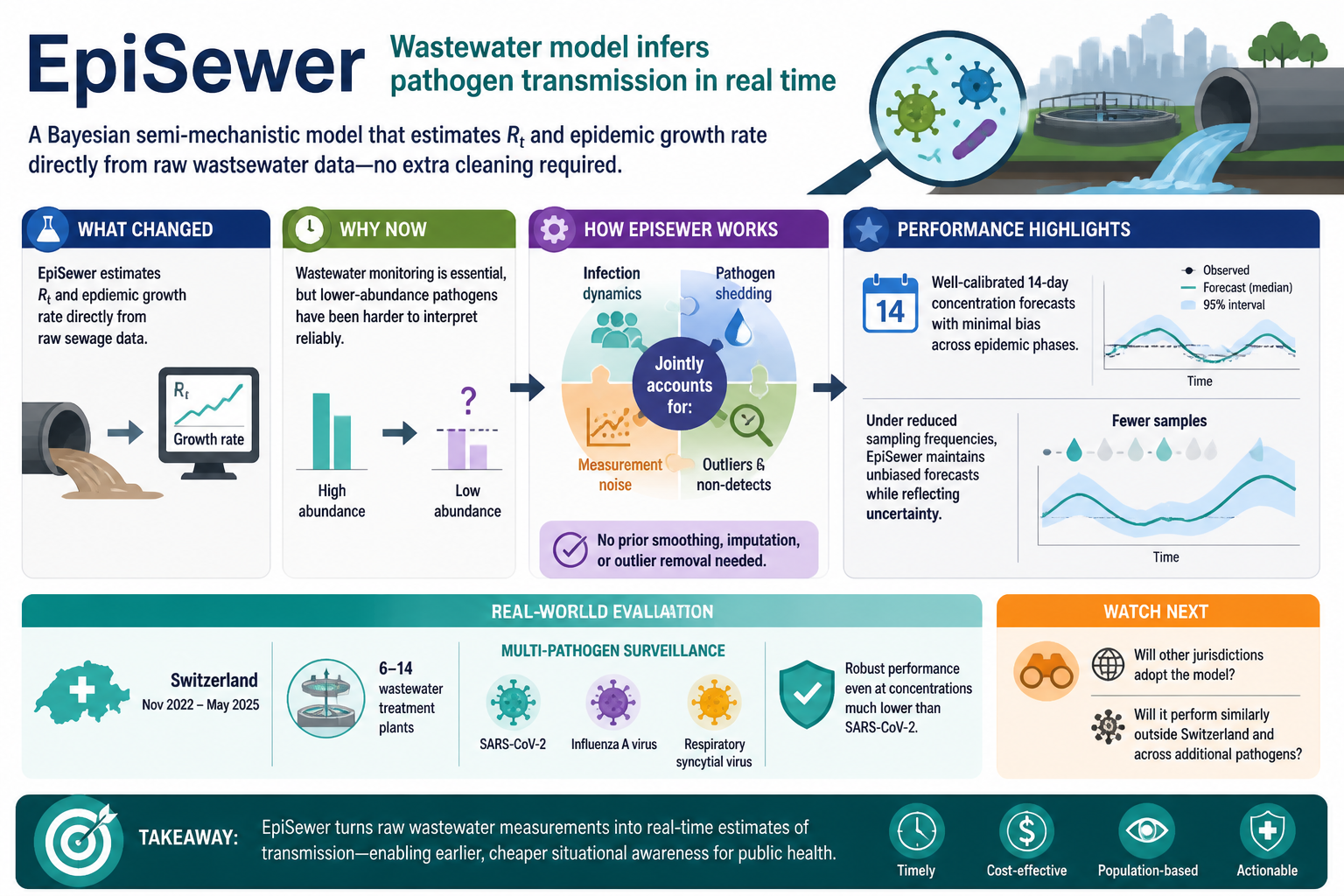
Researchers introduced EpiSewer, a Bayesian semi-mechanistic wastewater model that estimates effective reproduction number and epidemic growth rate directly from raw concentration and flow data. In multi-pathogen surveillance across 6–14 treatment plants in Switzerland from November 2022 to May 2025, the model tracked SARS-CoV-2, influenza A virus, and respiratory syncytial virus in real time and remained robust even when pathogen concentrations were much lower than SARS-CoV-2. [5]
Why it matters: If validated broadly, the approach could make wastewater surveillance more useful for pathogens with limited clinical testing or weaker sewage signals. That matters for public health systems that want earlier, cheaper situational awareness without relying on extensive patient-level surveillance. [5]
Key insights: The model jointly accounts for infection dynamics, pathogen shedding, measurement noise, outliers, and non-detects. [5] | It eliminates the need for prior smoothing, imputation, or outlier removal when estimating transmission dynamics from wastewater data. [5] | The study reports well-calibrated fourteen-day concentration forecasts with minimal bias across epidemic phases. [5] | Under reduced sampling frequencies, EpiSewer still maintained unbiased forecasts while reflecting uncertainty. [5]