Joint assessment targets MERS-CoV risks in African camel populations
GLEWS+, a joint initiative of FAO, WHO and WOAH, has published an assessment of MERS-CoV clade B transmission risks at the human–animal–ecosystem interface.[1] It examines potential spread among dromedary camels in the Nile Basin and across Africa, alongside zoonotic transmission from infected came…
GLEWS+, a joint initiative of FAO, WHO and WOAH, has published an assessment of MERS-CoV clade B transmission risks at the human–animal–ecosystem interface.[1] It examines potential spread among dromedary camels in the Nile Basin and across Africa, alongside zoonotic transmission from infected camels to people in Nile Basin countries.[1]
Why it matters: The assessment is intended to help countries strengthen prevention, detection, response and control by considering the interconnected virological, epidemiological, ecological and socioeconomic conditions that influence MERS-CoV circulation.[1]
Key insights: The analysis covers camel husbandry, pastoralist mobility, cross-border animal movements, live-animal trade and human–camel interactions.[1] | Its geographic scope distinguishes between spread within the Nile Basin, spread across Africa and camel-to-human transmission in Nile Basin countries.[1] | The work uses the GLEWS+ joint risk-assessment mechanism, through which FAO, WHO and WOAH develop evidence-based estimates of emerging health threats.[1]
Cheatsheet facts: What changed: GLEWS+ released a dedicated risk assessment for MERS-CoV clade B in African dromedary camel populations and possible spillover to humans.[1] | Why now: The assessment addresses factors that can sustain or extend transmission, including mobile pastoralism, animal trade, cross-border movements and close human–camel contact.[1] | Watch next: Watch for prevention, surveillance, detection and control measures adopted by Nile Basin and other African countries in response to the assessment.[1]
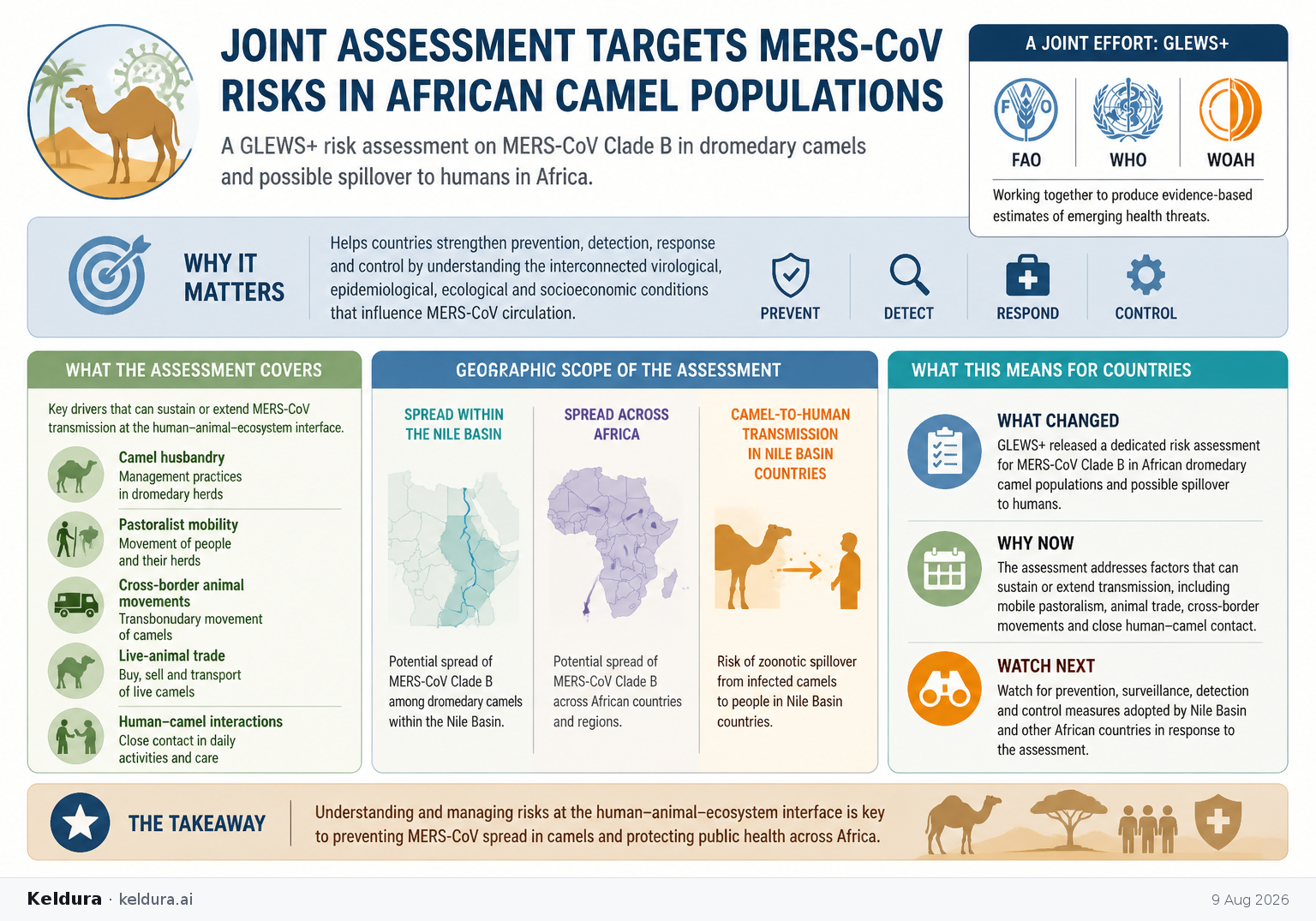
GLEWS+, a joint initiative of FAO, WHO and WOAH, has published an assessment of MERS-CoV clade B transmission risks at the human–animal–ecosystem interface.[1] It examines potential spread among dromedary camels in the Nile Basin and across Africa, alongside zoonotic transmission from infected camels to people in Nile Basin countries.[1]
Why it matters: The assessment is intended to help countries strengthen prevention, detection, response and control by considering the interconnected virological, epidemiological, ecological and socioeconomic conditions that influence MERS-CoV circulation.[1]
Key insights: The analysis covers camel husbandry, pastoralist mobility, cross-border animal movements, live-animal trade and human–camel interactions.[1] | Its geographic scope distinguishes between spread within the Nile Basin, spread across Africa and camel-to-human transmission in Nile Basin countries.[1] | The work uses the GLEWS+ joint risk-assessment mechanism, through which FAO, WHO and WOAH develop evidence-based estimates of emerging health threats.[1]
Cheatsheet facts: What changed: GLEWS+ released a dedicated risk assessment for MERS-CoV clade B in African dromedary camel populations and possible spillover to humans.[1] | Why now: The assessment addresses factors that can sustain or extend transmission, including mobile pastoralism, animal trade, cross-border movements and close human–camel contact.[1] | Watch next: Watch for prevention, surveillance, detection and control measures adopted by Nile Basin and other African countries in response to the assessment.[1]