WHO and DG HERA push pooled procurement toward operational readiness
WHO and the European Commission’s DG HERA, supported by the Regionalized Vaccine Manufacturing Collaborative, convened a second workshop on regional pooled procurement for health emergencies on 8 June 2026 in Kuala Lumpur.[1] Participants moved beyond broad concepts to examine financing, allocation…
WHO and the European Commission’s DG HERA, supported by the Regionalized Vaccine Manufacturing Collaborative, convened a second workshop on regional pooled procurement for health emergencies on 8 June 2026 in Kuala Lumpur.[1] Participants moved beyond broad concepts to examine financing, allocation, donation policies and links among procurement, regional manufacturing, stockpiling, and research and development.[1]
Why it matters: Regional purchasing systems could improve timely and equitable access to diagnostics, vaccines, therapeutics and other medical countermeasures, but the workshop found that financing must be connected to demand signals, governance and agile allocation mechanisms to translate commitments into delivery.[1]
Key insights: The interim Medical Countermeasures Network brought regional and global actors together to align procurement, access and coordination approaches.[1] | DG HERA said i‑MCM‑Net helped coordinate and prioritize procurement requests during the ongoing Bundibugyo Ebola outbreak, reducing duplication.[1] | Participants emphasized pre-financing, pooled financing and demand guarantees while acknowledging that financing alone does not ensure access.[1] | The group called for procurement capacity and trust to be built before crises, with emergency surge arrangements able to transition into sustainable demand and financing models.[1]
Cheatsheet facts: What changed: WHO, DG HERA and partners advanced discussions from conceptual pooled procurement toward operational questions involving financing, allocation and cross-regional coordination.[1] | Why now: Health emergencies require faster and more equitable access to medical countermeasures, while current procurement requests can create duplication without structured global–regional coordination.[1] | Watch next: Watch for regional procurement mechanisms to adopt linked pre-financing, demand guarantees, governance frameworks and science-based allocation processes.[1]
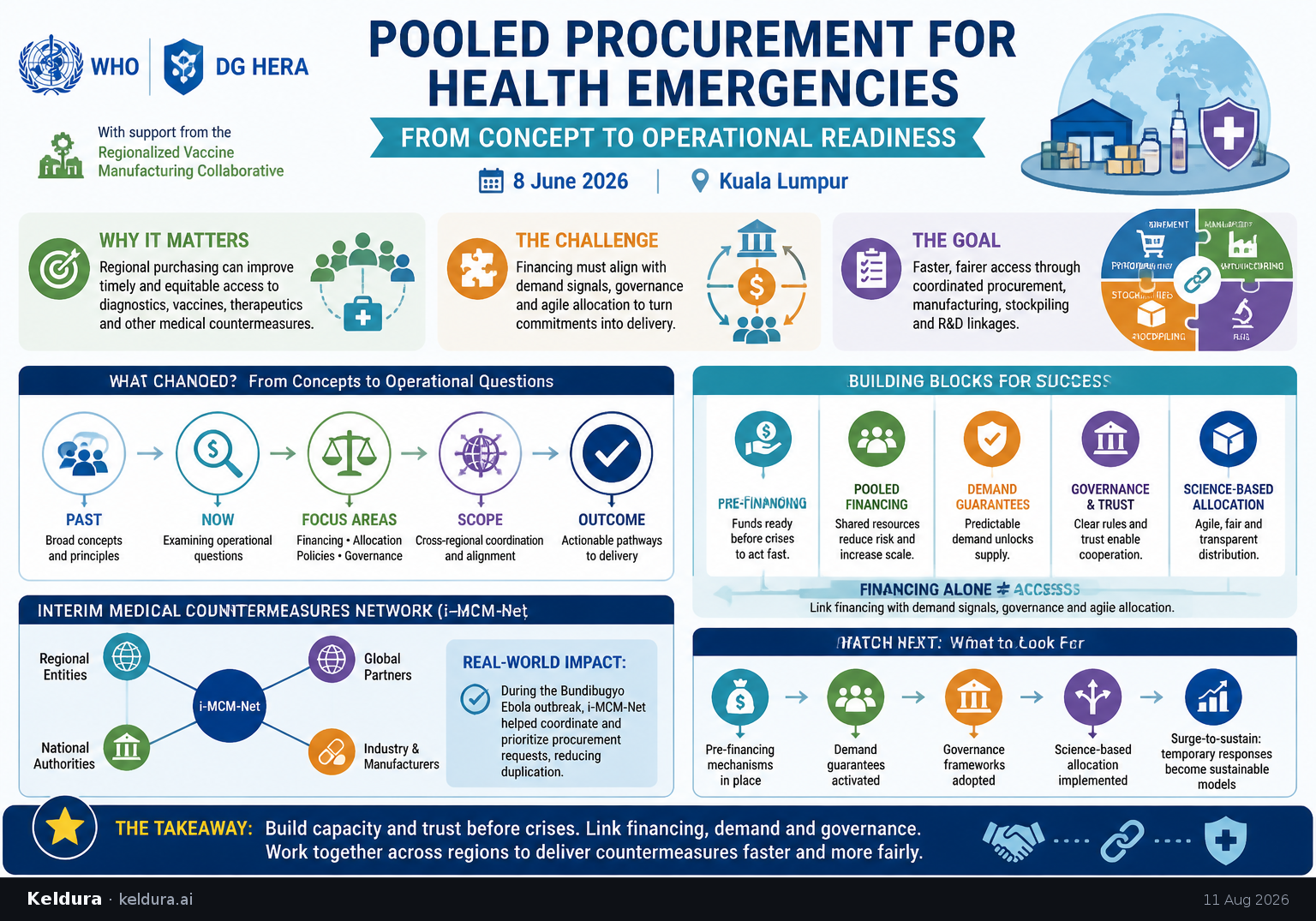
WHO and the European Commission’s DG HERA, supported by the Regionalized Vaccine Manufacturing Collaborative, convened a second workshop on regional pooled procurement for health emergencies on 8 June 2026 in Kuala Lumpur.[1] Participants moved beyond broad concepts to examine financing, allocation, donation policies and links among procurement, regional manufacturing, stockpiling, and research and development.[1]
Why it matters: Regional purchasing systems could improve timely and equitable access to diagnostics, vaccines, therapeutics and other medical countermeasures, but the workshop found that financing must be connected to demand signals, governance and agile allocation mechanisms to translate commitments into delivery.[1]
Key insights: The interim Medical Countermeasures Network brought regional and global actors together to align procurement, access and coordination approaches.[1] | DG HERA said i‑MCM‑Net helped coordinate and prioritize procurement requests during the ongoing Bundibugyo Ebola outbreak, reducing duplication.[1] | Participants emphasized pre-financing, pooled financing and demand guarantees while acknowledging that financing alone does not ensure access.[1] | The group called for procurement capacity and trust to be built before crises, with emergency surge arrangements able to transition into sustainable demand and financing models.[1]
Cheatsheet facts: What changed: WHO, DG HERA and partners advanced discussions from conceptual pooled procurement toward operational questions involving financing, allocation and cross-regional coordination.[1] | Why now: Health emergencies require faster and more equitable access to medical countermeasures, while current procurement requests can create duplication without structured global–regional coordination.[1] | Watch next: Watch for regional procurement mechanisms to adopt linked pre-financing, demand guarantees, governance frameworks and science-based allocation processes.[1]