Oura Ring 5 is a modest hardware update, but the software layer is getting much bigger
The Verge’s review says the Oura Ring 5 is mostly an aesthetic update over the Ring 4: it is smaller and lighter, but uses the same sensors, roughly the same battery life, and does not unlock exclusive software features.[4] At the same time, Oura is adding a wide set of software tools including GLP…
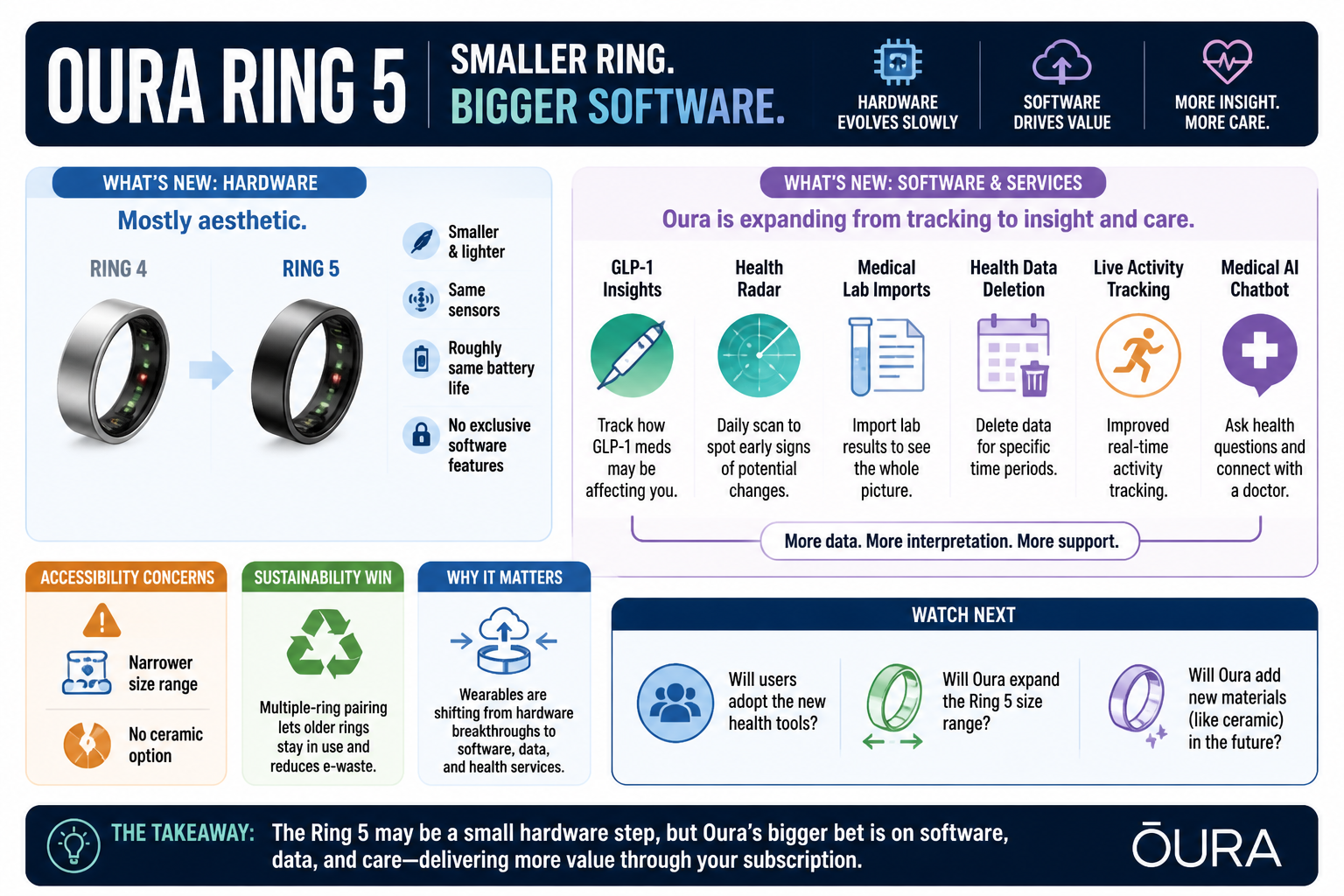
The Verge’s review says the Oura Ring 5 is mostly an aesthetic update over the Ring 4: it is smaller and lighter, but uses the same sensors, roughly the same battery life, and does not unlock exclusive software features.[4] At the same time, Oura is adding a wide set of software tools including GLP-1 Insights, Health Radar, medical lab imports, health-data deletion for specific periods, improved live activity tracking, and a medical AI chatbot that can connect users to a doctor.[4]
Why it matters: The story shows wearables evolving less through hardware leaps and more through software, data, and health services. That matters because it changes what consumers are paying for, how health data is interpreted, and how much value a wearable platform can extract from recurring subscriptions.[4]
Key insights: The Ring 5’s sensors are unchanged, so most functional value comes from the app and services rather than the device itself.[4] | Oura is expanding from tracking into interpretation and care-adjacent features, including an AI chatbot and doctor connection.[4] | The review flags accessibility concerns because the Ring 5 has a narrower size range and no ceramic option.[4] | The reviewer says multiple-ring pairing helps reduce e-waste by letting older rings remain in use.[4]