Wastewater surveillance gets more precise for tracking multiple pathogens in real time
A Nature Communications study introduces EpiSewer, a Bayesian semi-mechanistic wastewater model designed to infer transmission dynamics directly from raw wastewater concentration and flow data. In multi-pathogen surveillance across 6–14 treatment plants in Switzerland from November 2022 to May 2025…
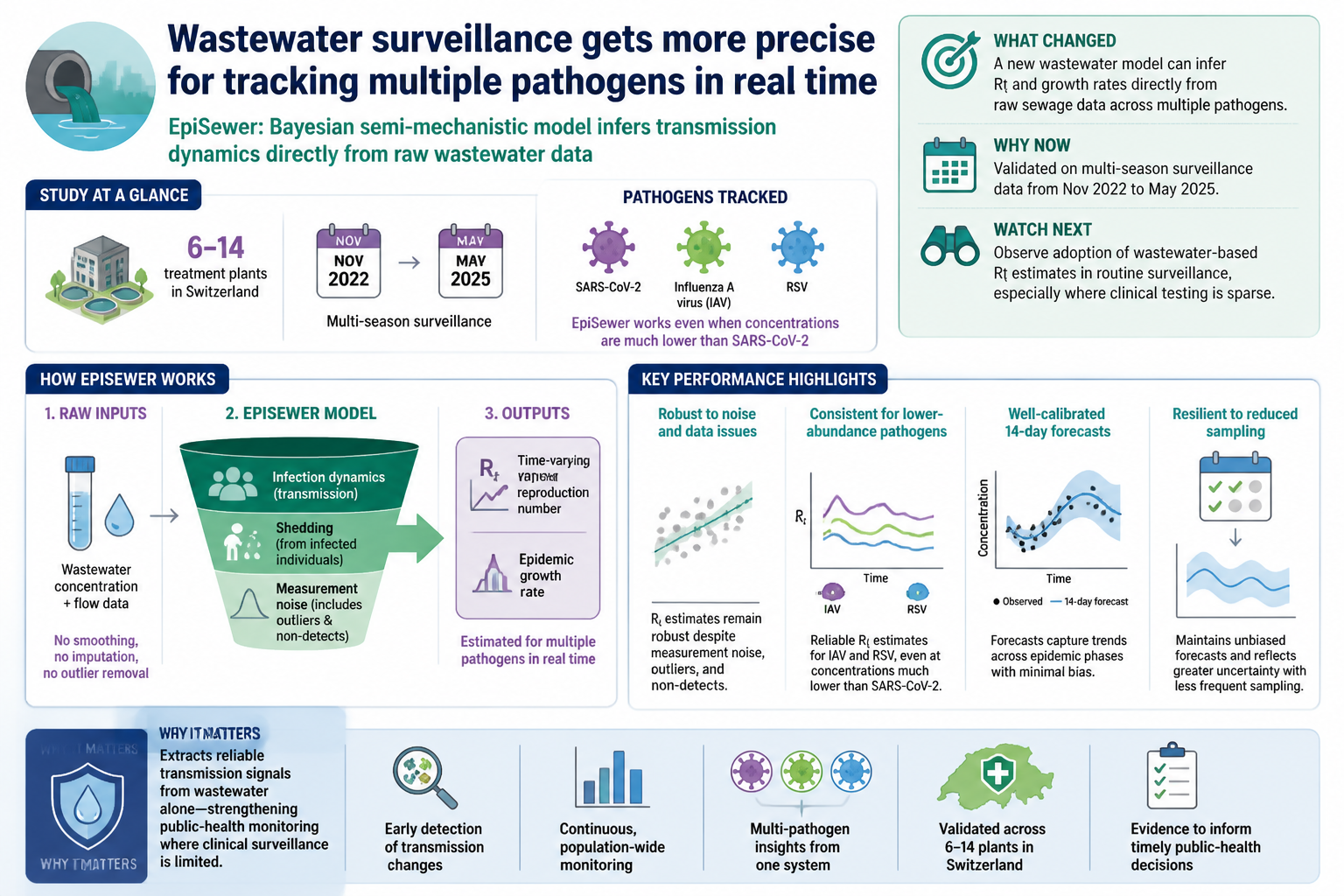
A Nature Communications study introduces EpiSewer, a Bayesian semi-mechanistic wastewater model designed to infer transmission dynamics directly from raw wastewater concentration and flow data. In multi-pathogen surveillance across 6–14 treatment plants in Switzerland from November 2022 to May 2025, the model estimated Rt and epidemic growth rates for SARS-CoV-2, influenza A virus, and RSV, even when pathogen concentrations were much lower than SARS-CoV-2 [3].
Why it matters: This could strengthen public-health monitoring where clinical surveillance is limited, because the model aims to extract transmission signals from wastewater without smoothing, imputation, or outlier removal [3].
Key insights: EpiSewer jointly models infection dynamics, shedding, and measurement noise, including outliers and non-detects [3]. | The study says Rt estimates were robust to measurement noise and remained consistent for lower-abundance pathogens such as IAV and RSV [3]. | The model produced well-calibrated 14-day concentration forecasts with minimal bias across epidemic phases [3]. | Under reduced sampling frequencies, EpiSewer still maintained unbiased forecasts while reflecting uncertainty [3].