U.S. lakes may absorb, not emit, more nitrous oxide than assumed in summer
A national-scale analysis of dissolved nitrous oxide in 465,896 U.S. waterbodies found widespread summertime undersaturation across the conterminous U.S. during summer 2017. The model estimates that 72.9% of lakes were functioning as N2O sinks, and the overall emission estimate remains highly uncer…
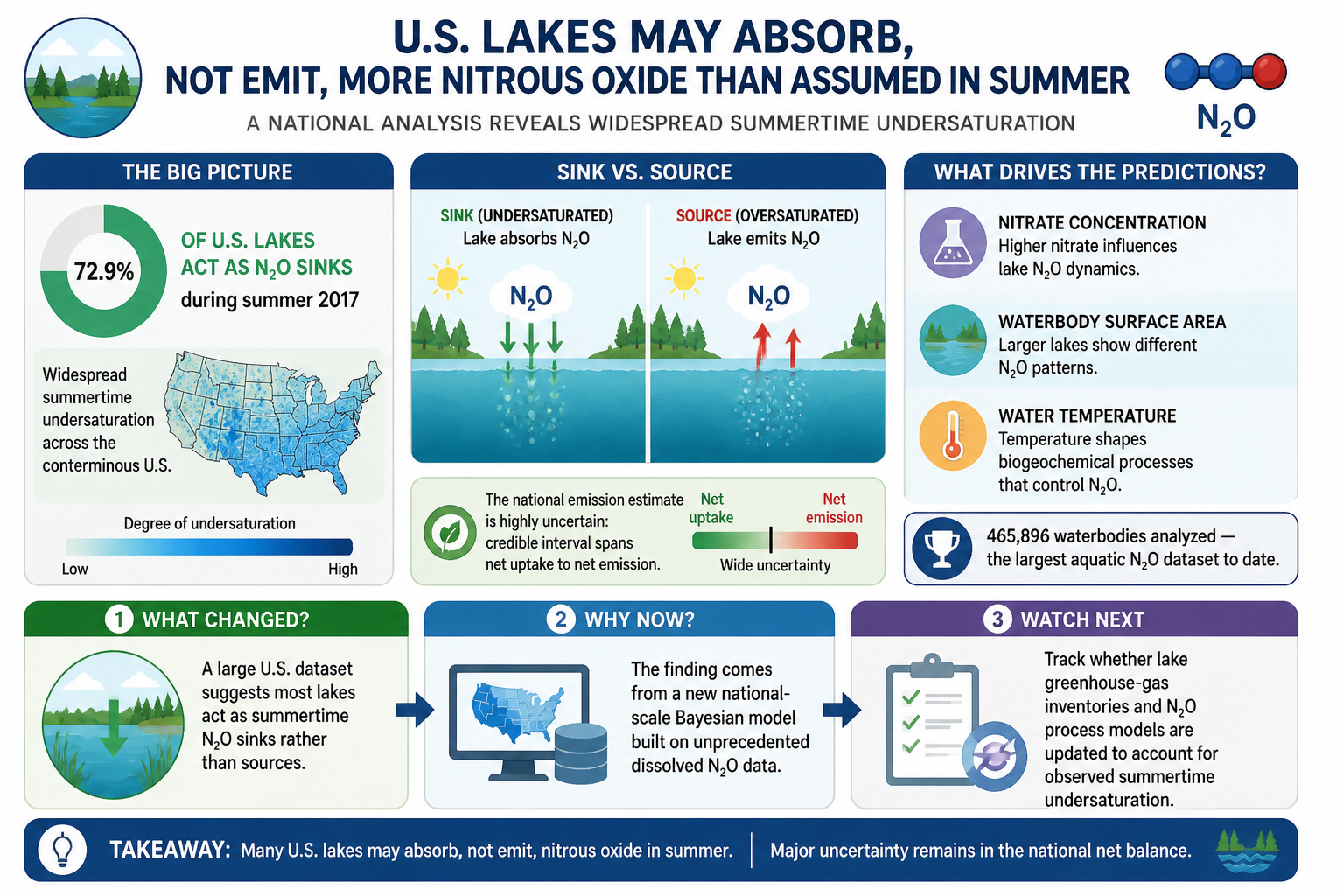
A national-scale analysis of dissolved nitrous oxide in 465,896 U.S. waterbodies found widespread summertime undersaturation across the conterminous U.S. during summer 2017. The model estimates that 72.9% of lakes were functioning as N2O sinks, and the overall emission estimate remains highly uncertain, with a credible interval spanning net uptake to net emission [5].
Why it matters: If many lakes are seasonal sinks rather than sources, existing greenhouse-gas accounting and lake-emissions models may need to be revised, especially those that assume surface waters always emit N2O [5].
Key insights: The dataset is described as the largest aquatic N2O dataset to date [5]. | Undersaturation was pervasive in summer, not an isolated regional anomaly [5]. | Predictions were driven partly by nitrate concentration, waterbody surface area, and water temperature [5]. | The study’s national emission estimate remains poorly constrained despite the large dataset, highlighting major uncertainty in the net balance [5].