Mars memory and space-station risk take center stage in two Space.com features
Space.com published an episode rundown for This Week In Space marking the 50th anniversary of Viking 1, including discussion of the mission’s life-detection experiments and the long-running controversy over what they found [2]. In a separate feature, Space.com shared an interview with Michael Foale…
Space.com published an episode rundown for This Week In Space marking the 50th anniversary of Viking 1, including discussion of the mission’s life-detection experiments and the long-running controversy over what they found [2]. In a separate feature, Space.com shared an interview with Michael Foale about the 1997 Mir crisis, describing the Progress collision, the decompression emergency, and the crew’s effort to save the station [3].
Why it matters: Together, these pieces show how space history still shapes present-day science and policy conversations: Viking 1 remains central to Mars astrobiology debates, while Mir remains a case study in station safety and human decision-making under extreme pressure [2][3]. They also highlight how media coverage continues to revisit foundational missions to explain current ambitions for Mars and commercial human spaceflight [2][3].
Key insights: The Viking 1 discussion centers on how later research linked the ambiguous findings to perchlorates in Martian soil [2]. | The Mir segment says a manual docking maneuver led a Progress cargo ship to collide with the Spektr module, causing a life-threatening decompression incident [3]. | Foale says the crew had only 23 minutes of oxygen left while trying to stop the leak and stabilize Mir [3]. | The Mir interview frames the accident as a consequence of cost-cutting and the decision to attempt a manual rendezvous without radar [3].
Cheatsheet facts: What changed: Space.com highlighted Viking 1’s 50th anniversary and released an interview focused on the Mir collision crisis [2][3]. | Why now: The anniversary and the PBS miniseries episode created a timely opening to revisit Mars life-detection history and station emergency response [2][3]. | Watch next: Whether the PBS series and related coverage prompt renewed discussion of Viking data interpretation or Mir-era safety lessons [2][3].
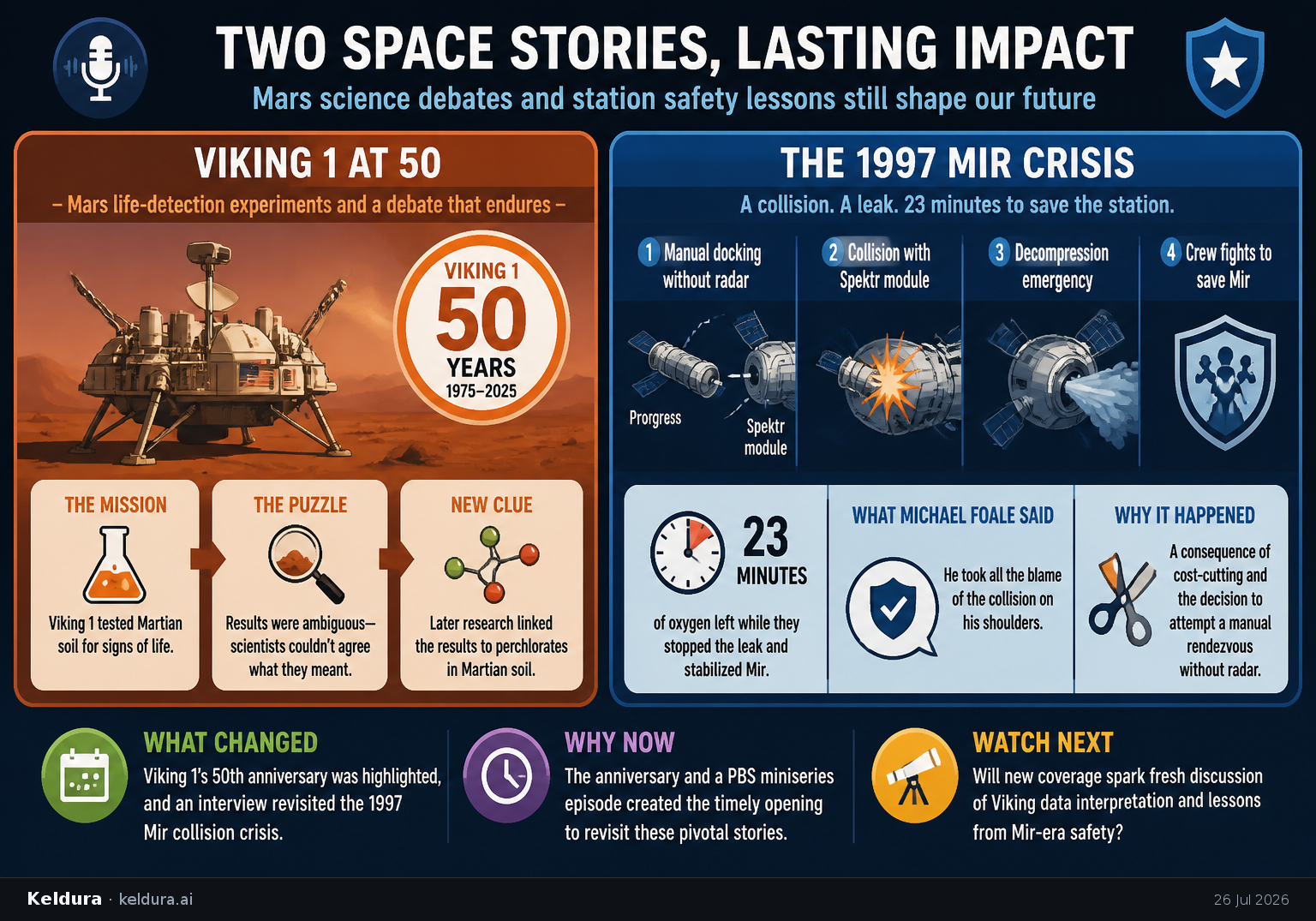
Space.com published an episode rundown for This Week In Space marking the 50th anniversary of Viking 1, including discussion of the mission’s life-detection experiments and the long-running controversy over what they found [2]. In a separate feature, Space.com shared an interview with Michael Foale about the 1997 Mir crisis, describing the Progress collision, the decompression emergency, and the crew’s effort to save the station [3].
Why it matters: Together, these pieces show how space history still shapes present-day science and policy conversations: Viking 1 remains central to Mars astrobiology debates, while Mir remains a case study in station safety and human decision-making under extreme pressure [2][3]. They also highlight how media coverage continues to revisit foundational missions to explain current ambitions for Mars and commercial human spaceflight [2][3].
Key insights: The Viking 1 discussion centers on how later research linked the ambiguous findings to perchlorates in Martian soil [2]. | The Mir segment says a manual docking maneuver led a Progress cargo ship to collide with the Spektr module, causing a life-threatening decompression incident [3]. | Foale says the crew had only 23 minutes of oxygen left while trying to stop the leak and stabilize Mir [3]. | The Mir interview frames the accident as a consequence of cost-cutting and the decision to attempt a manual rendezvous without radar [3].
Cheatsheet facts: What changed: Space.com highlighted Viking 1’s 50th anniversary and released an interview focused on the Mir collision crisis [2][3]. | Why now: The anniversary and the PBS miniseries episode created a timely opening to revisit Mars life-detection history and station emergency response [2][3]. | Watch next: Whether the PBS series and related coverage prompt renewed discussion of Viking data interpretation or Mir-era safety lessons [2][3].
X copy pack
Edition complete
You've reached the end of this edition.