Expedition 74 trio returns to Earth after 241 days in orbit
NASA says Soyuz MS-28 brought NASA astronaut Chris Williams and Roscosmos cosmonauts Sergey Kud‑Sverchkov and Sergei Mikaev back to Earth after an eight-month mission aboard the International Space Station. The spacecraft touched down on the Kazakh steppe southeast of Dzhezkazgan and the crew later…
NASA says Soyuz MS-28 brought NASA astronaut Chris Williams and Roscosmos cosmonauts Sergey Kud‑Sverchkov and Sergei Mikaev back to Earth after an eight-month mission aboard the International Space Station. The spacecraft touched down on the Kazakh steppe southeast of Dzhezkazgan and the crew later moved to recovery teams in Kazakhstan, with Williams scheduled to return to NASA’s Johnson Space Center in Houston.[2][5]
Why it matters: This is a concrete end-of-mission milestone for ISS operations, marking crew rotation, post-flight recovery, and the handoff between Expedition 74 and Expedition 75. It also shows continuing U.S.-Russian cooperation in crewed spaceflight despite broader geopolitical tensions.[2][5]
Key insights: The mission lasted 241 days, with the crew orbiting Earth 3,856 times and covering more than 102 million miles.[2][5] | NASA identified the landing site as the Kazakh steppe southeast of Dzhezkazgan and said recovery would proceed via helicopter to Karaganda before Williams heads to Houston.[2] | The trio’s flight was the first mission for Williams and Mikaev and the second for Kud‑Sverchkov.[2][5]
Cheatsheet facts: What changed: Soyuz MS-28 landed and returned the Expedition 74 trio from the ISS.[2][5] | Why now: Their planned return followed the completion of an eight-month research mission and station crew transition activities.[2][5] | Watch next: Post-landing medical checks, recovery transport to Karaganda, and Williams’s transfer to NASA’s Johnson Space Center.[2]
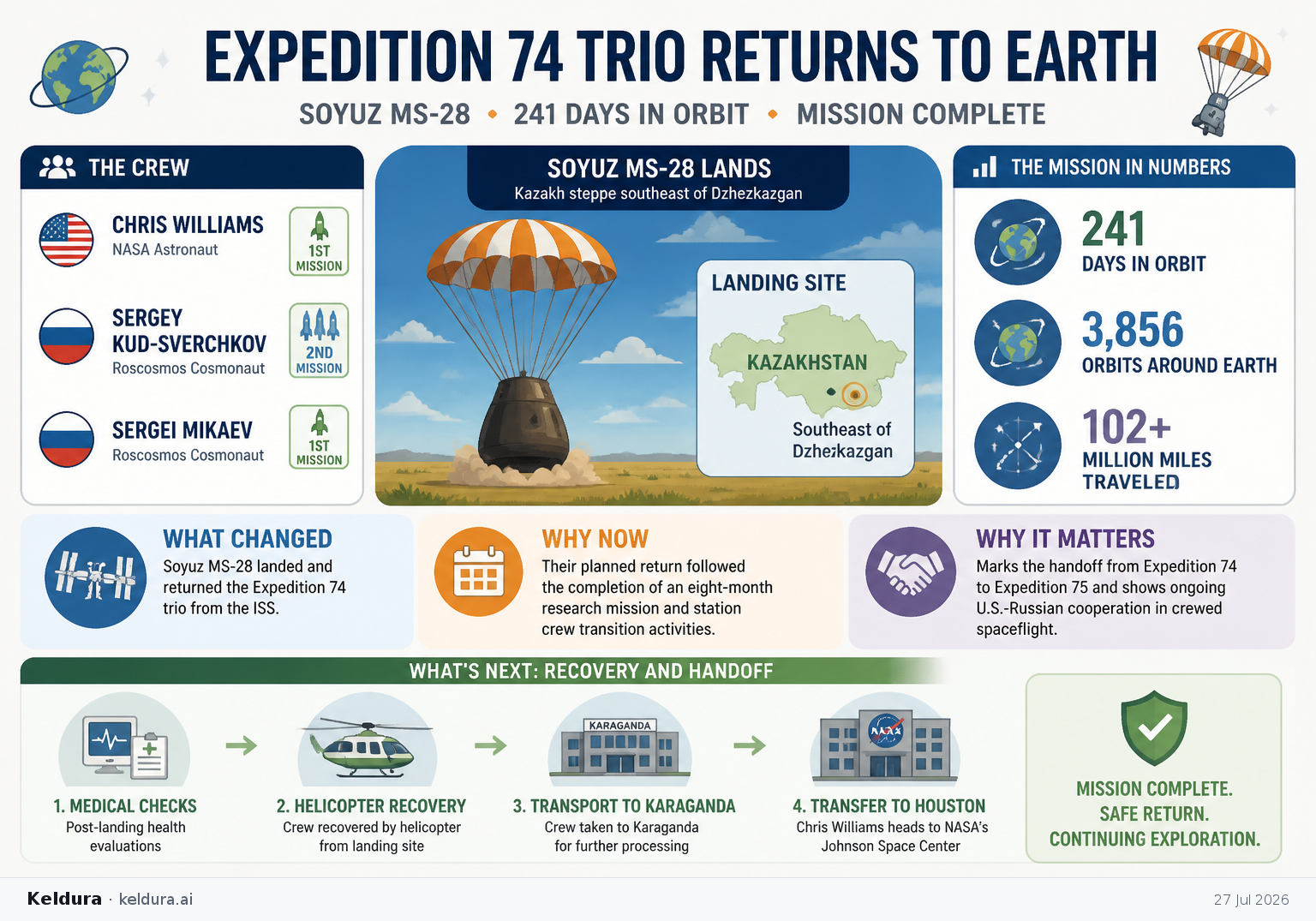
NASA says Soyuz MS-28 brought NASA astronaut Chris Williams and Roscosmos cosmonauts Sergey Kud‑Sverchkov and Sergei Mikaev back to Earth after an eight-month mission aboard the International Space Station. The spacecraft touched down on the Kazakh steppe southeast of Dzhezkazgan and the crew later moved to recovery teams in Kazakhstan, with Williams scheduled to return to NASA’s Johnson Space Center in Houston.[2][5]
Why it matters: This is a concrete end-of-mission milestone for ISS operations, marking crew rotation, post-flight recovery, and the handoff between Expedition 74 and Expedition 75. It also shows continuing U.S.-Russian cooperation in crewed spaceflight despite broader geopolitical tensions.[2][5]
Key insights: The mission lasted 241 days, with the crew orbiting Earth 3,856 times and covering more than 102 million miles.[2][5] | NASA identified the landing site as the Kazakh steppe southeast of Dzhezkazgan and said recovery would proceed via helicopter to Karaganda before Williams heads to Houston.[2] | The trio’s flight was the first mission for Williams and Mikaev and the second for Kud‑Sverchkov.[2][5]
Cheatsheet facts: What changed: Soyuz MS-28 landed and returned the Expedition 74 trio from the ISS.[2][5] | Why now: Their planned return followed the completion of an eight-month research mission and station crew transition activities.[2][5] | Watch next: Post-landing medical checks, recovery transport to Karaganda, and Williams’s transfer to NASA’s Johnson Space Center.[2]
X copy pack
Edition complete
You've reached the end of this edition.