ESA uses ILA 2026 to push autonomy, resilience and future European space capability
ESA’s second day at ILA Berlin International Airshow 2026 centered on Europe’s priorities in space, including exploration, cybersecurity and the future of the European space sector [1]. The day also featured discussions on AI in space, resilient Earth observation, secure satellite connectivity, lau…
ESA’s second day at ILA Berlin International Airshow 2026 centered on Europe’s priorities in space, including exploration, cybersecurity and the future of the European space sector [1]. The day also featured discussions on AI in space, resilient Earth observation, secure satellite connectivity, launch capability, and a live in-flight call with astronaut Sophie Adenot from the ISS [1].
Why it matters: This matters because ESA is clearly linking space policy to Europe’s security, competitiveness and sovereignty, not just to scientific exploration [1]. The focus on autonomy, launch access and secure communications shows where European institutions think the strategic pressure points are [1].
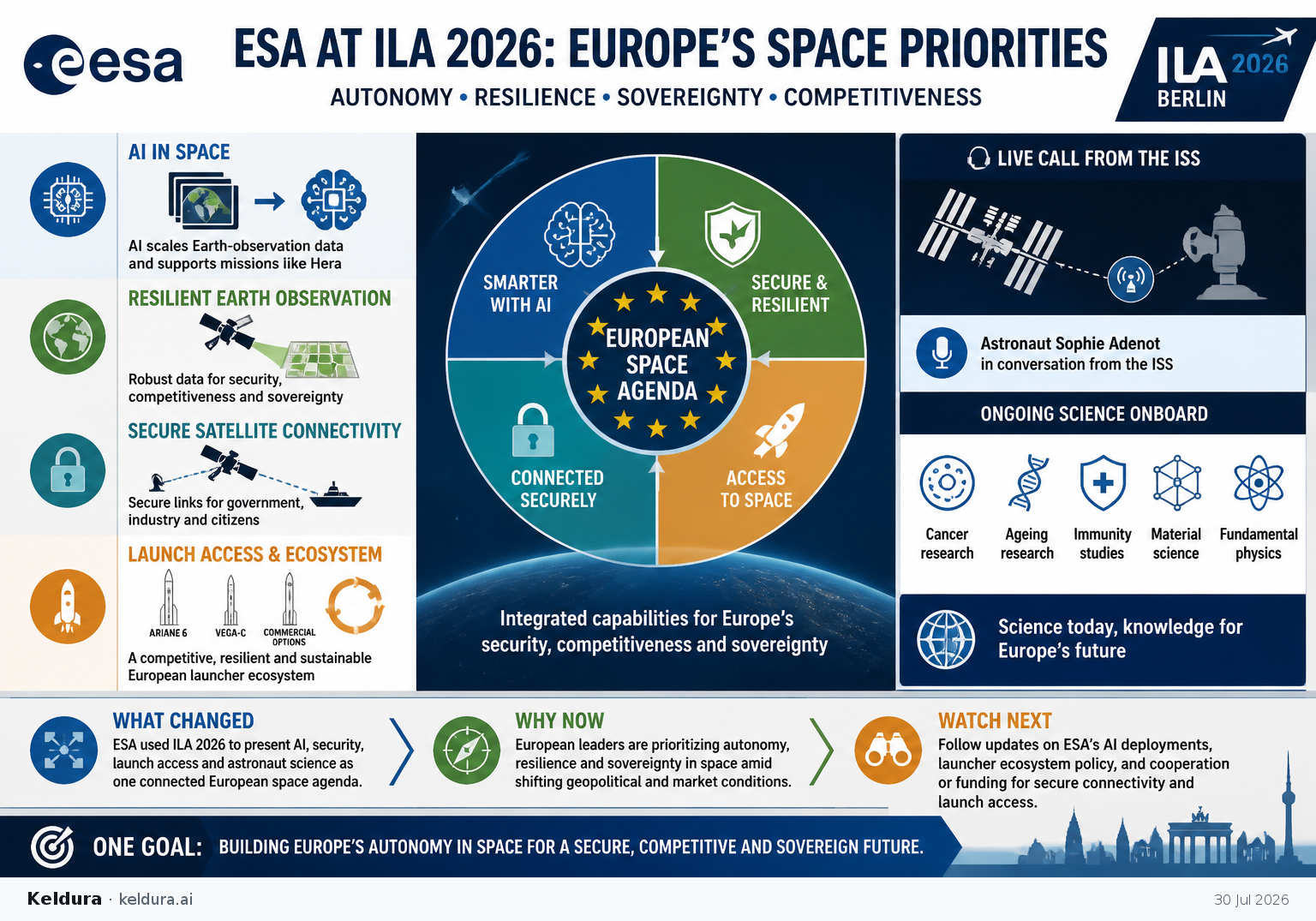
Key insights: ESA said its AI use now extends from processing growing Earth-observation data volumes to supporting missions such as Hera [1]. | The German-Italian Aerospace Forum emphasized resilient Earth observation and secure satellite connectivity as strategic capabilities for Europe’s security, competitiveness and sovereignty [1]. | A launch panel framed Ariane 6, Vega-C and emerging commercial options as part of a broader effort to build a more competitive, resilient and sustainable launcher ecosystem [1]. | The ISS call with Sophie Adenot highlighted ongoing science aboard station, including cancer, ageing, immunity, material science and fundamental physics experiments [1].
Cheatsheet facts: What changed: ESA used ILA 2026 to present AI, security, launch access and astronaut science as one connected European space agenda [1]. | Why now: European leaders are explicitly discussing autonomy, resilience and sovereignty as space-sector priorities amid shifting geopolitical and market conditions [1]. | Watch next: Look for follow-up on ESA’s AI deployments, launcher ecosystem policy, and any announced cooperation or funding tied to secure connectivity and launch access [1].
ESA’s second day at ILA Berlin International Airshow 2026 centered on Europe’s priorities in space, including exploration, cybersecurity and the future of the European space sector [1]. The day also featured discussions on AI in space, resilient Earth observation, secure satellite connectivity, launch capability, and a live in-flight call with astronaut Sophie Adenot from the ISS [1].
Why it matters: This matters because ESA is clearly linking space policy to Europe’s security, competitiveness and sovereignty, not just to scientific exploration [1]. The focus on autonomy, launch access and secure communications shows where European institutions think the strategic pressure points are [1].
Key insights: ESA said its AI use now extends from processing growing Earth-observation data volumes to supporting missions such as Hera [1]. | The German-Italian Aerospace Forum emphasized resilient Earth observation and secure satellite connectivity as strategic capabilities for Europe’s security, competitiveness and sovereignty [1]. | A launch panel framed Ariane 6, Vega-C and emerging commercial options as part of a broader effort to build a more competitive, resilient and sustainable launcher ecosystem [1]. | The ISS call with Sophie Adenot highlighted ongoing science aboard station, including cancer, ageing, immunity, material science and fundamental physics experiments [1].
Cheatsheet facts: What changed: ESA used ILA 2026 to present AI, security, launch access and astronaut science as one connected European space agenda [1]. | Why now: European leaders are explicitly discussing autonomy, resilience and sovereignty as space-sector priorities amid shifting geopolitical and market conditions [1]. | Watch next: Look for follow-up on ESA’s AI deployments, launcher ecosystem policy, and any announced cooperation or funding tied to secure connectivity and launch access [1].