World Cup 2026 reaches a historic semifinal set while FIFA weighs bigger future tournaments
Argentina, Spain, France and England entered the World Cup as FIFA’s top four-ranked teams and are now all two wins from the title, with France facing Spain and England meeting Argentina in the semifinals. The matchup set is notable both for the rankings milestone and for the star power and scoring…
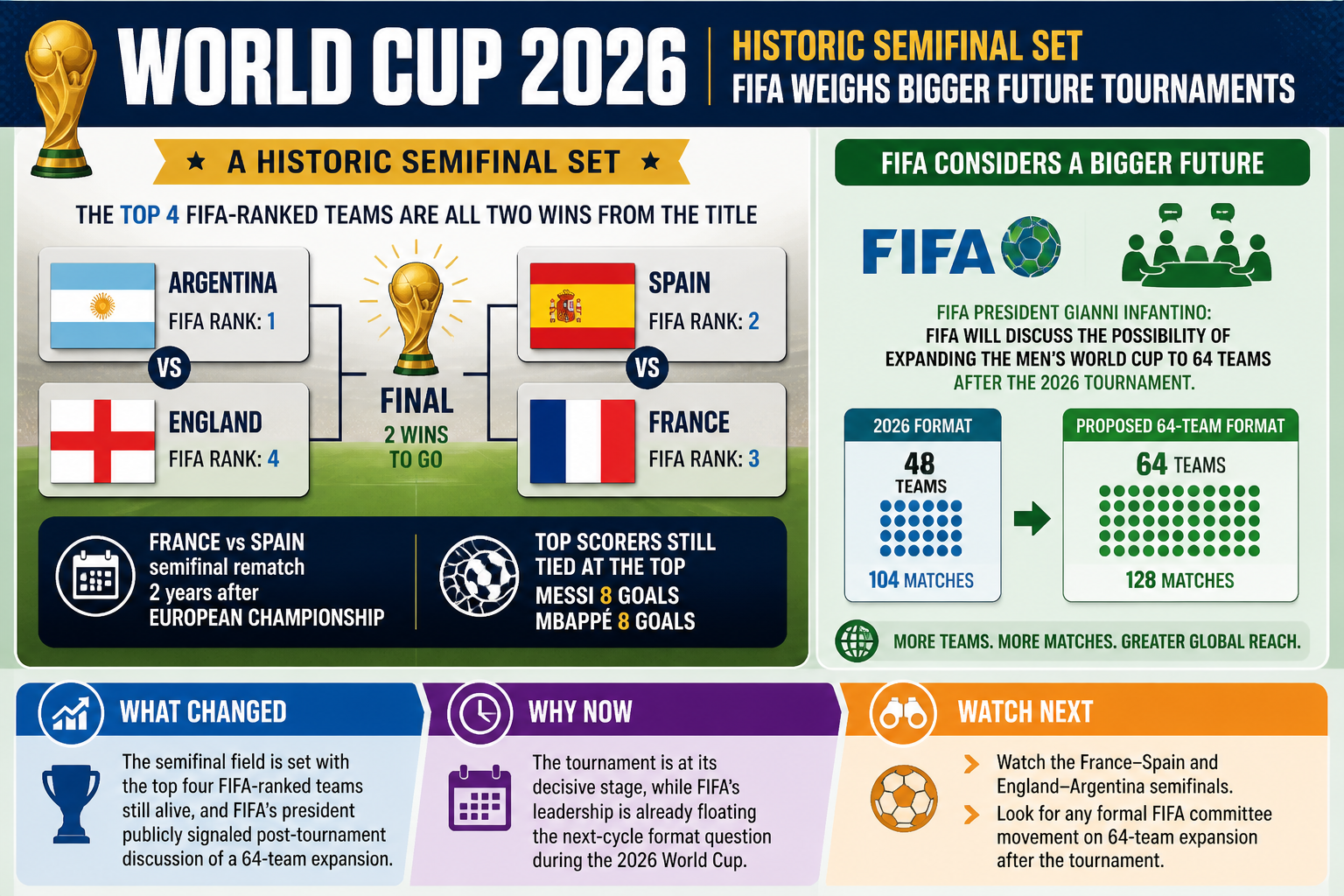
Argentina, Spain, France and England entered the World Cup as FIFA’s top four-ranked teams and are now all two wins from the title, with France facing Spain and England meeting Argentina in the semifinals. The matchup set is notable both for the rankings milestone and for the star power and scoring race still alive in the tournament [4]. Separately, FIFA president Gianni Infantino said FIFA will discuss the possibility of expanding the men’s World Cup to 64 teams after 2026 [3].
Why it matters: This is the most consequential soccer story in the evidence because it combines the competitive climax of the 2026 tournament with a potential structural change to the sport’s flagship event [4][3]. The semifinal bracket features the world’s top four teams, while the expansion discussion could reshape qualification, match volume and the tournament’s global reach [4][3].
Key insights: Argentina, Spain, France and England were the top four in FIFA’s rankings going into the tournament [4]. | France and Spain are meeting again in a major-tournament semifinal two years after the European Championship [4]. | Messi and Mbappé are both on eight goals, keeping the Golden Boot race unusually tight deep into the event [4]. | Infantino said the 64-team idea would be discussed after the World Cup, and a 64-team format would mean 128 matches versus 104 in 2026 [3].