China’s growth is holding up, but rebalancing pressure is rising
The World Bank’s July 2026 China Economic Update says China maintained solid growth early in the year, with high-tech investment and exports offsetting subdued consumption [1]. Momentum then softened in the second quarter after the global energy supply shock, though the report says the impact was c…
The World Bank’s July 2026 China Economic Update says China maintained solid growth early in the year, with high-tech investment and exports offsetting subdued consumption [1]. Momentum then softened in the second quarter after the global energy supply shock, though the report says the impact was cushioned by large oil reserves, diversified fuel imports, a high share of renewables, and policy measures [1].
Why it matters: The report points to a Chinese economy that is still growing, but increasingly constrained by weak domestic demand, which makes the outlook for global trade, commodities, and emerging-market supply chains more uncertain [1]. It also signals that near-term policy support and longer-term structural reform will both be needed if China is to sustain growth while rebalancing its economy [1].
Key insights: Growth is projected to moderate to 4.4 percent in 2026 amid persistent domestic demand headwinds [1]. | The low-carbon transition is changing labor demand, with green technical skills and transferable competencies gaining importance beyond low-carbon sectors [1]. | Those skills carry wage premiums of around 22 to 25 percent, but skill mismatches are limiting inclusive employment gains [1]. | The report argues for short-term reskilling and labor-mobility support, plus longer-term education and labor-market reforms [1].
Cheatsheet facts: What changed: China’s growth remained solid early in 2026, but second-quarter momentum softened and the forecast points to 4.4 percent growth for the year [1]. | Why now: A global energy supply shock hit in the second quarter, while weak domestic demand continues to weigh on the outlook [1]. | Watch next: Look for whether policy stays supportive and whether later updates show household demand or labor-market rebalancing improving [1].
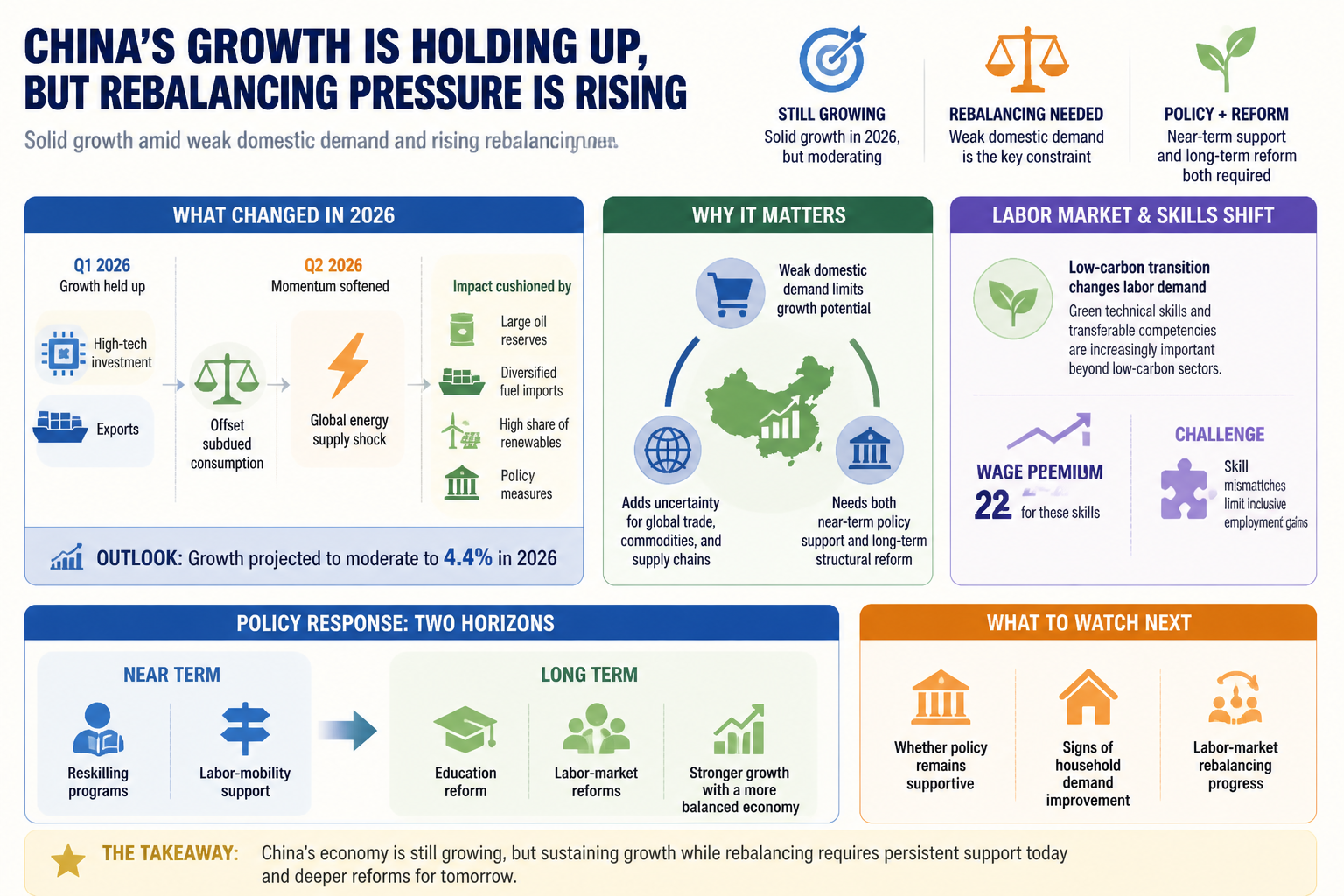
The World Bank’s July 2026 China Economic Update says China maintained solid growth early in the year, with high-tech investment and exports offsetting subdued consumption [1]. Momentum then softened in the second quarter after the global energy supply shock, though the report says the impact was cushioned by large oil reserves, diversified fuel imports, a high share of renewables, and policy measures [1].
Why it matters: The report points to a Chinese economy that is still growing, but increasingly constrained by weak domestic demand, which makes the outlook for global trade, commodities, and emerging-market supply chains more uncertain [1]. It also signals that near-term policy support and longer-term structural reform will both be needed if China is to sustain growth while rebalancing its economy [1].
Key insights: Growth is projected to moderate to 4.4 percent in 2026 amid persistent domestic demand headwinds [1]. | The low-carbon transition is changing labor demand, with green technical skills and transferable competencies gaining importance beyond low-carbon sectors [1]. | Those skills carry wage premiums of around 22 to 25 percent, but skill mismatches are limiting inclusive employment gains [1]. | The report argues for short-term reskilling and labor-mobility support, plus longer-term education and labor-market reforms [1].
Cheatsheet facts: What changed: China’s growth remained solid early in 2026, but second-quarter momentum softened and the forecast points to 4.4 percent growth for the year [1]. | Why now: A global energy supply shock hit in the second quarter, while weak domestic demand continues to weigh on the outlook [1]. | Watch next: Look for whether policy stays supportive and whether later updates show household demand or labor-market rebalancing improving [1].