China’s green transition is creating wage premiums, but skills gaps are limiting gains
The same World Bank update says China’s low-carbon transition is reshaping its labor market, with demand rising for green technical skills and broader competencies such as systems thinking and adaptive learning [2]. It says these skills are associated with wage premiums of around 22 to 25 percent,…
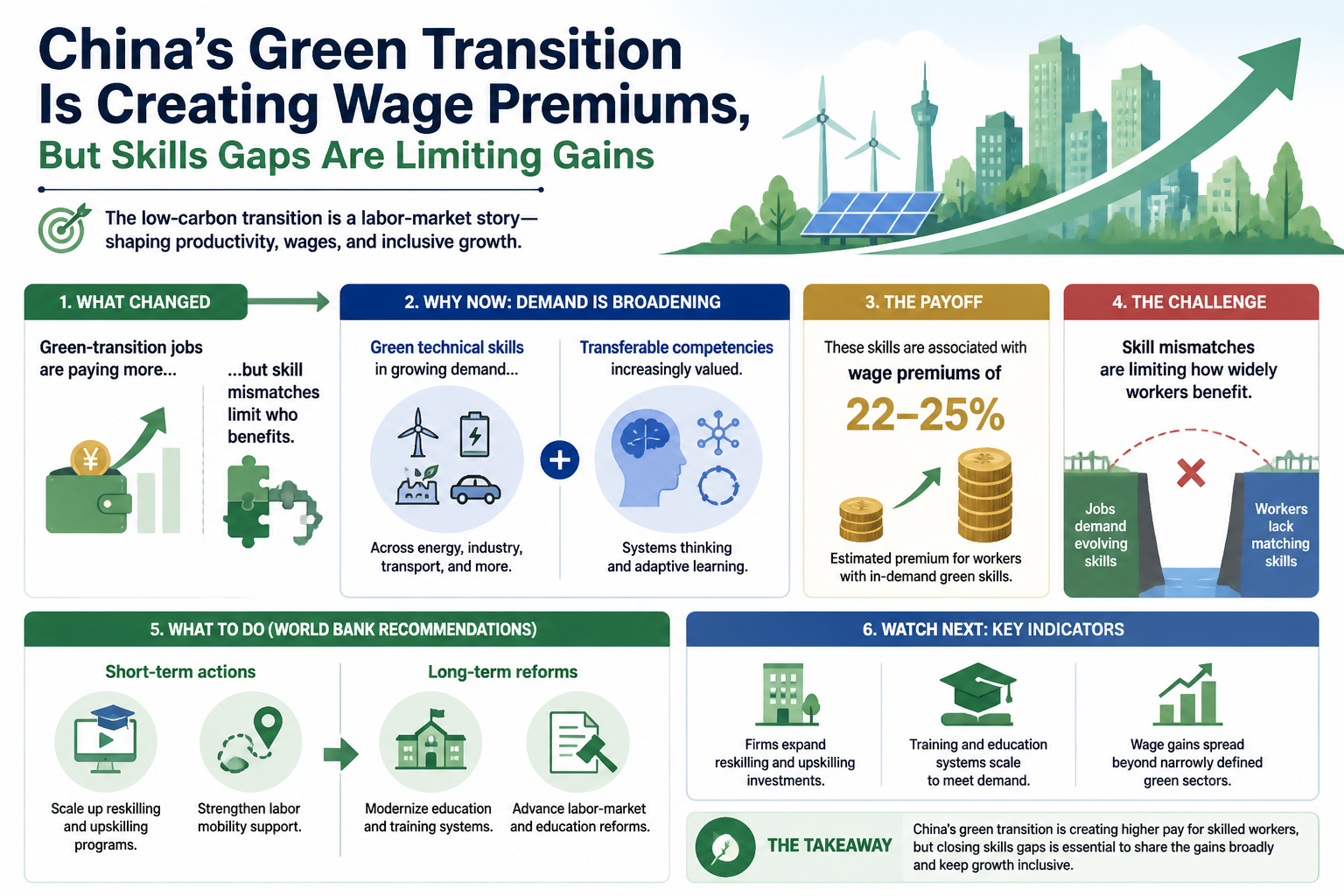
The same World Bank update says China’s low-carbon transition is reshaping its labor market, with demand rising for green technical skills and broader competencies such as systems thinking and adaptive learning [2]. It says these skills are associated with wage premiums of around 22 to 25 percent, but skill mismatches are limiting how widely workers benefit [2].
Why it matters: This matters for markets and policymakers because the energy transition is not only an industrial story but also a labor-market story that affects productivity, wages, and the pace of inclusive growth [2]. If training and education systems do not keep up, the transition could deepen inequality even as it creates new jobs and higher pay in specific segments [2].
Key insights: Demand for green technical skills is expanding beyond narrowly defined low-carbon sectors [2]. | Transferable competencies like systems thinking and adaptive learning are increasingly valued [2]. | The report estimates wage premiums of around 22 to 25 percent for these skills [2]. | The World Bank recommends short-term reskilling and labor mobility support, plus longer-term education and labor-market reforms [2].
Cheatsheet facts: What changed: Green-transition jobs are paying more, but skill mismatches are stopping workers from fully capturing the gains [2]. | Why now: China’s low-carbon transition is broadening demand for both technical and transferable skills [2]. | Watch next: Track whether firms and training systems expand reskilling programs and whether evidence of wage gains spreads beyond narrowly defined green sectors [2].
The same World Bank update says China’s low-carbon transition is reshaping its labor market, with demand rising for green technical skills and broader competencies such as systems thinking and adaptive learning [2]. It says these skills are associated with wage premiums of around 22 to 25 percent, but skill mismatches are limiting how widely workers benefit [2].
Why it matters: This matters for markets and policymakers because the energy transition is not only an industrial story but also a labor-market story that affects productivity, wages, and the pace of inclusive growth [2]. If training and education systems do not keep up, the transition could deepen inequality even as it creates new jobs and higher pay in specific segments [2].
Key insights: Demand for green technical skills is expanding beyond narrowly defined low-carbon sectors [2]. | Transferable competencies like systems thinking and adaptive learning are increasingly valued [2]. | The report estimates wage premiums of around 22 to 25 percent for these skills [2]. | The World Bank recommends short-term reskilling and labor mobility support, plus longer-term education and labor-market reforms [2].
Cheatsheet facts: What changed: Green-transition jobs are paying more, but skill mismatches are stopping workers from fully capturing the gains [2]. | Why now: China’s low-carbon transition is broadening demand for both technical and transferable skills [2]. | Watch next: Track whether firms and training systems expand reskilling programs and whether evidence of wage gains spreads beyond narrowly defined green sectors [2].
X copy pack
Edition complete
You've reached the end of this edition.