Why is the Fed being pushed toward another rate increase?
August inflation data released on September 11 pushed traders toward expecting a Federal Reserve rate increase at its September 16 meeting.
US consumer prices rose 0.4% in August and 3.4% from a year earlier, while annual inflation remained well above the Fed's 2% target.[2][6] Markets subsequently assigned more than an 85% probability to a quarter-point increase, which would lift rates from their current 3.50%-3.75% range.[2]
US consumer prices rose 0.4% in August and 3.4% from a year earlier, while annual inflation remained well above the Fed's 2% target.[2][6] Markets subsequently assigned more than an 85% probability to a quarter-point increase, which would lift rates from their current 3.50%-3.75% range.[2]
Why it matters: A rate increase would raise borrowing costs and restrain investment and consumption, while the decision will also test whether Fed chair Kevin Warsh can demonstrate independence amid White House demands for lower rates.[2]
Key insights: Core prices rose 0.3% in August and 2.4% annually, while energy, airfares, repairs, clothing, restaurants, shelter and food all recorded increases over the year.[6] | The Fed has held rates steady since January while assessing energy shocks and the inflationary effects of tariffs.[2] | Interest-rate futures moved from a 72% probability of an increase on September 10 to nearly 90% after the inflation data.[5] | Despite stronger rate-hike expectations, the S&P 500 gained 0.86%, the Nasdaq rose 0.96% and the Dow advanced 0.98% on September 11 as oil prices retreated.[5]
Cheatsheet facts: What changed: August consumer prices rose 0.4% month over month, while annual inflation held at 3.4%.[6] | Why now: Persistent inflation and energy-price pressure pushed market odds of a September 16 rate increase above 85%.[2] | Watch next: The Federal Open Market Committee will announce its decision on September 16 at 2 p.m. Eastern time, alongside the Fed's explanation for raising rates or holding steady.[2]
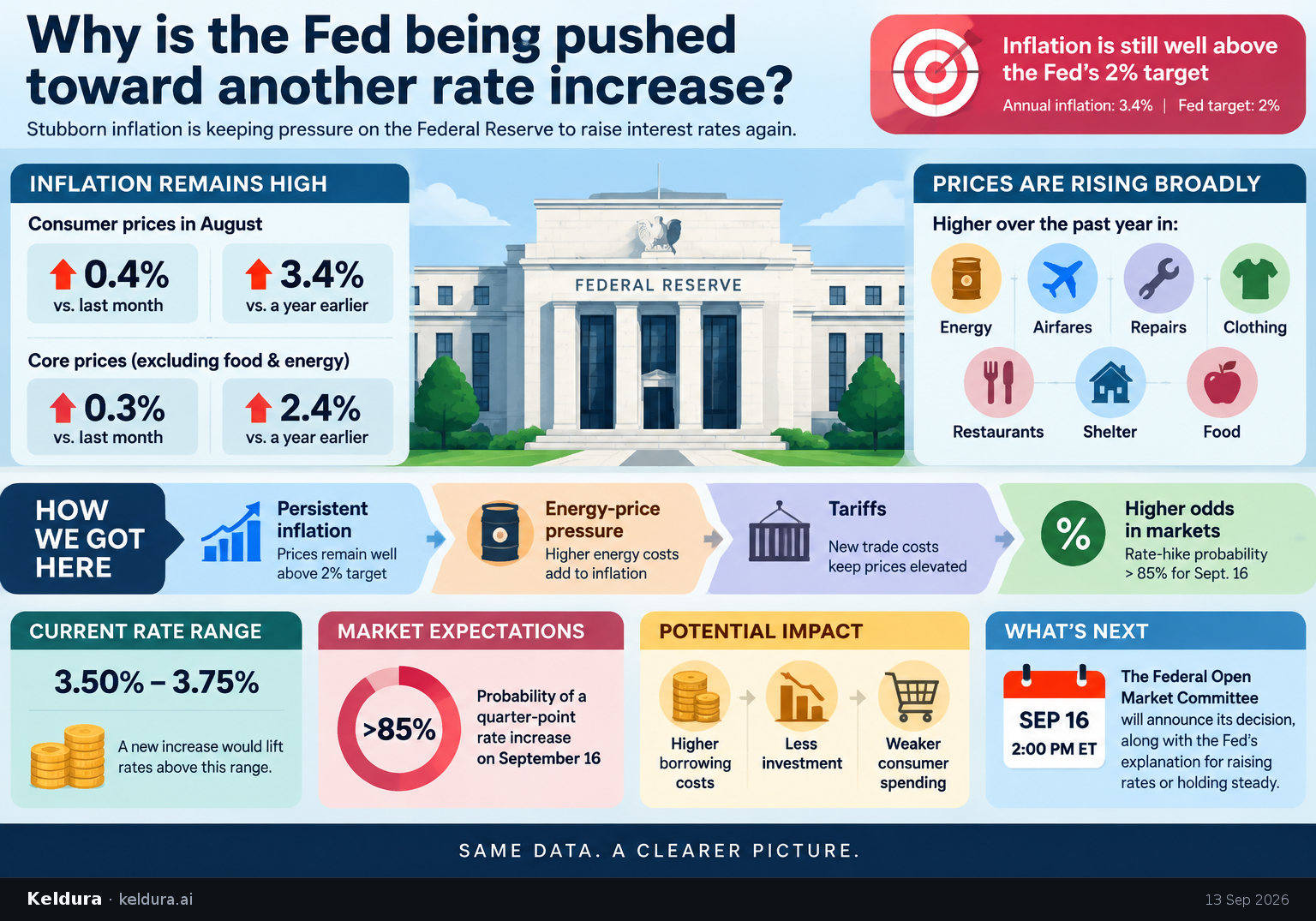
US consumer prices rose 0.4% in August and 3.4% from a year earlier, while annual inflation remained well above the Fed's 2% target.[2][6] Markets subsequently assigned more than an 85% probability to a quarter-point increase, which would lift rates from their current 3.50%-3.75% range.[2]
Why it matters: A rate increase would raise borrowing costs and restrain investment and consumption, while the decision will also test whether Fed chair Kevin Warsh can demonstrate independence amid White House demands for lower rates.[2]
Key insights: Core prices rose 0.3% in August and 2.4% annually, while energy, airfares, repairs, clothing, restaurants, shelter and food all recorded increases over the year.[6] | The Fed has held rates steady since January while assessing energy shocks and the inflationary effects of tariffs.[2] | Interest-rate futures moved from a 72% probability of an increase on September 10 to nearly 90% after the inflation data.[5] | Despite stronger rate-hike expectations, the S&P 500 gained 0.86%, the Nasdaq rose 0.96% and the Dow advanced 0.98% on September 11 as oil prices retreated.[5]
Cheatsheet facts: What changed: August consumer prices rose 0.4% month over month, while annual inflation held at 3.4%.[6] | Why now: Persistent inflation and energy-price pressure pushed market odds of a September 16 rate increase above 85%.[2] | Watch next: The Federal Open Market Committee will announce its decision on September 16 at 2 p.m. Eastern time, alongside the Fed's explanation for raising rates or holding steady.[2]
X copy pack
[2] 'This is the test': All eyes on US Fed to tackle high inflation | The Business Standard — tbsnews.net[6] Stubbornly Hot Inflation Raises Pressure on the Fed - Nevada Sentinel News — nevada-sentinel.com[5] S&P 500 ends increased as sturdy inflation knowledge cements rate-hike bets - Nevada Sentinel News — nevada-sentinel.comRead in BriefingsPost to X