Global leaders prepare to press road safety commitments into delivery
WHO says a United Nations High-Level Meeting on Improving Global Road Safety will be held on July 20-21, convened by the President of the UN General Assembly and WHO under the theme of accelerating implementation of commitments to halve road traffic deaths and injuries by 2030 [1]. The meeting foll…
WHO says a United Nations High-Level Meeting on Improving Global Road Safety will be held on July 20-21, convened by the President of the UN General Assembly and WHO under the theme of accelerating implementation of commitments to halve road traffic deaths and injuries by 2030 [1]. The meeting follows a February 2026 UN Secretary-General note arguing that road safety must become a long-term, institutionalized priority with measurable targets and support from the private sector, civil society, and youth movements [1].
Why it matters: Road traffic injury remains a major global health and development problem, with nearly 1.2 million deaths a year and the leading cause of death among children and young people ages 5-29 [1]. If the meeting translates commitments into enforceable national action, it could affect a very large preventable mortality burden.
Key insights: The event is not just symbolic: WHO says it will bring together governments, the UN, civil society, academia, the private sector, and philanthropic foundations to advance the 2030 road safety goal [1]. | WHO is also using a July 20 side-event to review country progress and discuss how to turn commitments into impact, which suggests the focus is on implementation rather than new pledges alone [1]. | The Secretary-General’s February 2026 note frames road safety as a systems issue requiring agencies, strategic planning, and measurable targets across countries [1]. | Recent WHO-linked road safety activity in May, July, and a legal guidance effort indicates a broader policy push around road safety governance [1].
Cheatsheet facts: What changed: A UN high-level road safety meeting is set for July 20-21, with a companion WHO side-event focused on country progress [1]. | Why now: Global road deaths remain high, and the 2030 target to halve deaths and injuries is approaching [1]. | Watch next: Look for any country-specific commitments, published progress summaries, or legal guidance outputs linked to the meeting and side-event [1].
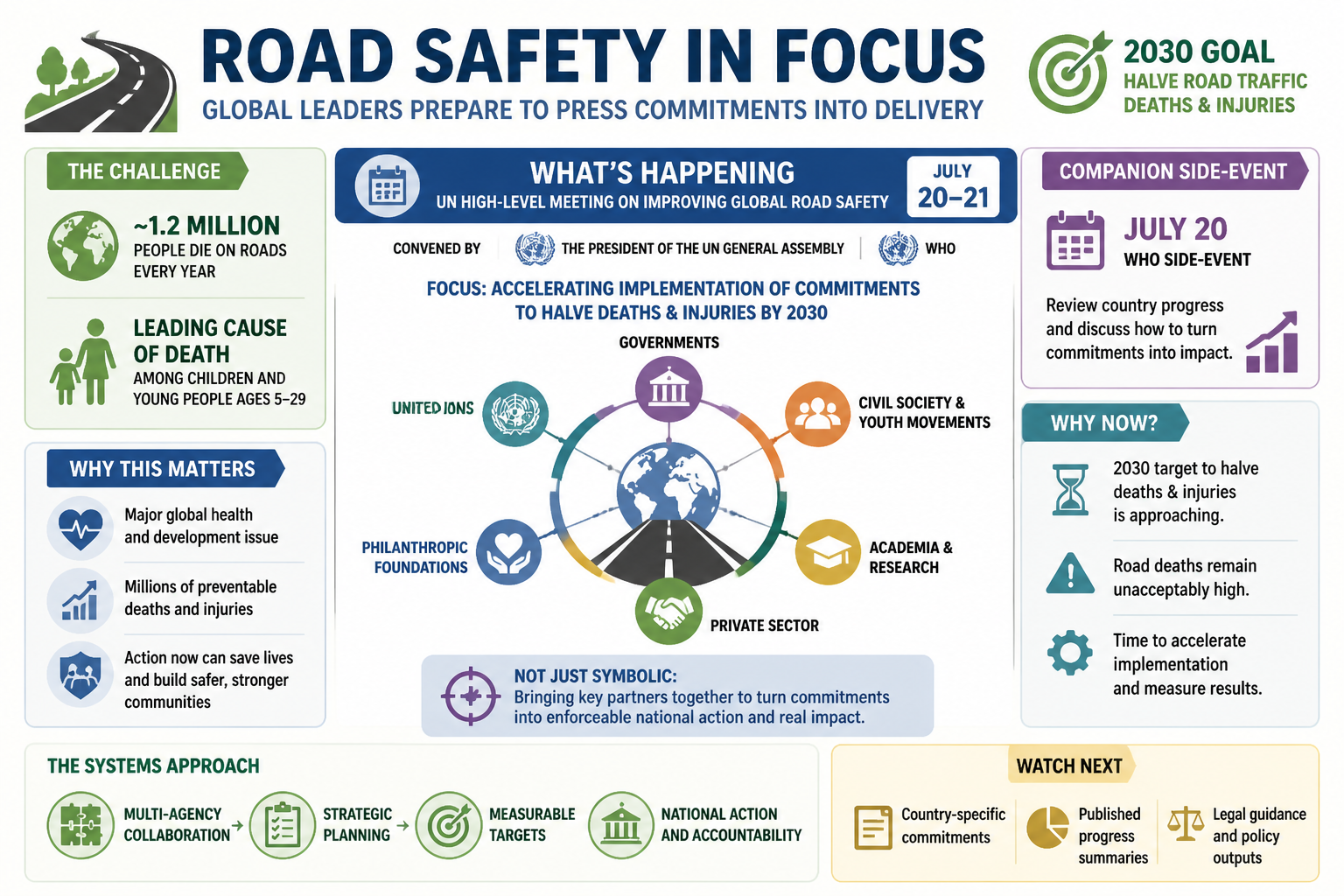
WHO says a United Nations High-Level Meeting on Improving Global Road Safety will be held on July 20-21, convened by the President of the UN General Assembly and WHO under the theme of accelerating implementation of commitments to halve road traffic deaths and injuries by 2030 [1]. The meeting follows a February 2026 UN Secretary-General note arguing that road safety must become a long-term, institutionalized priority with measurable targets and support from the private sector, civil society, and youth movements [1].
Why it matters: Road traffic injury remains a major global health and development problem, with nearly 1.2 million deaths a year and the leading cause of death among children and young people ages 5-29 [1]. If the meeting translates commitments into enforceable national action, it could affect a very large preventable mortality burden.
Key insights: The event is not just symbolic: WHO says it will bring together governments, the UN, civil society, academia, the private sector, and philanthropic foundations to advance the 2030 road safety goal [1]. | WHO is also using a July 20 side-event to review country progress and discuss how to turn commitments into impact, which suggests the focus is on implementation rather than new pledges alone [1]. | The Secretary-General’s February 2026 note frames road safety as a systems issue requiring agencies, strategic planning, and measurable targets across countries [1]. | Recent WHO-linked road safety activity in May, July, and a legal guidance effort indicates a broader policy push around road safety governance [1].
Cheatsheet facts: What changed: A UN high-level road safety meeting is set for July 20-21, with a companion WHO side-event focused on country progress [1]. | Why now: Global road deaths remain high, and the 2030 target to halve deaths and injuries is approaching [1]. | Watch next: Look for any country-specific commitments, published progress summaries, or legal guidance outputs linked to the meeting and side-event [1].