WHO Europe plans a Central Asia-focused push on pediatric care quality and mental health
WHO says its 2026 European Autumn Schools will be held as two consecutive meetings in Dushanbe, Tajikistan, hosted with the Tajik Ministry of Health and the WHO country office [2]. The program includes a July 20-24 school on quality of care and patient safety, followed by a July 24-25 satellite mee…
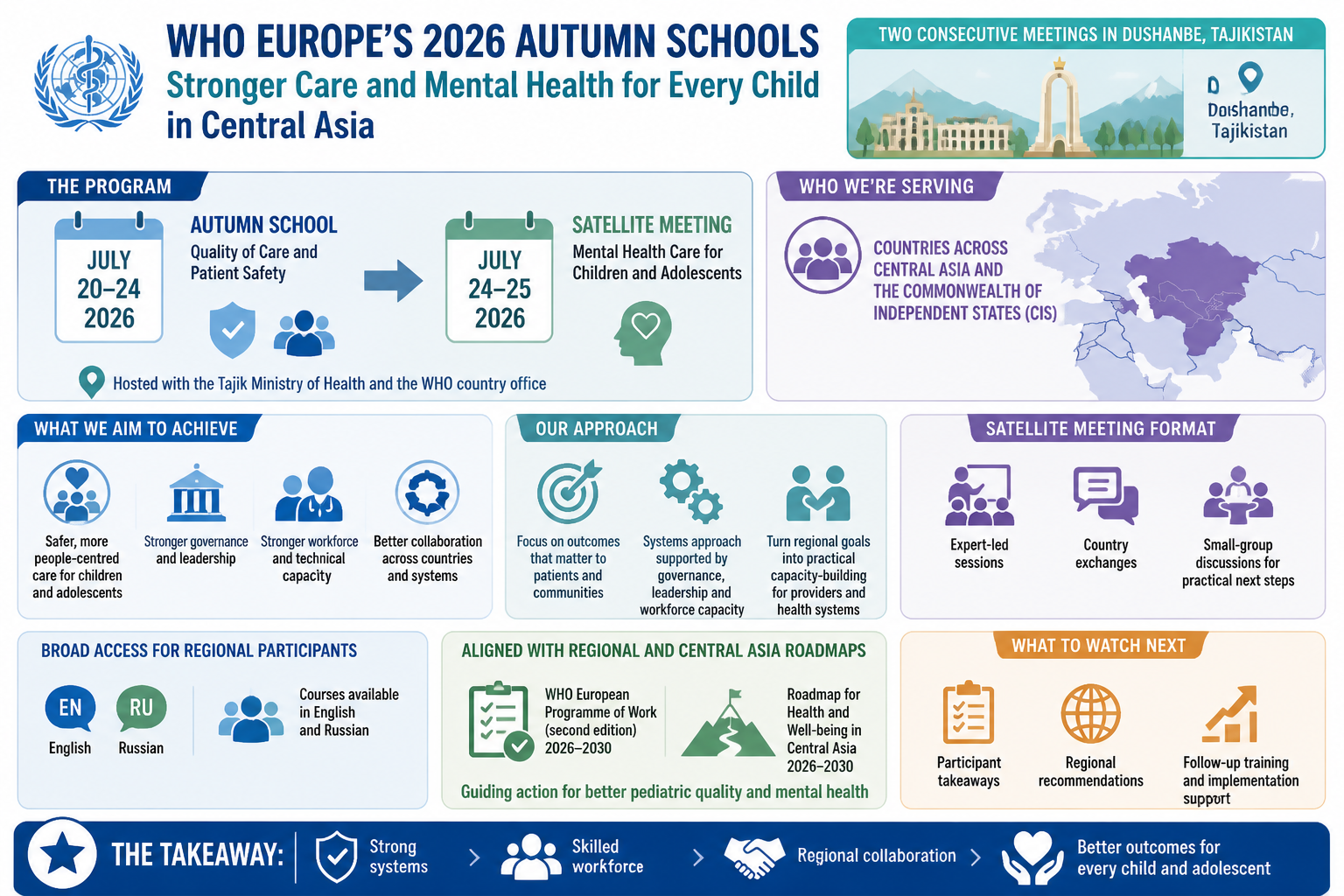
WHO says its 2026 European Autumn Schools will be held as two consecutive meetings in Dushanbe, Tajikistan, hosted with the Tajik Ministry of Health and the WHO country office [2]. The program includes a July 20-24 school on quality of care and patient safety, followed by a July 24-25 satellite meeting on mental health care for children and adolescents [2].
Why it matters: The meetings target safer, more people-centred care for children and adolescents by strengthening leadership, technical capacity, and country collaboration across Central Asia and the Commonwealth of Independent States [2]. Because the program aligns with WHO regional and Central Asia roadmaps through 2030, it may influence how pediatric quality and mental health priorities are implemented in the region [2].
Key insights: WHO says the school emphasizes outcomes that matter to patients and communities and promotes a systems approach supported by governance, leadership, and workforce capacity [2]. | The satellite meeting will include expert-led sessions, country exchanges, and small-group discussions aimed at practical next steps for mental health services [2]. | Courses will be available in English and Russian, which broadens access for regional participants [2]. | The agenda is tied to both the second European Programme of Work 2026-2030 and the Roadmap for Health and Well-being in Central Asia 2026-2030 [2].
Cheatsheet facts: What changed: WHO is running a two-part Autumn Schools program in Tajikistan focused on quality of care, patient safety, and child and adolescent mental health [2]. | Why now: WHO is trying to convert regional work-plan goals into practical capacity-building for providers and health systems [2]. | Watch next: Look for participant takeaways, regional recommendations, or any announced follow-up training and implementation support [2].
WHO says its 2026 European Autumn Schools will be held as two consecutive meetings in Dushanbe, Tajikistan, hosted with the Tajik Ministry of Health and the WHO country office [2]. The program includes a July 20-24 school on quality of care and patient safety, followed by a July 24-25 satellite meeting on mental health care for children and adolescents [2].
Why it matters: The meetings target safer, more people-centred care for children and adolescents by strengthening leadership, technical capacity, and country collaboration across Central Asia and the Commonwealth of Independent States [2]. Because the program aligns with WHO regional and Central Asia roadmaps through 2030, it may influence how pediatric quality and mental health priorities are implemented in the region [2].
Key insights: WHO says the school emphasizes outcomes that matter to patients and communities and promotes a systems approach supported by governance, leadership, and workforce capacity [2]. | The satellite meeting will include expert-led sessions, country exchanges, and small-group discussions aimed at practical next steps for mental health services [2]. | Courses will be available in English and Russian, which broadens access for regional participants [2]. | The agenda is tied to both the second European Programme of Work 2026-2030 and the Roadmap for Health and Well-being in Central Asia 2026-2030 [2].
Cheatsheet facts: What changed: WHO is running a two-part Autumn Schools program in Tajikistan focused on quality of care, patient safety, and child and adolescent mental health [2]. | Why now: WHO is trying to convert regional work-plan goals into practical capacity-building for providers and health systems [2]. | Watch next: Look for participant takeaways, regional recommendations, or any announced follow-up training and implementation support [2].