WHO rolls out prevention and preparedness agendas across drowning, oral health, climate-health migration, and Ebola readiness
WHO is using a series of launches and webinars to push prevention and operational readiness across multiple public-health areas. The package on drowning prevention, oral-health guidelines tied to AMR, a climate-change migration and displacement research agenda, and Ebola Bundibugyo readiness tools…
WHO is using a series of launches and webinars to push prevention and operational readiness across multiple public-health areas. The package on drowning prevention, oral-health guidelines tied to AMR, a climate-change migration and displacement research agenda, and Ebola Bundibugyo readiness tools all emphasize translating evidence into policy, practice, and country implementation [1][2][3][4].
Why it matters: These are not isolated events; together they show WHO trying to convert technical guidance into practical government action on preventable injury, antibiotic stewardship, climate-related health vulnerability, and outbreak preparedness [1][2][3][4]. The common thread is system strengthening rather than one-off response.
Key insights: Drowning remains a major preventable cause of death, with WHO saying it claims more than 300,000 lives each year [1]. | WHO says oral diseases affect an estimated 960 million people in the Western Pacific Region, and that unnecessary antibiotic use in oral care contributes to AMR [2]. | WHO’s climate-health migration work says the climate–migration–health nexus is under-researched and aims to prioritize evidence gaps for policy and practice [3]. | The Ebola Bundibugyo readiness webinar centers on simulation exercises, contingency planning, and the EVD Preparedness Matrix for scenario-based readiness planning [4].
Cheatsheet facts: What changed: WHO announced or highlighted new prevention and readiness tools and launch events across four public-health areas [1][2][3][4]. | Why now: The source materials say the issues are urgent and under-addressed: drowning deaths remain high, AMR is rising, climate-linked displacement lacks evidence, and Ebola readiness needs strengthening [1][2][3][4]. | Watch next: Look for the launch outputs themselves: the PROTECT package release, dissemination of oral-health guidelines and AWaRe materials, publication of the GRPE report/roadmap, and follow-up use of the EVD Preparedness Matrix in at-risk settings [1][2][3][4].
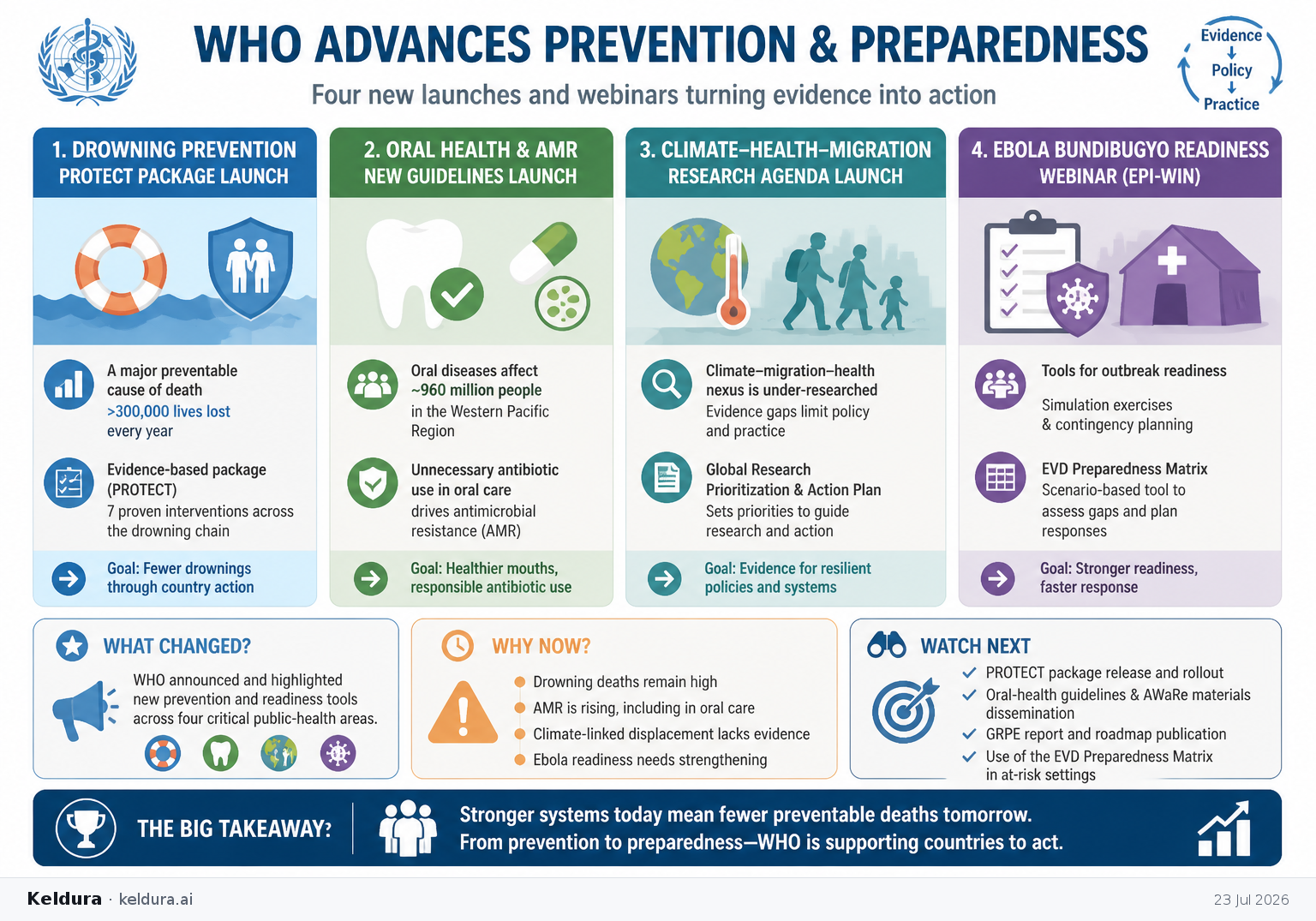
WHO is using a series of launches and webinars to push prevention and operational readiness across multiple public-health areas. The package on drowning prevention, oral-health guidelines tied to AMR, a climate-change migration and displacement research agenda, and Ebola Bundibugyo readiness tools all emphasize translating evidence into policy, practice, and country implementation [1][2][3][4].
Why it matters: These are not isolated events; together they show WHO trying to convert technical guidance into practical government action on preventable injury, antibiotic stewardship, climate-related health vulnerability, and outbreak preparedness [1][2][3][4]. The common thread is system strengthening rather than one-off response.
Key insights: Drowning remains a major preventable cause of death, with WHO saying it claims more than 300,000 lives each year [1]. | WHO says oral diseases affect an estimated 960 million people in the Western Pacific Region, and that unnecessary antibiotic use in oral care contributes to AMR [2]. | WHO’s climate-health migration work says the climate–migration–health nexus is under-researched and aims to prioritize evidence gaps for policy and practice [3]. | The Ebola Bundibugyo readiness webinar centers on simulation exercises, contingency planning, and the EVD Preparedness Matrix for scenario-based readiness planning [4].
Cheatsheet facts: What changed: WHO announced or highlighted new prevention and readiness tools and launch events across four public-health areas [1][2][3][4]. | Why now: The source materials say the issues are urgent and under-addressed: drowning deaths remain high, AMR is rising, climate-linked displacement lacks evidence, and Ebola readiness needs strengthening [1][2][3][4]. | Watch next: Look for the launch outputs themselves: the PROTECT package release, dissemination of oral-health guidelines and AWaRe materials, publication of the GRPE report/roadmap, and follow-up use of the EVD Preparedness Matrix in at-risk settings [1][2][3][4].
[1] Launch event: Technical Package for Drowning Prevention — World Health Organization News[2] Oral health and AMR: New guidelines on minimally invasive care and appropriate antibiotic use for oral health — World Health Organization News[3] Launch webinar: Global research prioritization and action plan on health, migration and displacement in the context of climate change — World Health Organization News[4] WHO Health Emergencies EPI-WIN webinar: Ebola Bundibugyo Virus Disease outbreak readiness: tools, Experiences and Lessons from the Field — World Health Organization NewsRead the full editionPost to X