WHO is pushing a broader HIV, hepatitis, and STI integration agenda
At the International AIDS Society, the WHO Director-General said WHO was launching the mid-term assessment of its Global Health Sector Strategies on HIV, viral hepatitis, and sexually transmitted infections for 2022 to 2030 [3]. He said new HIV surveillance guidance and consolidated HIV service del…
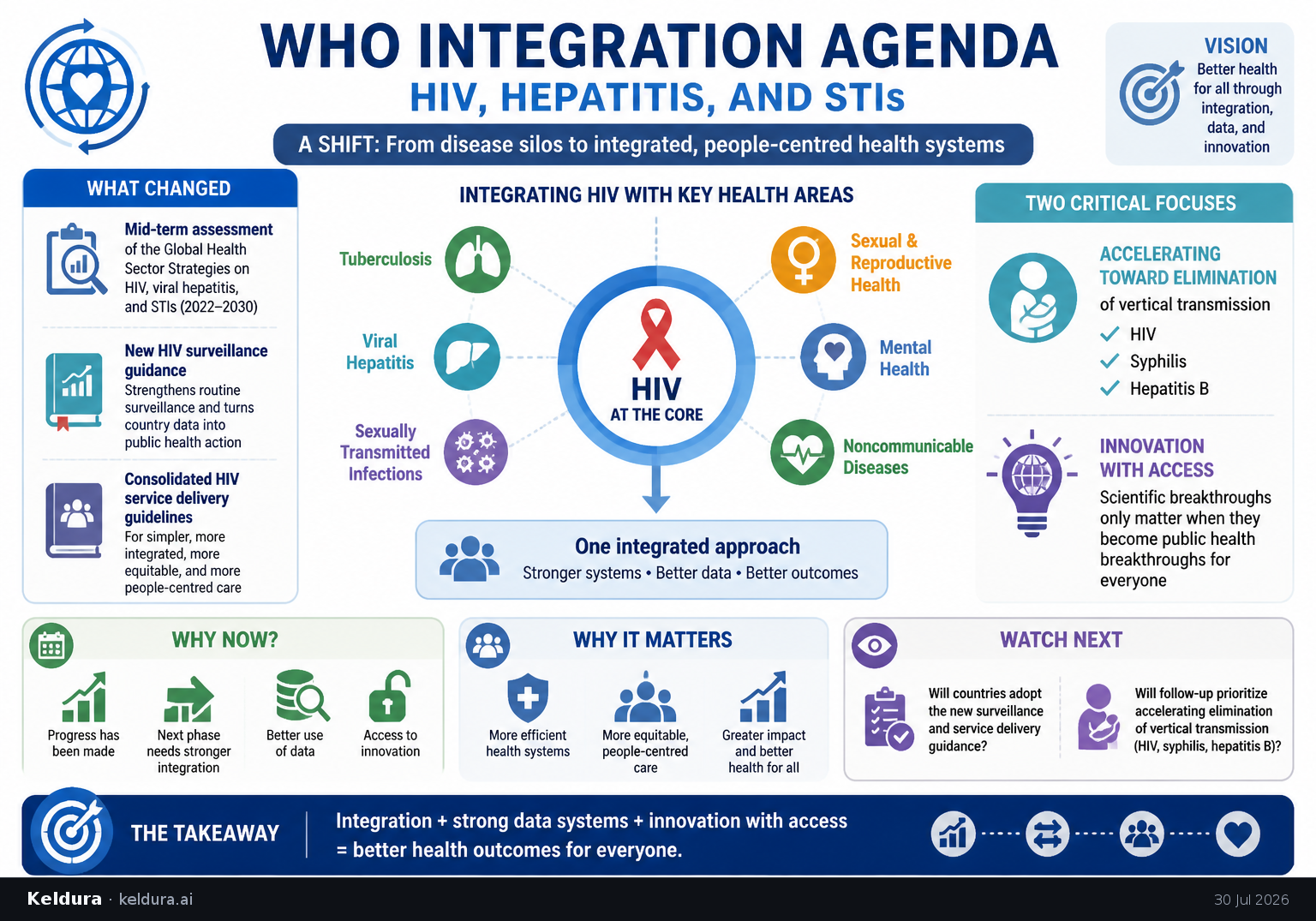
At the International AIDS Society, the WHO Director-General said WHO was launching the mid-term assessment of its Global Health Sector Strategies on HIV, viral hepatitis, and sexually transmitted infections for 2022 to 2030 [3]. He said new HIV surveillance guidance and consolidated HIV service delivery guidelines are being released, and that WHO will keep integrating HIV with tuberculosis, viral hepatitis, STIs, sexual and reproductive health, mental health, and noncommunicable diseases [3].
Why it matters: This matters because it shows WHO moving from disease-specific responses toward more integrated service delivery, data systems, and health-system strengthening [3].
Key insights: WHO says new HIV surveillance guidance is meant to strengthen routine surveillance systems and turn country data into public health action [3]. | WHO says the new HIV service delivery guidelines aim for care that is simpler, more integrated, more equitable, and more people-centred [3]. | The address ties innovation to access, stressing that scientific breakthroughs only matter when they become public health breakthroughs for everyone [3]. | WHO also says it will accelerate progress toward eliminating vertical transmission of HIV, syphilis, and hepatitis B [3].
Cheatsheet facts: What changed: WHO launched a mid-term assessment and released new HIV surveillance and service delivery guidance [3]. | Why now: WHO says progress has been made, but the next phase needs stronger integration, data use, and access to innovation [3]. | Watch next: Monitor whether countries adopt the new surveillance and service delivery guidance and whether WHO follow-up centers on vertical transmission elimination [3].
At the International AIDS Society, the WHO Director-General said WHO was launching the mid-term assessment of its Global Health Sector Strategies on HIV, viral hepatitis, and sexually transmitted infections for 2022 to 2030 [3]. He said new HIV surveillance guidance and consolidated HIV service delivery guidelines are being released, and that WHO will keep integrating HIV with tuberculosis, viral hepatitis, STIs, sexual and reproductive health, mental health, and noncommunicable diseases [3].
Why it matters: This matters because it shows WHO moving from disease-specific responses toward more integrated service delivery, data systems, and health-system strengthening [3].
Key insights: WHO says new HIV surveillance guidance is meant to strengthen routine surveillance systems and turn country data into public health action [3]. | WHO says the new HIV service delivery guidelines aim for care that is simpler, more integrated, more equitable, and more people-centred [3]. | The address ties innovation to access, stressing that scientific breakthroughs only matter when they become public health breakthroughs for everyone [3]. | WHO also says it will accelerate progress toward eliminating vertical transmission of HIV, syphilis, and hepatitis B [3].
Cheatsheet facts: What changed: WHO launched a mid-term assessment and released new HIV surveillance and service delivery guidance [3]. | Why now: WHO says progress has been made, but the next phase needs stronger integration, data use, and access to innovation [3]. | Watch next: Monitor whether countries adopt the new surveillance and service delivery guidance and whether WHO follow-up centers on vertical transmission elimination [3].
X copy pack
Edition complete
You've reached the end of this edition.