NASA’s Roman Space Telescope is in launch-mode for an August 30 liftoff
NASA says the Nancy Grace Roman Space Telescope is set to launch on August 30, 2026 at 07:20 am EDT on a SpaceX Falcon Heavy rocket from Launch Complex 39A at NASA’s Kennedy Space Center in Florida [1]. The mission is framed around settling essential questions in dark energy, exoplanets, and infrar…
NASA says the Nancy Grace Roman Space Telescope is set to launch on August 30, 2026 at 07:20 am EDT on a SpaceX Falcon Heavy rocket from Launch Complex 39A at NASA’s Kennedy Space Center in Florida [1]. The mission is framed around settling essential questions in dark energy, exoplanets, and infrared astrophysics, and NASA says Roman will have a field of view at least 100 times larger than Hubble’s [1].
Why it matters: Roman is positioned as a major next-generation observatory that could survey a billion galaxies over its lifetime and directly study exoplanets and planet-forming disks [1]. That makes the launch timing and pre-launch readiness significant not just for NASA, but for the broader astronomy community waiting on new data about cosmic expansion and planetary systems [1].
Key insights: NASA says Roman can block starlight to directly see exoplanets and planet-forming disks [1]. | The mission is also described as able to complete a statistical census of planetary systems in our galaxy [1]. | NASA’s Roman page highlights multiple related launch-prep and mission-update items, signaling active pre-launch operations [1].
Cheatsheet facts: What changed: NASA says Roman is set for launch on August 30, 2026 at 07:20 am EDT [1]. | Why now: The mission is entering its final launch window ahead of liftoff from Kennedy Space Center [1]. | Watch next: NASA media briefings and launch-prep updates tied to Roman’s August 30 launch [1].
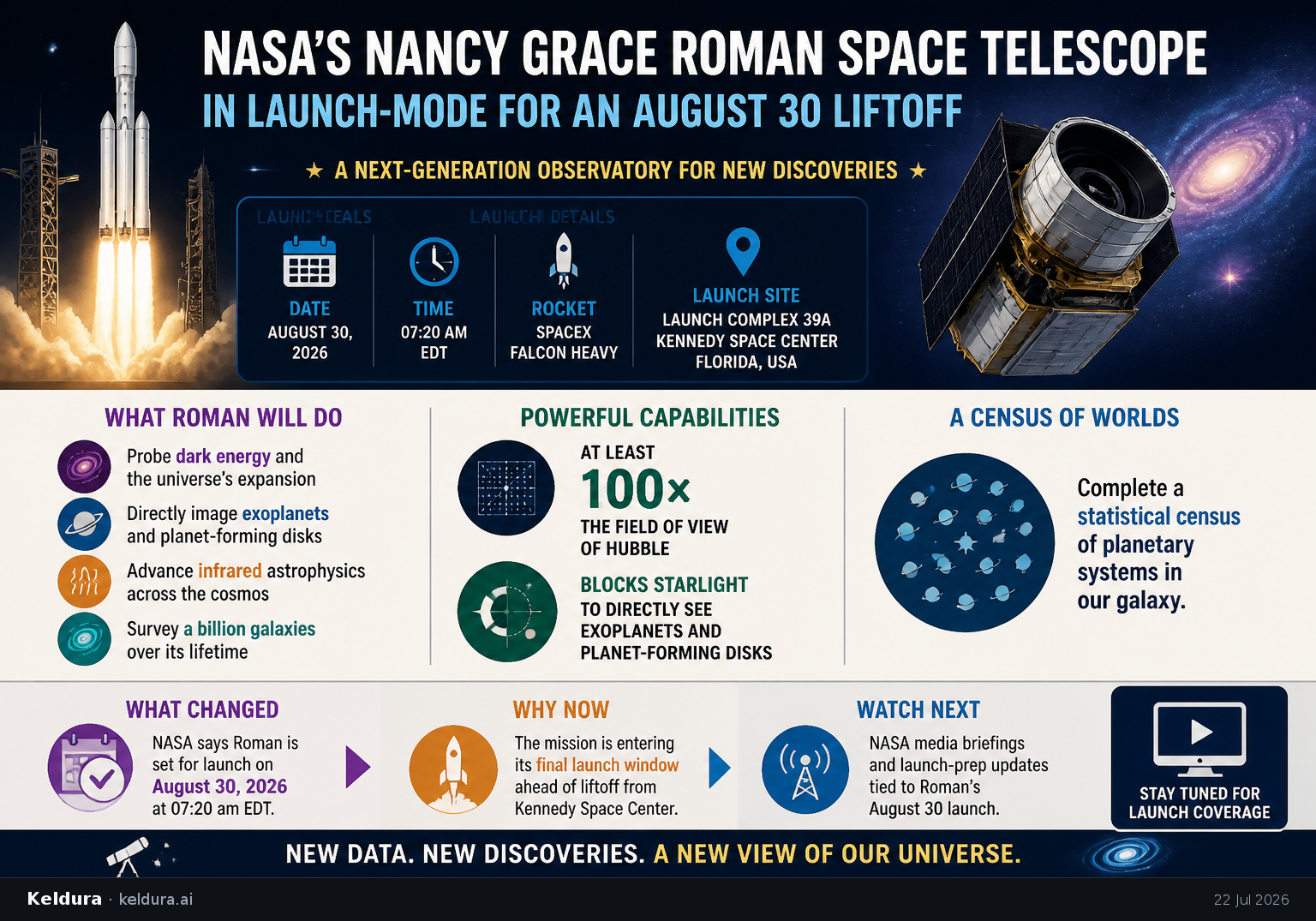
NASA says the Nancy Grace Roman Space Telescope is set to launch on August 30, 2026 at 07:20 am EDT on a SpaceX Falcon Heavy rocket from Launch Complex 39A at NASA’s Kennedy Space Center in Florida [1]. The mission is framed around settling essential questions in dark energy, exoplanets, and infrared astrophysics, and NASA says Roman will have a field of view at least 100 times larger than Hubble’s [1].
Why it matters: Roman is positioned as a major next-generation observatory that could survey a billion galaxies over its lifetime and directly study exoplanets and planet-forming disks [1]. That makes the launch timing and pre-launch readiness significant not just for NASA, but for the broader astronomy community waiting on new data about cosmic expansion and planetary systems [1].
Key insights: NASA says Roman can block starlight to directly see exoplanets and planet-forming disks [1]. | The mission is also described as able to complete a statistical census of planetary systems in our galaxy [1]. | NASA’s Roman page highlights multiple related launch-prep and mission-update items, signaling active pre-launch operations [1].
Cheatsheet facts: What changed: NASA says Roman is set for launch on August 30, 2026 at 07:20 am EDT [1]. | Why now: The mission is entering its final launch window ahead of liftoff from Kennedy Space Center [1]. | Watch next: NASA media briefings and launch-prep updates tied to Roman’s August 30 launch [1].