Iran weighs three risky paths after clashes over the Strait of Hormuz
After 10 days of exchanging strikes with the US over the Strait of Hormuz, Iran is described as facing three imperfect choices: accept US demands, escalate further, or keep the current level of instability. The piece says each option carries major costs, from political blowback at home to a broader…
After 10 days of exchanging strikes with the US over the Strait of Hormuz, Iran is described as facing three imperfect choices: accept US demands, escalate further, or keep the current level of instability. The piece says each option carries major costs, from political blowback at home to a broader regional war or a slow erosion of Iran’s leverage if trade routes adapt.[1]
Why it matters: The Strait of Hormuz remains a pressure point that can affect global energy flows, regional security, and the odds of wider war. The article also shows that Iran’s strategy is not only military but political, because different power centers inside the system may prefer different outcomes.[1]
Key insights: The least costly military option may be the most costly politically for Tehran, because it would mean accepting intrusive nuclear inspections and ending attacks on shipping.[1] | Escalation could force Gulf states and the US into a broader coalition if strikes cause mass casualties or serious infrastructure damage.[1] | A strategy of managed instability may preserve leverage short term, but sanctions, war damage, and inflation are increasing domestic pressure inside Iran.[1] | The article says the decision is complicated by unclear authority under Mojtaba Khamenei, with pragmatists, hardliners, and Revolutionary Guards potentially favoring different paths.[1]
Cheatsheet facts: What changed: Iran is reportedly choosing among settlement, escalation, or controlled instability after 10 days of strikes with the US over Hormuz.[1] | Why now: The conflict has raised the stakes around shipping, nuclear demands, and Iran’s internal power balance at the same time.[1] | Watch next: Any visible move on shipping attacks, nuclear access, or formal statements from President Masoud Pezeshkian, parliament, or the Revolutionary Guards.[1]
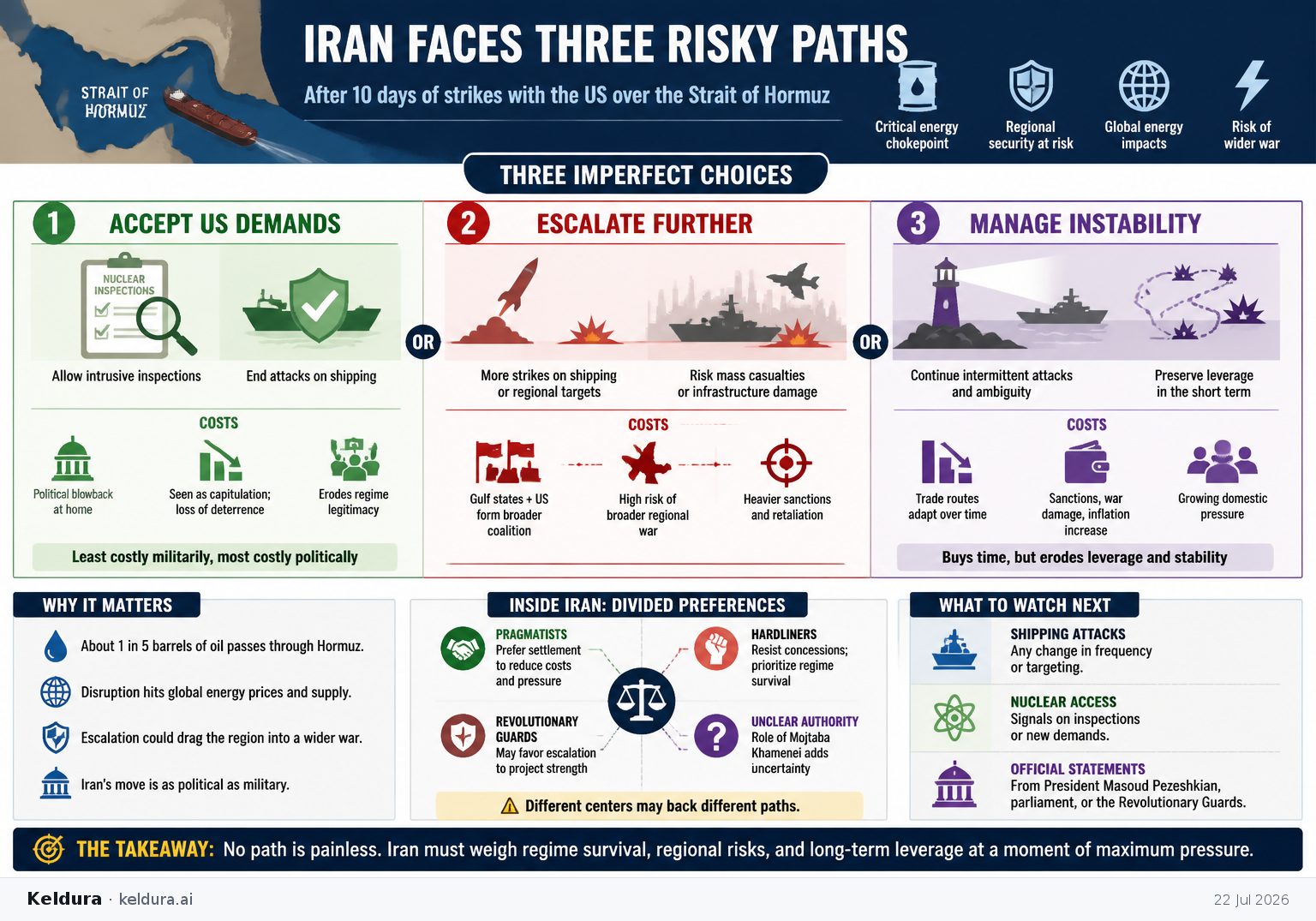
After 10 days of exchanging strikes with the US over the Strait of Hormuz, Iran is described as facing three imperfect choices: accept US demands, escalate further, or keep the current level of instability. The piece says each option carries major costs, from political blowback at home to a broader regional war or a slow erosion of Iran’s leverage if trade routes adapt.[1]
Why it matters: The Strait of Hormuz remains a pressure point that can affect global energy flows, regional security, and the odds of wider war. The article also shows that Iran’s strategy is not only military but political, because different power centers inside the system may prefer different outcomes.[1]
Key insights: The least costly military option may be the most costly politically for Tehran, because it would mean accepting intrusive nuclear inspections and ending attacks on shipping.[1] | Escalation could force Gulf states and the US into a broader coalition if strikes cause mass casualties or serious infrastructure damage.[1] | A strategy of managed instability may preserve leverage short term, but sanctions, war damage, and inflation are increasing domestic pressure inside Iran.[1] | The article says the decision is complicated by unclear authority under Mojtaba Khamenei, with pragmatists, hardliners, and Revolutionary Guards potentially favoring different paths.[1]
Cheatsheet facts: What changed: Iran is reportedly choosing among settlement, escalation, or controlled instability after 10 days of strikes with the US over Hormuz.[1] | Why now: The conflict has raised the stakes around shipping, nuclear demands, and Iran’s internal power balance at the same time.[1] | Watch next: Any visible move on shipping attacks, nuclear access, or formal statements from President Masoud Pezeshkian, parliament, or the Revolutionary Guards.[1]