US and Iran exchange escalating strikes as the Strait of Hormuz becomes a pressure point
The US says it launched another wave of strikes on Iran, with President Donald Trump saying the attacks hit Iran “very hard” and were carried out “in honour” of three US soldiers killed in recent days [1]. BBC reporting also says the fighting has run for consecutive nights, with Iran reporting stri…
The US says it launched another wave of strikes on Iran, with President Donald Trump saying the attacks hit Iran “very hard” and were carried out “in honour” of three US soldiers killed in recent days [1]. BBC reporting also says the fighting has run for consecutive nights, with Iran reporting strikes across multiple cities, claims of tankers exploding near the strait, and IRGC threats that the waterway will not be safe if the attacks continue [1].
Why it matters: This is a widening regional security crisis because it now combines direct US-Iran military action, casualties on both sides, and explicit threats to a critical global shipping lane [1][4]. The Strait of Hormuz matters well beyond the immediate conflict because disruptions there can affect commercial shipping and raise the risk of broader diplomatic and economic fallout [1][4].
Key insights: The US says it targeted military sites and communications networks to reduce Iranian attacks on vessels in the Strait of Hormuz [1]. | Iranian media and the IRGC are framing the strait as leverage, while Centcom disputes Iranian claims about tanker explosions [1][4]. | The exchange is tied to a collapse in the earlier ceasefire framework, with both sides accusing each other of violating or abandoning the deal [1][4]. | Regional spillover is already visible: Jordan says it shot down missiles, Kuwait says it intercepted drones, and Israel reported interceptors and debris near Eilat [1][4].
Cheatsheet facts: What changed: The US says it carried out another wave of strikes on Iran, while Iran and regional states reported retaliatory incidents, missile interceptions, and threats to shipping [1][4]. | Why now: The conflict has intensified after recent attacks that killed US soldiers, and both sides are treating the Strait of Hormuz as a live pressure point [1][4]. | Watch next: Any new official statement on maritime security in the Strait of Hormuz, or fresh reports of strikes, interceptions, or vessel disruptions [1][4].
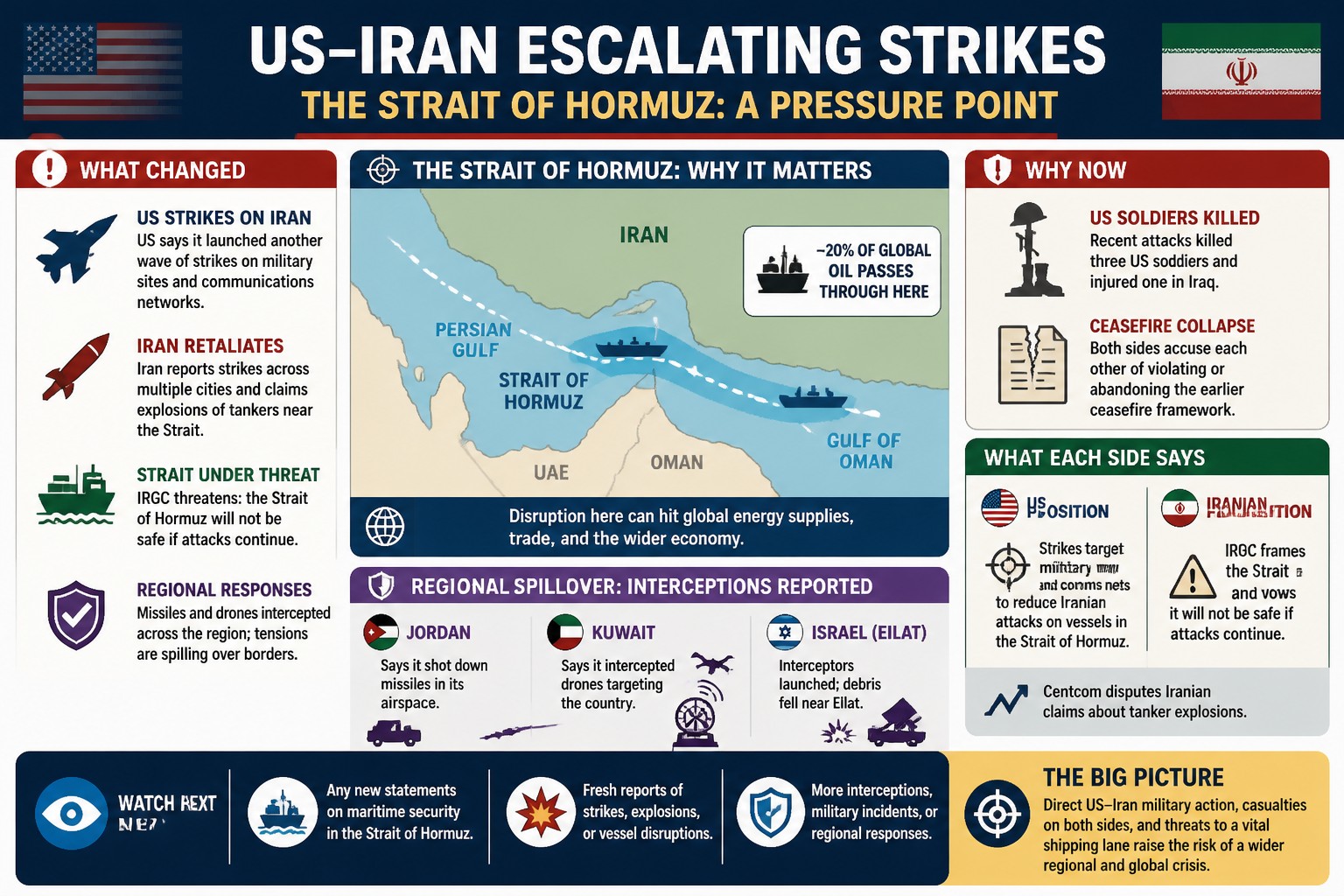
The US says it launched another wave of strikes on Iran, with President Donald Trump saying the attacks hit Iran “very hard” and were carried out “in honour” of three US soldiers killed in recent days [1]. BBC reporting also says the fighting has run for consecutive nights, with Iran reporting strikes across multiple cities, claims of tankers exploding near the strait, and IRGC threats that the waterway will not be safe if the attacks continue [1].
Why it matters: This is a widening regional security crisis because it now combines direct US-Iran military action, casualties on both sides, and explicit threats to a critical global shipping lane [1][4]. The Strait of Hormuz matters well beyond the immediate conflict because disruptions there can affect commercial shipping and raise the risk of broader diplomatic and economic fallout [1][4].
Key insights: The US says it targeted military sites and communications networks to reduce Iranian attacks on vessels in the Strait of Hormuz [1]. | Iranian media and the IRGC are framing the strait as leverage, while Centcom disputes Iranian claims about tanker explosions [1][4]. | The exchange is tied to a collapse in the earlier ceasefire framework, with both sides accusing each other of violating or abandoning the deal [1][4]. | Regional spillover is already visible: Jordan says it shot down missiles, Kuwait says it intercepted drones, and Israel reported interceptors and debris near Eilat [1][4].
Cheatsheet facts: What changed: The US says it carried out another wave of strikes on Iran, while Iran and regional states reported retaliatory incidents, missile interceptions, and threats to shipping [1][4]. | Why now: The conflict has intensified after recent attacks that killed US soldiers, and both sides are treating the Strait of Hormuz as a live pressure point [1][4]. | Watch next: Any new official statement on maritime security in the Strait of Hormuz, or fresh reports of strikes, interceptions, or vessel disruptions [1][4].