Christopher Nolan frames AI as a ‘Trojan horse’ and says public skepticism is healthy
Christopher Nolan said AI is an obvious “Trojan horse,” arguing that the public’s suspicion of the technology — especially among young people — is “very healthy.” He said technology should be embraced with skepticism, and that the motives of the people building it should also be questioned rather t…
Christopher Nolan said AI is an obvious “Trojan horse,” arguing that the public’s suspicion of the technology — especially among young people — is “very healthy.” He said technology should be embraced with skepticism, and that the motives of the people building it should also be questioned rather than trusted blindly [1].
Why it matters: Nolan’s comments matter because they reflect a broader cultural backlash to generative AI, not just a celebrity opinion. His remarks connect AI skepticism to Hollywood’s labor fights and to the idea that powerful technologies can be sold to users while displacing still-viable systems [1].
Key insights: Nolan said he has “never seen a technology advancing so rapidly” that has been “so completely rejected by the public,” pointing to the reaction to AI videos and the phrase “AI slop” [1]. | He linked his AI skepticism to a larger pattern in Hollywood, where AI became a major issue during the 2023 writers’ and actors’ strikes and in Directors Guild contract protections [1]. | Nolan positioned himself as a “techno-skeptic,” not a technophobe, and tied that stance to his preference for film over digital imaging [1]. | His comments come as The Odyssey is shot entirely on Imax film, underscoring his long-running preference for older production tools over newer digital ones [1].
Cheatsheet facts: What changed: A major filmmaker publicly sharpened the anti-AI argument, calling AI a Trojan horse and praising public skepticism [1]. | Why now: The comments land amid continuing Hollywood concerns over generative AI and labor protections, making the critique more than symbolic [1]. | Watch next: Watch for whether other major film, union, or awards-season figures echo this skepticism in public comments or contract debates [1].
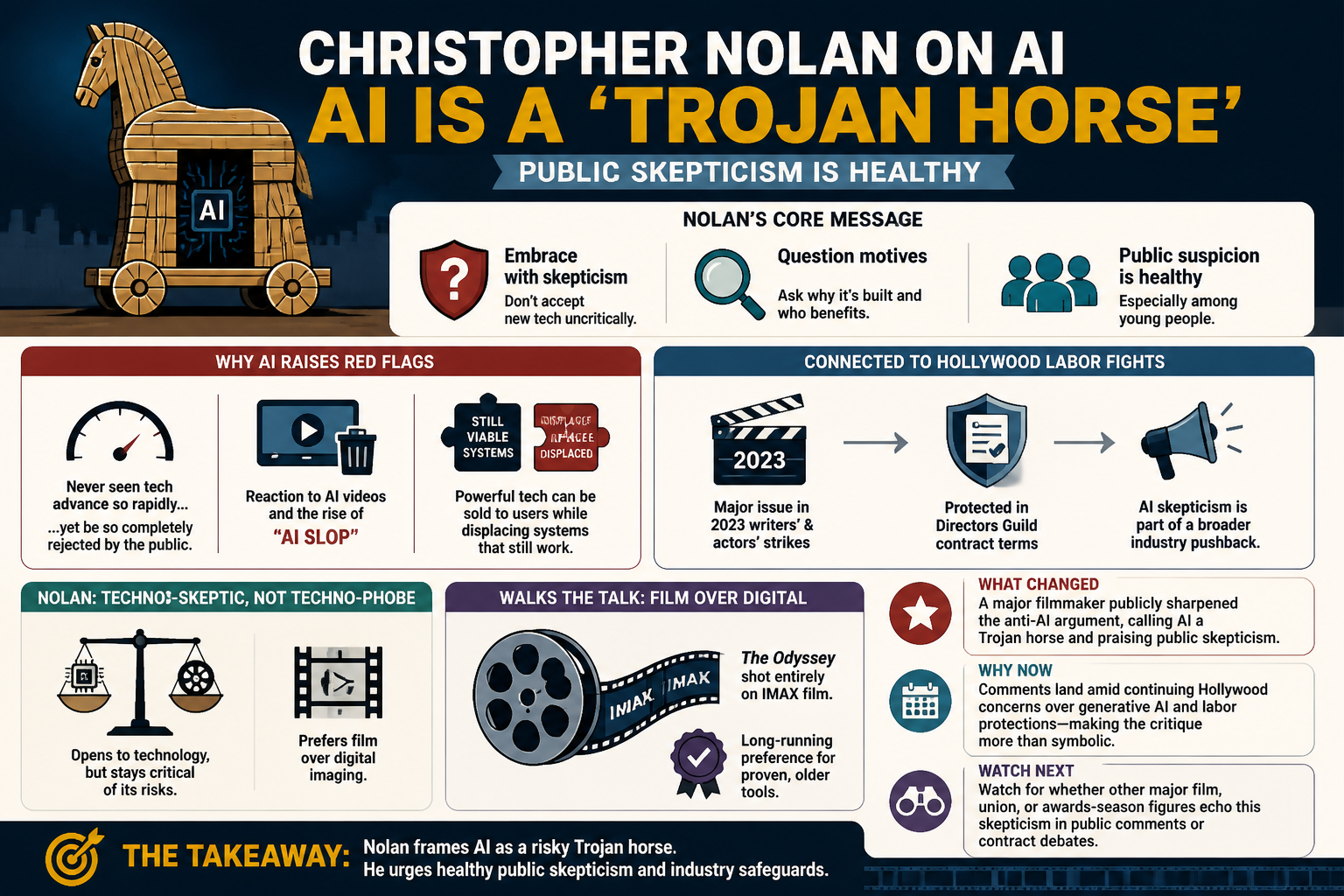
Christopher Nolan said AI is an obvious “Trojan horse,” arguing that the public’s suspicion of the technology — especially among young people — is “very healthy.” He said technology should be embraced with skepticism, and that the motives of the people building it should also be questioned rather than trusted blindly [1].
Why it matters: Nolan’s comments matter because they reflect a broader cultural backlash to generative AI, not just a celebrity opinion. His remarks connect AI skepticism to Hollywood’s labor fights and to the idea that powerful technologies can be sold to users while displacing still-viable systems [1].
Key insights: Nolan said he has “never seen a technology advancing so rapidly” that has been “so completely rejected by the public,” pointing to the reaction to AI videos and the phrase “AI slop” [1]. | He linked his AI skepticism to a larger pattern in Hollywood, where AI became a major issue during the 2023 writers’ and actors’ strikes and in Directors Guild contract protections [1]. | Nolan positioned himself as a “techno-skeptic,” not a technophobe, and tied that stance to his preference for film over digital imaging [1]. | His comments come as The Odyssey is shot entirely on Imax film, underscoring his long-running preference for older production tools over newer digital ones [1].
Cheatsheet facts: What changed: A major filmmaker publicly sharpened the anti-AI argument, calling AI a Trojan horse and praising public skepticism [1]. | Why now: The comments land amid continuing Hollywood concerns over generative AI and labor protections, making the critique more than symbolic [1]. | Watch next: Watch for whether other major film, union, or awards-season figures echo this skepticism in public comments or contract debates [1].