ESCAPADE snaps Earth-Moon images on the way to Mars
NASA says one of the two Mars-bound ESCAPADE spacecraft captured visible-light and thermal-infrared images of Earth and the Moon on July 3 while the probe was still far from home. The images showed both bodies as crescents in visible light, while thermal infrared revealed Earth’s warm atmosphere an…
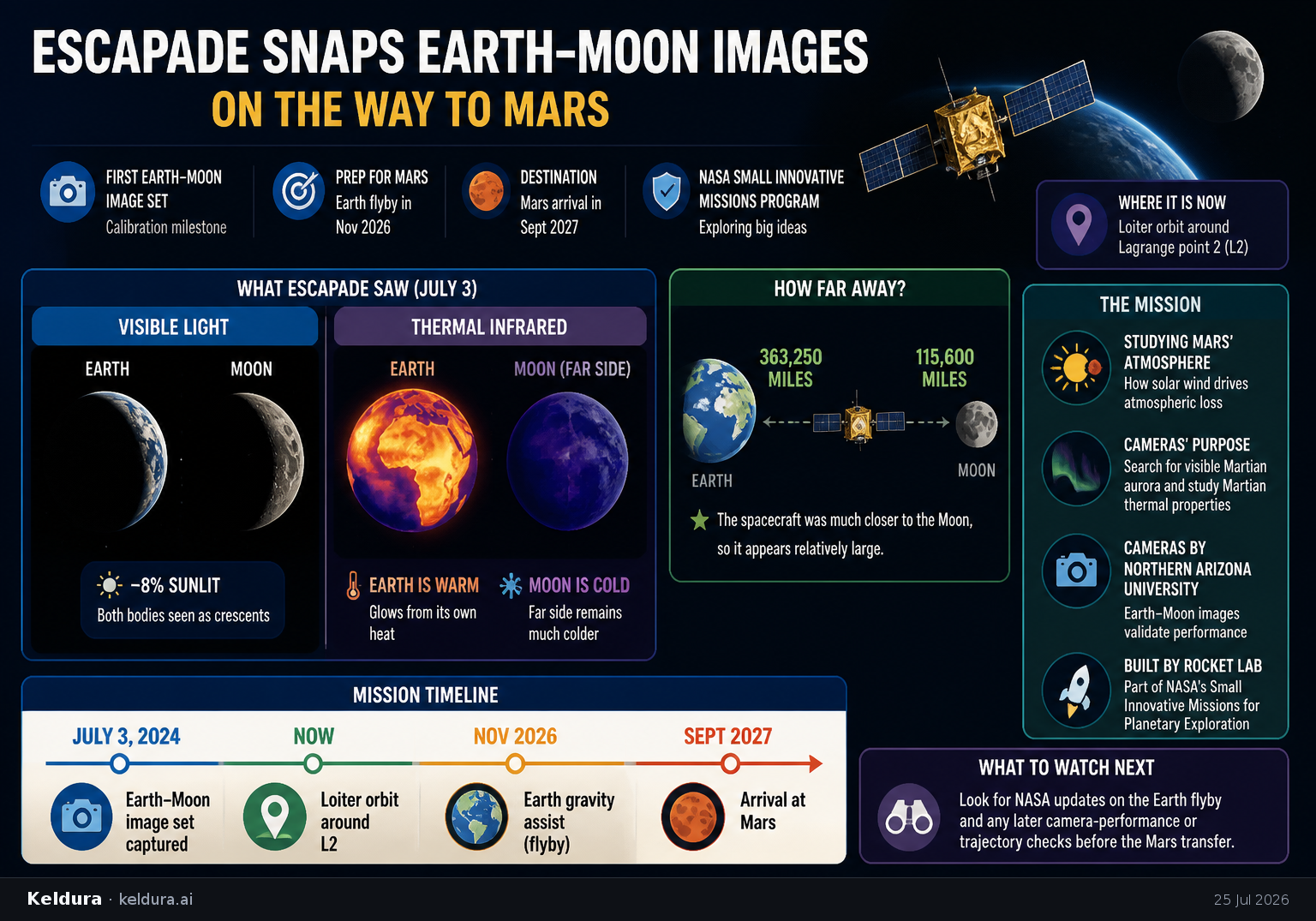
NASA says one of the two Mars-bound ESCAPADE spacecraft captured visible-light and thermal-infrared images of Earth and the Moon on July 3 while the probe was still far from home. The images showed both bodies as crescents in visible light, while thermal infrared revealed Earth’s warm atmosphere and surface and the Moon’s much colder far side.[1]
Why it matters: The photos are not just a visual milestone; NASA says they serve as an important calibration check for the spacecraft’s cameras before ESCAPADE uses an Earth flyby in November 2026 to head toward Mars.[1] The mission is part of NASA’s plan to study how solar wind interacts with Mars and drives atmospheric loss when it arrives in September 2027.[1]
Key insights: The spacecraft was 363,250 miles from Earth and 115,600 miles from the Moon when it took the images, which is why the Moon appeared relatively large.[1] | NASA says the visible image had only about 8% of each body sunlit, but thermal infrared showed Earth glowing from its own heat while the Moon stayed far colder.[1] | The cameras were provided by Northern Arizona University and are meant to search for visible Martian aurora and study Martian thermal properties, with Earth-Moon imaging used to validate them.[1] | ESCAPADE is in loiter orbit around Lagrange point 2 and was built by Rocket Lab under a NASA Small Innovative Missions for Planetary Exploration program.[1]
Cheatsheet facts: What changed: ESCAPADE returned its first Earth-Moon image set and NASA highlighted it as a camera calibration milestone.[1] | Why now: The mission is in loiter orbit ahead of a planned Earth gravity assist in November 2026 and Mars arrival in September 2027.[1] | Watch next: Look for NASA updates on the Earth flyby and any later camera-performance or trajectory checks before the Mars transfer.[1]
NASA says one of the two Mars-bound ESCAPADE spacecraft captured visible-light and thermal-infrared images of Earth and the Moon on July 3 while the probe was still far from home. The images showed both bodies as crescents in visible light, while thermal infrared revealed Earth’s warm atmosphere and surface and the Moon’s much colder far side.[1]
Why it matters: The photos are not just a visual milestone; NASA says they serve as an important calibration check for the spacecraft’s cameras before ESCAPADE uses an Earth flyby in November 2026 to head toward Mars.[1] The mission is part of NASA’s plan to study how solar wind interacts with Mars and drives atmospheric loss when it arrives in September 2027.[1]
Key insights: The spacecraft was 363,250 miles from Earth and 115,600 miles from the Moon when it took the images, which is why the Moon appeared relatively large.[1] | NASA says the visible image had only about 8% of each body sunlit, but thermal infrared showed Earth glowing from its own heat while the Moon stayed far colder.[1] | The cameras were provided by Northern Arizona University and are meant to search for visible Martian aurora and study Martian thermal properties, with Earth-Moon imaging used to validate them.[1] | ESCAPADE is in loiter orbit around Lagrange point 2 and was built by Rocket Lab under a NASA Small Innovative Missions for Planetary Exploration program.[1]
Cheatsheet facts: What changed: ESCAPADE returned its first Earth-Moon image set and NASA highlighted it as a camera calibration milestone.[1] | Why now: The mission is in loiter orbit ahead of a planned Earth gravity assist in November 2026 and Mars arrival in September 2027.[1] | Watch next: Look for NASA updates on the Earth flyby and any later camera-performance or trajectory checks before the Mars transfer.[1]