Hubble reveals a lopsided spiral galaxy shaped by cluster forces
A new NASA/ESA Hubble image shows NGC 4654, a spiral galaxy 72 million light-years away in Virgo, with a rounded edge on one side and a long gas tail on the other. NASA says the asymmetry is tied to ram pressure stripping in the Virgo Cluster, along with an older fly-by interaction with nearby gala…
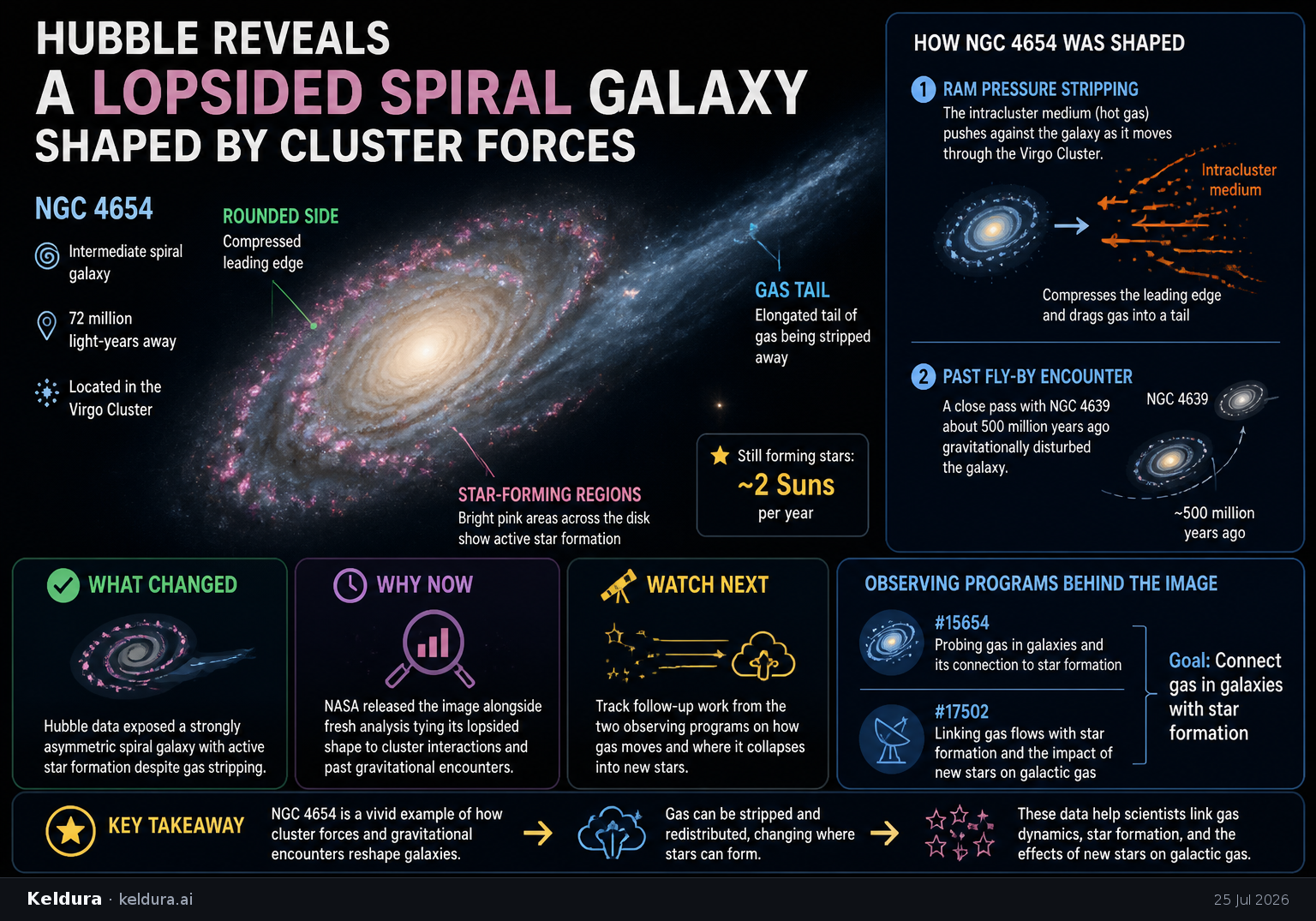
A new NASA/ESA Hubble image shows NGC 4654, a spiral galaxy 72 million light-years away in Virgo, with a rounded edge on one side and a long gas tail on the other. NASA says the asymmetry is tied to ram pressure stripping in the Virgo Cluster, along with an older fly-by interaction with nearby galaxy NGC 4639 about 500 million years ago.[2]
Why it matters: The image is a concrete example of how gas dynamics and gravitational encounters reshape galaxies and influence where stars can form. NASA says the data are helping researchers connect gas flows, star formation, and the effects of new stars on galactic gas in nearby galaxies.[2]
Key insights: NGC 4654 is classified as an intermediate spiral because it sits between barred and unbarred spiral types.[2] | NASA says ram pressure from the intracluster medium compresses the galaxy’s leading edge and drags gas into an elongated tail.[2] | Unlike many stripped galaxies, NGC 4654 is still forming nearly two Suns’ worth of stars per year, and Hubble’s red-light data show bright pink star-forming regions across the disk.[2] | The image draws on observing programs #15654 and #17502, which aim to link gas in galaxies with star formation.[2]
Cheatsheet facts: What changed: Hubble data exposed a strongly asymmetric spiral galaxy with active star formation despite gas stripping.[2] | Why now: NASA released the image alongside fresh analysis tying its lopsided shape to cluster interactions and past gravitational encounters.[2] | Watch next: Track follow-up work from the two observing programs on how gas moves and where it collapses into new stars.[2]
A new NASA/ESA Hubble image shows NGC 4654, a spiral galaxy 72 million light-years away in Virgo, with a rounded edge on one side and a long gas tail on the other. NASA says the asymmetry is tied to ram pressure stripping in the Virgo Cluster, along with an older fly-by interaction with nearby galaxy NGC 4639 about 500 million years ago.[2]
Why it matters: The image is a concrete example of how gas dynamics and gravitational encounters reshape galaxies and influence where stars can form. NASA says the data are helping researchers connect gas flows, star formation, and the effects of new stars on galactic gas in nearby galaxies.[2]
Key insights: NGC 4654 is classified as an intermediate spiral because it sits between barred and unbarred spiral types.[2] | NASA says ram pressure from the intracluster medium compresses the galaxy’s leading edge and drags gas into an elongated tail.[2] | Unlike many stripped galaxies, NGC 4654 is still forming nearly two Suns’ worth of stars per year, and Hubble’s red-light data show bright pink star-forming regions across the disk.[2] | The image draws on observing programs #15654 and #17502, which aim to link gas in galaxies with star formation.[2]
Cheatsheet facts: What changed: Hubble data exposed a strongly asymmetric spiral galaxy with active star formation despite gas stripping.[2] | Why now: NASA released the image alongside fresh analysis tying its lopsided shape to cluster interactions and past gravitational encounters.[2] | Watch next: Track follow-up work from the two observing programs on how gas moves and where it collapses into new stars.[2]
X copy pack
Edition complete
You've reached the end of this edition.