ESA says wildfire-hit Cebreros ground station is safe for nominal operations
ESA reported that wildfires near Cebreros, west of Madrid, affected an area that includes its Cebreros ground station, which hosts a 35-metre antenna and supports deep-space missions such as Mars Express, Gaia, BepiColombo, Solar Orbiter, Juice and Euclid. ESA said it reviewed the station on the mo…
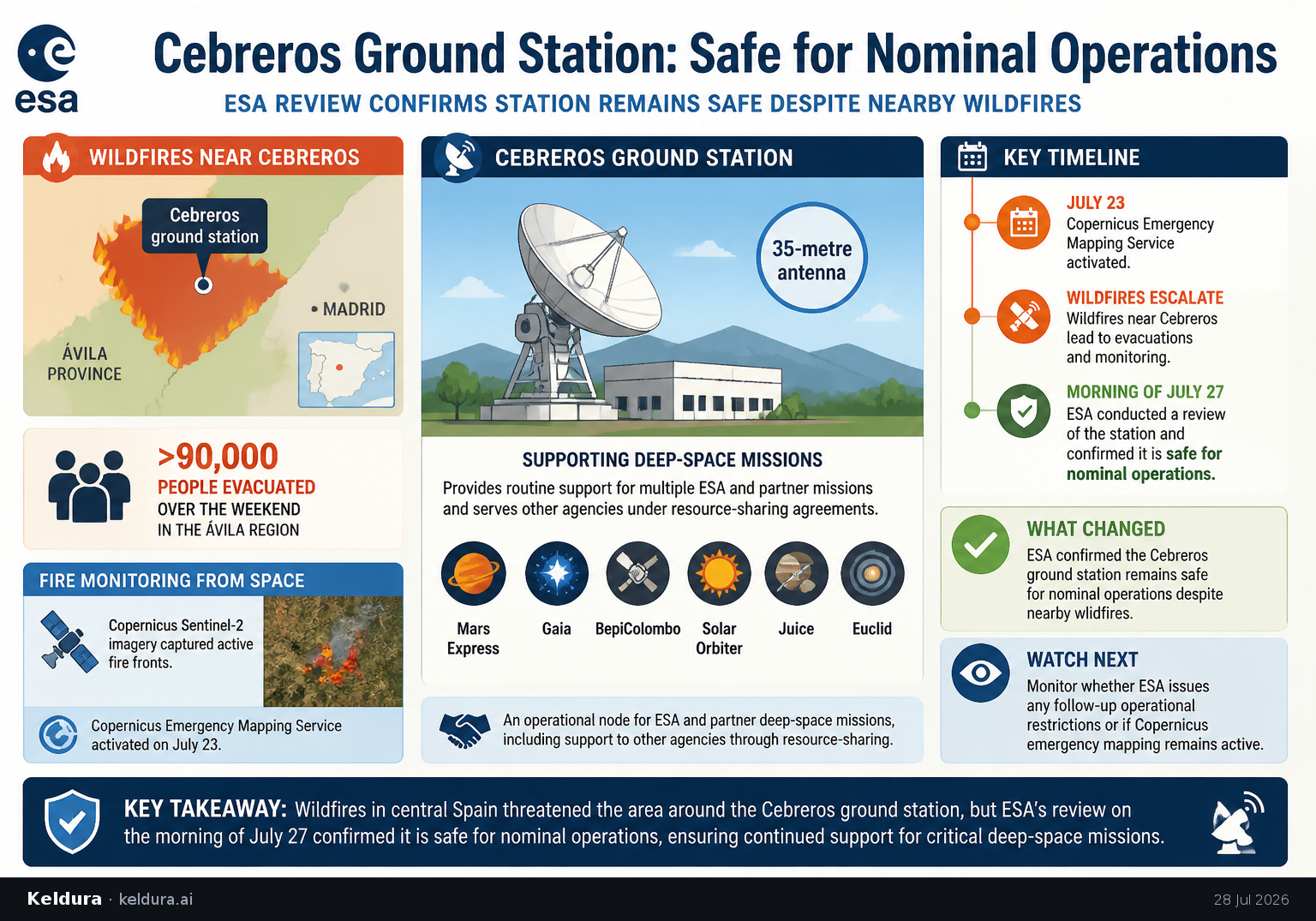
ESA reported that wildfires near Cebreros, west of Madrid, affected an area that includes its Cebreros ground station, which hosts a 35-metre antenna and supports deep-space missions such as Mars Express, Gaia, BepiColombo, Solar Orbiter, Juice and Euclid. ESA said it reviewed the station on the morning of July 27 and declared it safe for nominal operations, while Copernicus Sentinel-2 imagery captured the fire fronts and the European Union’s Copernicus Emergency Mapping Service had been activated on July 23 [2].
Why it matters: Cebreros is not just a local facility; it is an operational support node for multiple ESA and partner deep-space missions, so wildfire exposure at the site is a mission-operations issue, not only a land-use or civil-protection story [2]. The confirmation that it remains safe for nominal operations reduces immediate concern, but the situation shows how environmental hazards can intersect with space-infrastructure resilience [2].
Key insights: The affected region around Ávila saw more than 90,000 people evacuated over the weekend [2]. | ESA’s Cebreros ground station provides routine support for a roster of major deep-space missions and also serves other agencies under resource-sharing agreements [2]. | Copernicus Sentinel-2 imagery was used to visualize active fire fronts in the area [2]. | ESA’s safety review as of the morning of July 27 found nominal operations could continue [2].
Cheatsheet facts: What changed: ESA confirmed the Cebreros ground station remained safe for nominal operations despite nearby wildfires [2]. | Why now: Wildfire monitoring and evacuations in central Spain prompted immediate review of the site [2]. | Watch next: Monitor whether ESA issues any follow-up operational restrictions or if Copernicus emergency mapping remains active [2].
ESA reported that wildfires near Cebreros, west of Madrid, affected an area that includes its Cebreros ground station, which hosts a 35-metre antenna and supports deep-space missions such as Mars Express, Gaia, BepiColombo, Solar Orbiter, Juice and Euclid. ESA said it reviewed the station on the morning of July 27 and declared it safe for nominal operations, while Copernicus Sentinel-2 imagery captured the fire fronts and the European Union’s Copernicus Emergency Mapping Service had been activated on July 23 [2].
Why it matters: Cebreros is not just a local facility; it is an operational support node for multiple ESA and partner deep-space missions, so wildfire exposure at the site is a mission-operations issue, not only a land-use or civil-protection story [2]. The confirmation that it remains safe for nominal operations reduces immediate concern, but the situation shows how environmental hazards can intersect with space-infrastructure resilience [2].
Key insights: The affected region around Ávila saw more than 90,000 people evacuated over the weekend [2]. | ESA’s Cebreros ground station provides routine support for a roster of major deep-space missions and also serves other agencies under resource-sharing agreements [2]. | Copernicus Sentinel-2 imagery was used to visualize active fire fronts in the area [2]. | ESA’s safety review as of the morning of July 27 found nominal operations could continue [2].
Cheatsheet facts: What changed: ESA confirmed the Cebreros ground station remained safe for nominal operations despite nearby wildfires [2]. | Why now: Wildfire monitoring and evacuations in central Spain prompted immediate review of the site [2]. | Watch next: Monitor whether ESA issues any follow-up operational restrictions or if Copernicus emergency mapping remains active [2].
X copy pack
Edition complete
You've reached the end of this edition.