SpaceX’s Starship Flight 13 reaches several major test milestones
SpaceX’s 13th Starship test flight launched on July 24 from Starbase in South Texas and returned a 408-foot-tall Starship Version 3 vehicle to space. The upper stage deployed 20 next-gen Starlink satellites, reignited one of its Raptor engines in space, and made a soft splashdown off Western Austra…
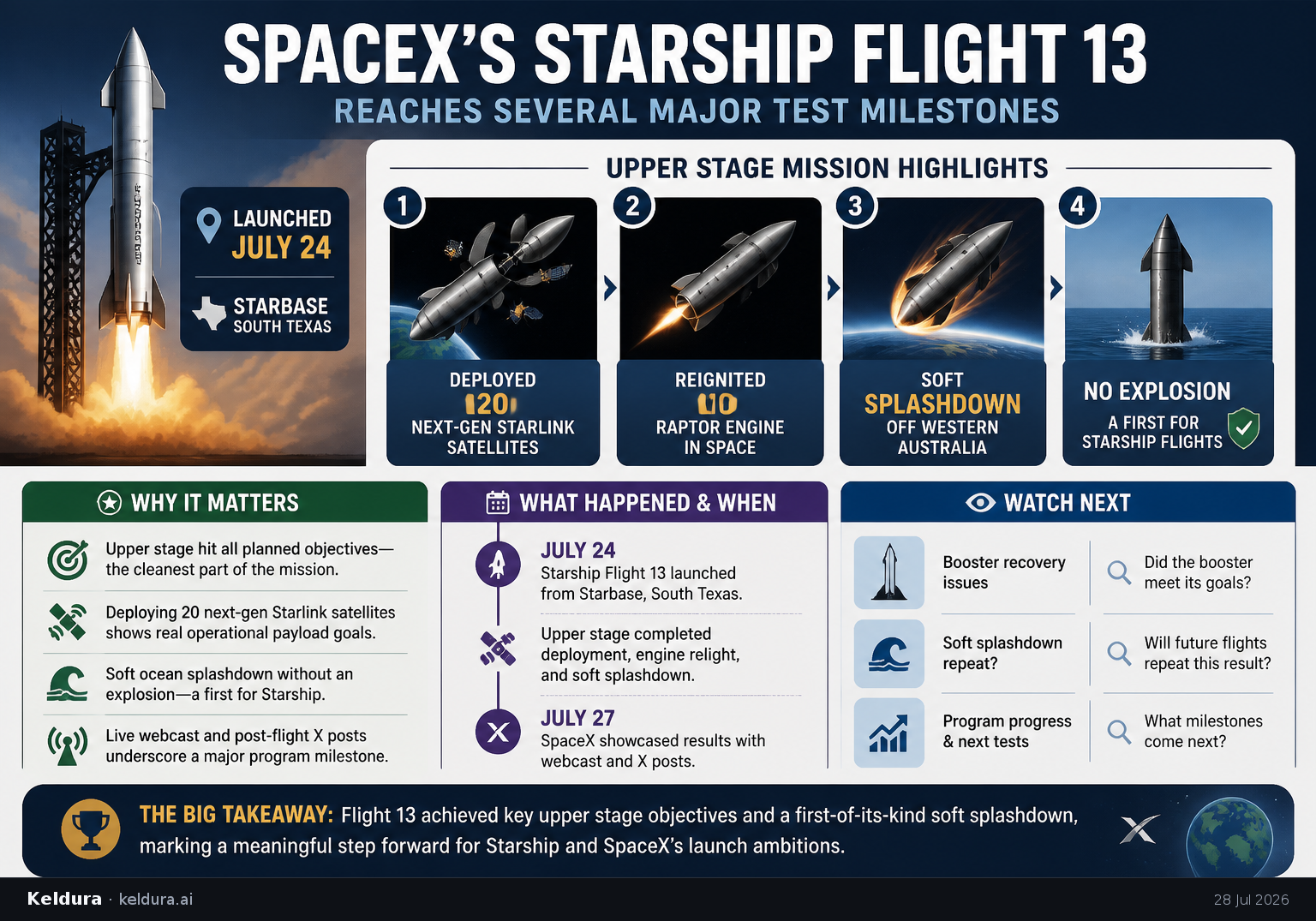
SpaceX’s 13th Starship test flight launched on July 24 from Starbase in South Texas and returned a 408-foot-tall Starship Version 3 vehicle to space. The upper stage deployed 20 next-gen Starlink satellites, reignited one of its Raptor engines in space, and made a soft splashdown off Western Australia without exploding, which SpaceX highlighted in its webcast and post-flight imagery [1].
Why it matters: This flight appears to mark a meaningful step forward for Starship’s test program because the upper stage achieved multiple planned objectives and the splashdown ended without the vehicle exploding, a first for a Starship flight [1]. Those results matter because Starship is central to SpaceX’s larger launch ambitions and to future high-capacity deployments such as Starlink [1].
Key insights: The upper stage, not the booster, delivered the cleanest part of the mission by hitting its planned marks [1]. | Deploying 20 next-gen Starlink satellites shows the test was tied to operational payload objectives, not just flight demonstration [1]. | The soft ocean splashdown without an explosion is presented as a first for Starship [1]. | SpaceX emphasized the flight with real-time webcast coverage and post-flight X posts, suggesting the company considers the result a visible program milestone [1].
Cheatsheet facts: What changed: Starship Flight 13 completed deployment, engine relight, and soft splashdown milestones [1]. | Why now: The test flew on July 24 and SpaceX publicly showcased the results on July 27 [1]. | Watch next: Look for follow-up Starship test reporting on booster recovery issues and whether future flights repeat the soft splashdown outcome [1].
SpaceX’s 13th Starship test flight launched on July 24 from Starbase in South Texas and returned a 408-foot-tall Starship Version 3 vehicle to space. The upper stage deployed 20 next-gen Starlink satellites, reignited one of its Raptor engines in space, and made a soft splashdown off Western Australia without exploding, which SpaceX highlighted in its webcast and post-flight imagery [1].
Why it matters: This flight appears to mark a meaningful step forward for Starship’s test program because the upper stage achieved multiple planned objectives and the splashdown ended without the vehicle exploding, a first for a Starship flight [1]. Those results matter because Starship is central to SpaceX’s larger launch ambitions and to future high-capacity deployments such as Starlink [1].
Key insights: The upper stage, not the booster, delivered the cleanest part of the mission by hitting its planned marks [1]. | Deploying 20 next-gen Starlink satellites shows the test was tied to operational payload objectives, not just flight demonstration [1]. | The soft ocean splashdown without an explosion is presented as a first for Starship [1]. | SpaceX emphasized the flight with real-time webcast coverage and post-flight X posts, suggesting the company considers the result a visible program milestone [1].
Cheatsheet facts: What changed: Starship Flight 13 completed deployment, engine relight, and soft splashdown milestones [1]. | Why now: The test flew on July 24 and SpaceX publicly showcased the results on July 27 [1]. | Watch next: Look for follow-up Starship test reporting on booster recovery issues and whether future flights repeat the soft splashdown outcome [1].