India’s Cockroach Janta Party protest is moving from online satire to mass street pressure
Thousands of students, parents, activists and political leaders are set to march toward the Indian parliament after a call from the Cockroach Janta Party for education reforms [5]. The protest follows chaos around activist Sonam Wangchuk’s hunger strike, his forced transfer to hospital, and a wider…
Thousands of students, parents, activists and political leaders are set to march toward the Indian parliament after a call from the Cockroach Janta Party for education reforms [5]. The protest follows chaos around activist Sonam Wangchuk’s hunger strike, his forced transfer to hospital, and a wider campaign focused on exam leaks, cancellations, and demands for Education Minister Dharmendra Pradhan to resign [5].
Why it matters: This has become a test of how the government responds to a fast-growing civil protest movement that mixes satire, student anger, and direct accountability demands [5]. The scale of the turnout, the heavy police deployment, and the march toward parliament show the issue has moved from online activism into a broader political challenge [5].
Key insights: The movement was founded as an online satirical campaign but has gained a large following and formal protest momentum [5]. | Authorities say the march does not have permission, yet organizers say it will proceed anyway [5]. | Security in Delhi has been tightened with hundreds of police and paramilitary personnel, sealed roads, and barricades around the venue [5]. | The protest agenda has broadened from education minister accountability to demands for Narendra Modi’s resignation after Wangchuk was forcibly taken to hospital [5].
Cheatsheet facts: What changed: A student-led grievance campaign is now a planned mass march toward parliament, with organizers saying they will proceed despite police objections [5]. | Why now: Anger over exam leaks, cancelled tests, and Wangchuk’s hospital transfer has intensified support and widened the political demands [5]. | Watch next: Whether the march reaches parliament, whether police block it, and whether the government responds publicly to the protesters’ demands [5].
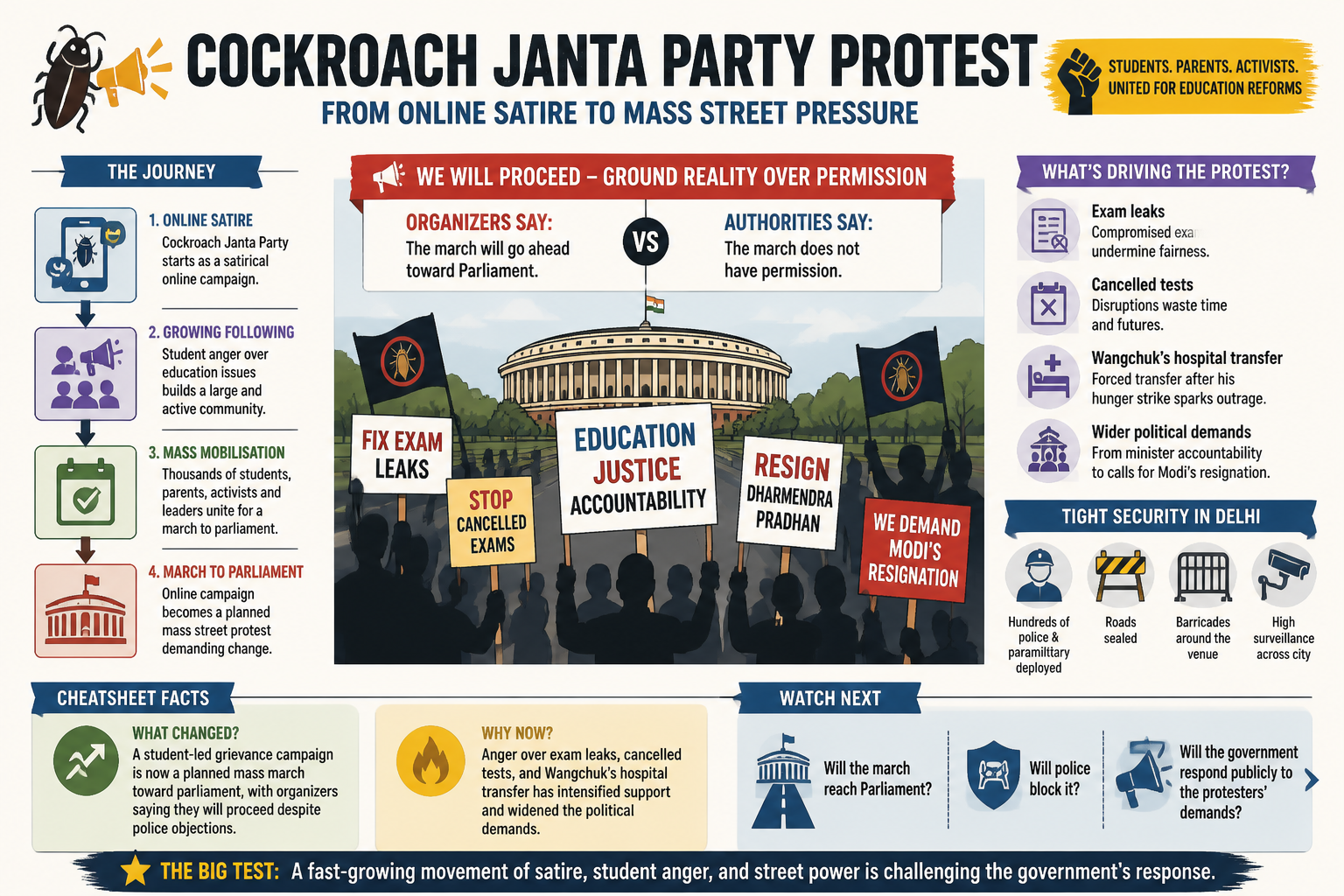
Thousands of students, parents, activists and political leaders are set to march toward the Indian parliament after a call from the Cockroach Janta Party for education reforms [5]. The protest follows chaos around activist Sonam Wangchuk’s hunger strike, his forced transfer to hospital, and a wider campaign focused on exam leaks, cancellations, and demands for Education Minister Dharmendra Pradhan to resign [5].
Why it matters: This has become a test of how the government responds to a fast-growing civil protest movement that mixes satire, student anger, and direct accountability demands [5]. The scale of the turnout, the heavy police deployment, and the march toward parliament show the issue has moved from online activism into a broader political challenge [5].
Key insights: The movement was founded as an online satirical campaign but has gained a large following and formal protest momentum [5]. | Authorities say the march does not have permission, yet organizers say it will proceed anyway [5]. | Security in Delhi has been tightened with hundreds of police and paramilitary personnel, sealed roads, and barricades around the venue [5]. | The protest agenda has broadened from education minister accountability to demands for Narendra Modi’s resignation after Wangchuk was forcibly taken to hospital [5].
Cheatsheet facts: What changed: A student-led grievance campaign is now a planned mass march toward parliament, with organizers saying they will proceed despite police objections [5]. | Why now: Anger over exam leaks, cancelled tests, and Wangchuk’s hospital transfer has intensified support and widened the political demands [5]. | Watch next: Whether the march reaches parliament, whether police block it, and whether the government responds publicly to the protesters’ demands [5].