Current AI is building open, public AI infrastructure for multilingual and community-controlled use
Nonprofit Current AI is trying to build what it describes as a public alternative to today’s private AI systems, including open infrastructure and locally controlled tools. Its recent work includes Suno Sutra, an offline device that runs AI in 22 Indian languages, plus grant-funded projects across…
Nonprofit Current AI is trying to build what it describes as a public alternative to today’s private AI systems, including open infrastructure and locally controlled tools. Its recent work includes Suno Sutra, an offline device that runs AI in 22 Indian languages, plus grant-funded projects across Kenya, Lebanon, the Brazilian Amazon, and an open-source chatbot launched at the AI for Good Summit in Geneva [2].
Why it matters: This matters because it represents a concrete counter-model to Big Tech’s closed AI platforms: public funding, open-source tools, and community data control. If it scales, the effort could broaden AI access for languages and communities that are currently underserved or excluded [2].
Key insights: Current AI says the goal is a public AI alternative “like the World Wide Web,” available to anyone for free [2]. | The nonprofit says the French government seeded it with $100 million and that total committed funding has reached $400 million from public and philanthropic backers [2]. | Its language-focused work is explicitly tied to cultural preservation, with Bdeir arguing that if AI cannot speak a community’s language, it cannot hold that culture either [2]. | Current AI says it stores models and data locally and uses consent protocols so communities can halt projects during the build process [2].
Cheatsheet facts: What changed: Current AI has moved from concept to deployment, with grants, an offline multilingual device, and an open-source chatbot already launched [2]. | Why now: The nonprofit is responding to the dominance of private AI systems and the risk that smaller languages and communities get left out [2]. | Watch next: Watch for more releases from the four grant-backed projects and whether Suno Sutra or similar tools are adopted in other regions [2].
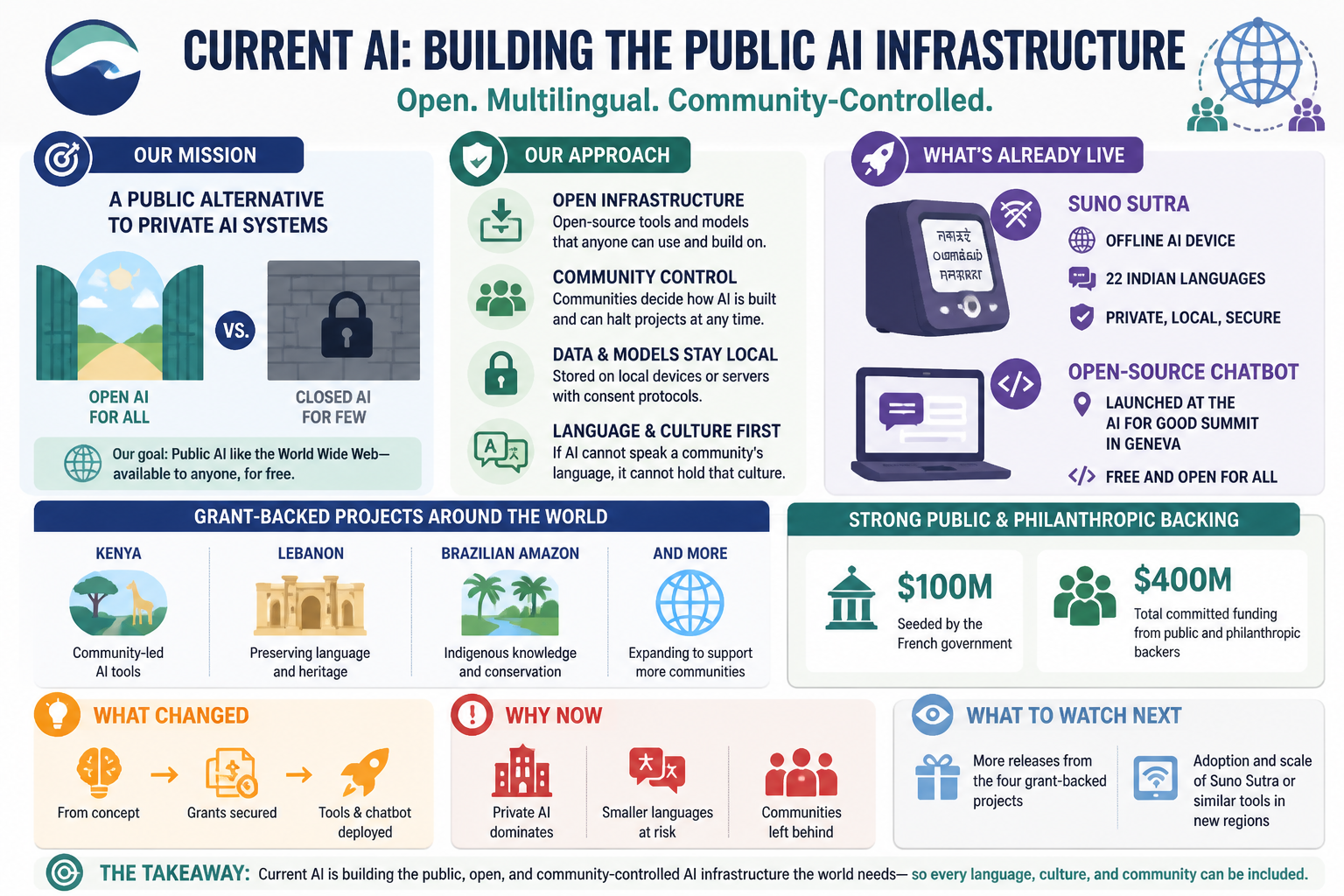
Nonprofit Current AI is trying to build what it describes as a public alternative to today’s private AI systems, including open infrastructure and locally controlled tools. Its recent work includes Suno Sutra, an offline device that runs AI in 22 Indian languages, plus grant-funded projects across Kenya, Lebanon, the Brazilian Amazon, and an open-source chatbot launched at the AI for Good Summit in Geneva [2].
Why it matters: This matters because it represents a concrete counter-model to Big Tech’s closed AI platforms: public funding, open-source tools, and community data control. If it scales, the effort could broaden AI access for languages and communities that are currently underserved or excluded [2].
Key insights: Current AI says the goal is a public AI alternative “like the World Wide Web,” available to anyone for free [2]. | The nonprofit says the French government seeded it with $100 million and that total committed funding has reached $400 million from public and philanthropic backers [2]. | Its language-focused work is explicitly tied to cultural preservation, with Bdeir arguing that if AI cannot speak a community’s language, it cannot hold that culture either [2]. | Current AI says it stores models and data locally and uses consent protocols so communities can halt projects during the build process [2].
Cheatsheet facts: What changed: Current AI has moved from concept to deployment, with grants, an offline multilingual device, and an open-source chatbot already launched [2]. | Why now: The nonprofit is responding to the dominance of private AI systems and the risk that smaller languages and communities get left out [2]. | Watch next: Watch for more releases from the four grant-backed projects and whether Suno Sutra or similar tools are adopted in other regions [2].