US and Iran escalate strikes around the Strait of Hormuz
The US says it carried out overnight strikes on dozens of Iranian military targets, including air-defense systems, coastal radar sites, and missile and drone capabilities, in response to Iranian attacks on commercial shipping in the Strait of Hormuz [1][3]. Iran’s IRGC then said it hit US bases in…
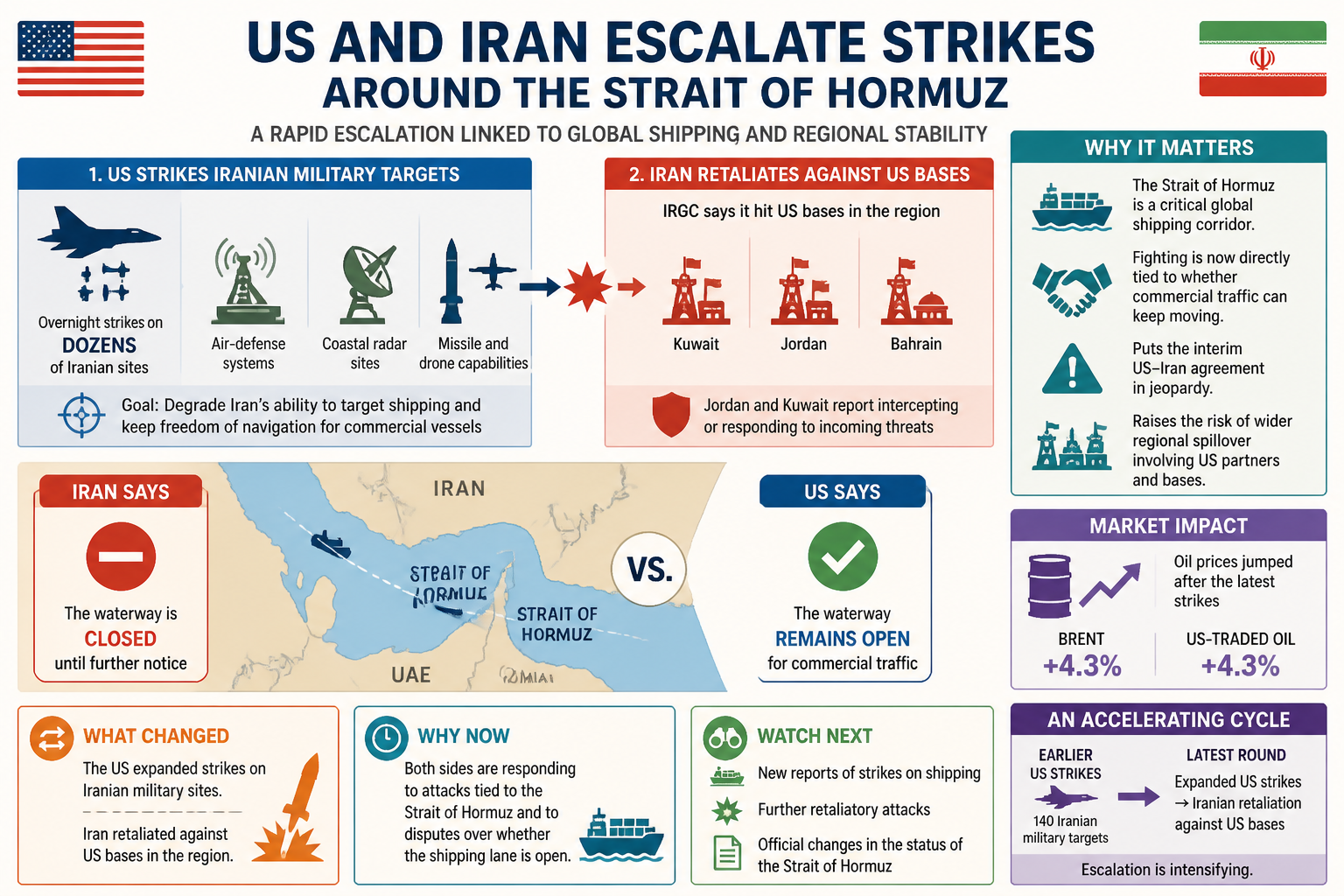
The US says it carried out overnight strikes on dozens of Iranian military targets, including air-defense systems, coastal radar sites, and missile and drone capabilities, in response to Iranian attacks on commercial shipping in the Strait of Hormuz [1][3]. Iran’s IRGC then said it hit US bases in Kuwait, Jordan, and Bahrain, while Jordan and Kuwait reported intercepting or responding to incoming threats [1][3].
Why it matters: The Strait of Hormuz is a critical global shipping corridor, and the reporting says the fighting is now directly tied to whether commercial traffic can keep moving through it [1][3]. The exchange also puts the interim US-Iran agreement in jeopardy and raises the risk of wider regional spillover involving US partners and bases [3].
Key insights: Centcom said the strikes were meant to degrade Iran’s ability to target shipping and to keep freedom of navigation available for commercial vessels [1][3]. | Iran says the waterway is closed until further notice, while the US insists it remains open [1][3]. | The BBC reports oil prices jumped after the latest strikes, with Brent and US-traded oil both up 4.3% [3]. | The reporting says the latest round followed earlier US strikes on 140 Iranian military targets, suggesting an accelerating cycle of retaliation [3].
Cheatsheet facts: What changed: The US expanded strikes on Iranian military sites and Iran retaliated against US bases in the region [1][3]. | Why now: Both sides are responding to attacks tied to the Strait of Hormuz and to disputes over whether the shipping lane is open [1][3]. | Watch next: Whether there are new reports of strikes on shipping, further retaliatory attacks, or official changes in the Strait of Hormuz’s status [1][3].
The US says it carried out overnight strikes on dozens of Iranian military targets, including air-defense systems, coastal radar sites, and missile and drone capabilities, in response to Iranian attacks on commercial shipping in the Strait of Hormuz [1][3]. Iran’s IRGC then said it hit US bases in Kuwait, Jordan, and Bahrain, while Jordan and Kuwait reported intercepting or responding to incoming threats [1][3].
Why it matters: The Strait of Hormuz is a critical global shipping corridor, and the reporting says the fighting is now directly tied to whether commercial traffic can keep moving through it [1][3]. The exchange also puts the interim US-Iran agreement in jeopardy and raises the risk of wider regional spillover involving US partners and bases [3].
Key insights: Centcom said the strikes were meant to degrade Iran’s ability to target shipping and to keep freedom of navigation available for commercial vessels [1][3]. | Iran says the waterway is closed until further notice, while the US insists it remains open [1][3]. | The BBC reports oil prices jumped after the latest strikes, with Brent and US-traded oil both up 4.3% [3]. | The reporting says the latest round followed earlier US strikes on 140 Iranian military targets, suggesting an accelerating cycle of retaliation [3].
Cheatsheet facts: What changed: The US expanded strikes on Iranian military sites and Iran retaliated against US bases in the region [1][3]. | Why now: Both sides are responding to attacks tied to the Strait of Hormuz and to disputes over whether the shipping lane is open [1][3]. | Watch next: Whether there are new reports of strikes on shipping, further retaliatory attacks, or official changes in the Strait of Hormuz’s status [1][3].