Iran weighs three risky paths as Hormuz becomes a lever in the war
After 10 days of strikes with the US over the Strait of Hormuz, Iran appears to face three options: accept Washington’s demands, escalate attacks, or keep pressure on shipping without triggering full-scale war [1]. The BBC says none offers a clear route to victory, and the longer the standoff lasts…
After 10 days of strikes with the US over the Strait of Hormuz, Iran appears to face three options: accept Washington’s demands, escalate attacks, or keep pressure on shipping without triggering full-scale war [1]. The BBC says none offers a clear route to victory, and the longer the standoff lasts, the more Iran risks sanctions, war damage and inflation at home [1].
Why it matters: The Strait of Hormuz is a global energy chokepoint, so Iran’s choices affect not just the war but international shipping, energy prices and the risk of broader regional conflict [1]. The piece also shows that any deal or escalation has internal political consequences inside Iran, especially if hardliners frame concessions as proof that US pressure works [1].
Key insights: Iran’s first option would trade freer shipping and nuclear limits for sanctions relief, but it is described as politically costly inside Tehran [1]. | A second option—intensifying attacks on US bases, shipping and Gulf infrastructure—carries the greatest military risk because it could draw in more regional actors [1]. | A third option is to preserve instability as leverage, but the BBC notes that this strategy could lose value if other countries find ways around Hormuz [1]. | Decision-making is unusually unclear after Ayatollah Ali Khamenei was killed in a strike and leadership shifted to Mojtaba Khamenei, with competing views from pragmatists, hardliners and the Revolutionary Guards [1].
Cheatsheet facts: What changed: Iran is being pressed into choosing among concession, escalation or managed instability in the Strait of Hormuz crisis [1]. | Why now: After 10 days of US-Iran strikes, shipping pressure and nuclear demands have converged into a high-stakes decision point [1]. | Watch next: Whether attacks on commercial shipping continue, and whether Tehran’s leaders publicly signal who is directing the response [1].
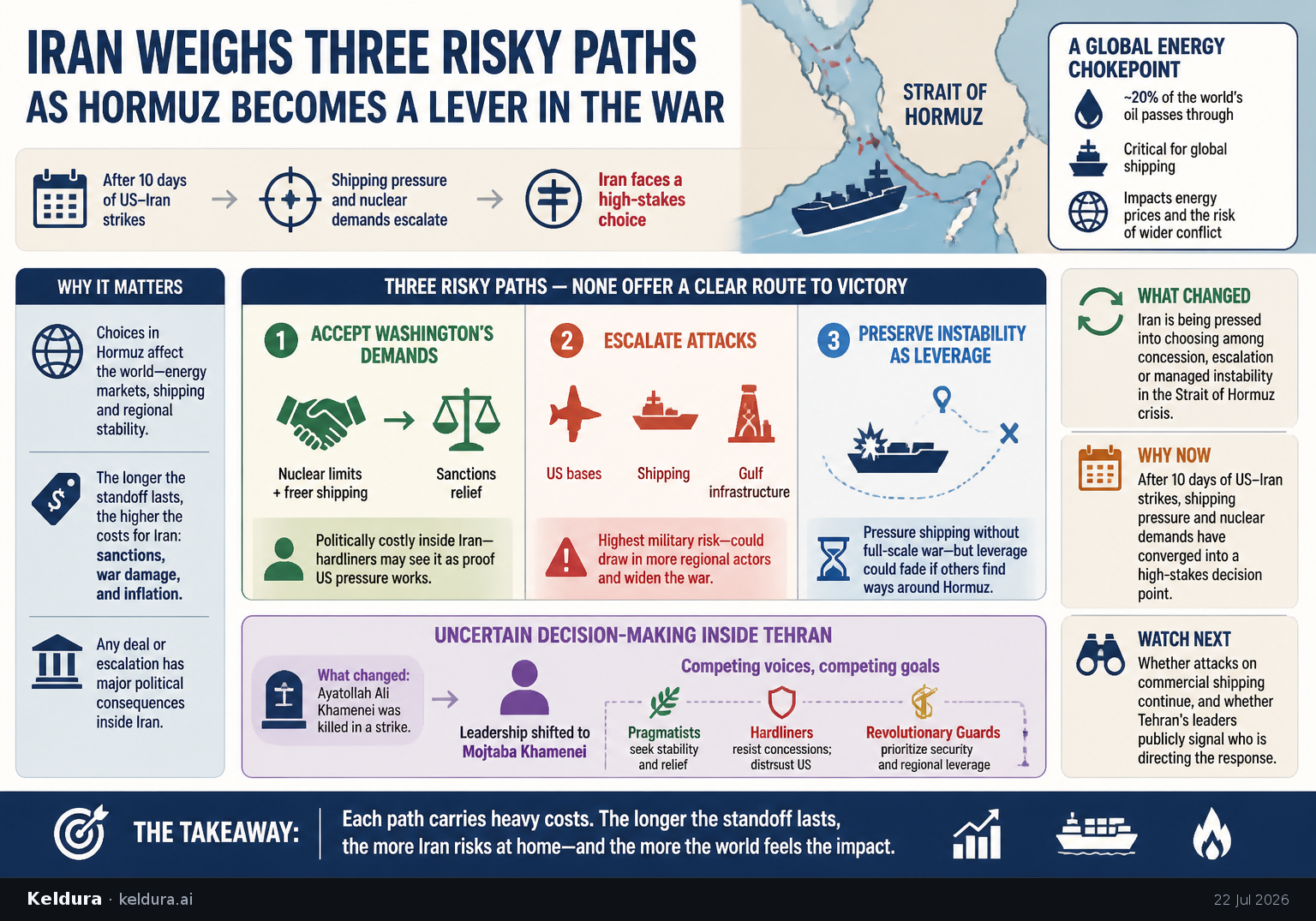
After 10 days of strikes with the US over the Strait of Hormuz, Iran appears to face three options: accept Washington’s demands, escalate attacks, or keep pressure on shipping without triggering full-scale war [1]. The BBC says none offers a clear route to victory, and the longer the standoff lasts, the more Iran risks sanctions, war damage and inflation at home [1].
Why it matters: The Strait of Hormuz is a global energy chokepoint, so Iran’s choices affect not just the war but international shipping, energy prices and the risk of broader regional conflict [1]. The piece also shows that any deal or escalation has internal political consequences inside Iran, especially if hardliners frame concessions as proof that US pressure works [1].
Key insights: Iran’s first option would trade freer shipping and nuclear limits for sanctions relief, but it is described as politically costly inside Tehran [1]. | A second option—intensifying attacks on US bases, shipping and Gulf infrastructure—carries the greatest military risk because it could draw in more regional actors [1]. | A third option is to preserve instability as leverage, but the BBC notes that this strategy could lose value if other countries find ways around Hormuz [1]. | Decision-making is unusually unclear after Ayatollah Ali Khamenei was killed in a strike and leadership shifted to Mojtaba Khamenei, with competing views from pragmatists, hardliners and the Revolutionary Guards [1].
Cheatsheet facts: What changed: Iran is being pressed into choosing among concession, escalation or managed instability in the Strait of Hormuz crisis [1]. | Why now: After 10 days of US-Iran strikes, shipping pressure and nuclear demands have converged into a high-stakes decision point [1]. | Watch next: Whether attacks on commercial shipping continue, and whether Tehran’s leaders publicly signal who is directing the response [1].