Weather forecasting faces new sabotage risks as AI gains ground
MIT Technology Review reports that weather predictions are becoming more vulnerable to manipulation as prediction markets and AI-driven forecasting increase the value of weather data. The article cites a recent case at Paris Charles de Gaulle Airport where a weather station was allegedly manipulate…
MIT Technology Review reports that weather predictions are becoming more vulnerable to manipulation as prediction markets and AI-driven forecasting increase the value of weather data. The article cites a recent case at Paris Charles de Gaulle Airport where a weather station was allegedly manipulated, leading to suspicious payouts in prediction markets, and warns that coordinated interference could eventually affect renewable energy trading, disaster readiness, or national security. [1]
Why it matters: Weather data is a hidden dependency for aviation, energy, farming, and emergency response, so even small integrity failures can ripple into economic loss and safety risks. The shift toward data-driven AI forecasting raises the stakes because these systems rely even more heavily on clean inputs and may weaken existing quality filters. [1]
Key insights: Traditional weather systems use data assimilation and cross-checks against nearby stations to catch errors, but those defenses can be too slow for live operations. [1] | The reported CDG Airport incident shows how relatively simple physical tampering can create market distortions and payout opportunities. [1] | AI forecasting models may skip or reduce some of the human and physical safeguards that currently help validate observations. [1] | The article frames the risk spectrum from individual fraud to compromised warning systems and national security concerns. [1]
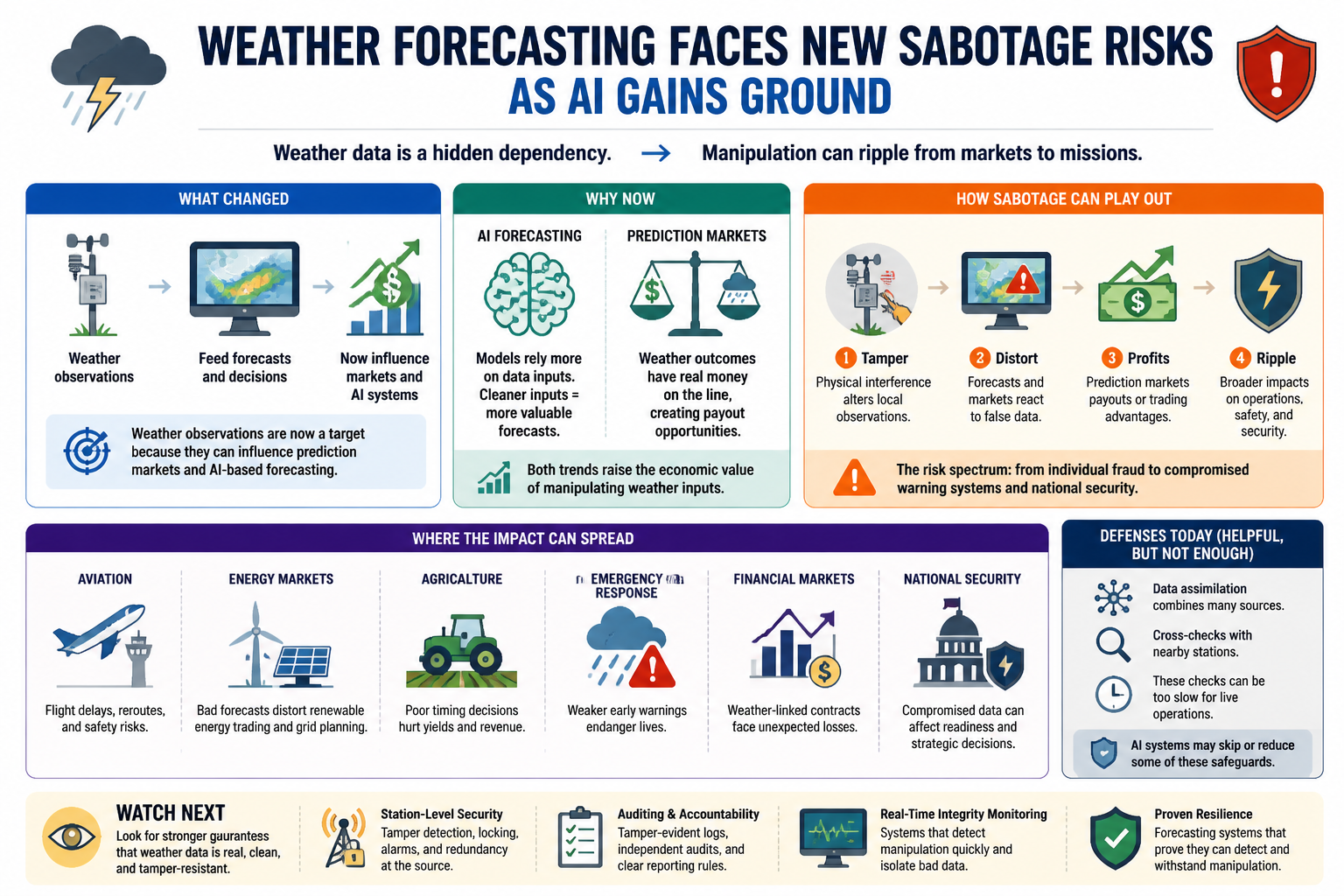
Cheatsheet facts: What changed: Weather observations are now a target because they can influence prediction markets and AI-based forecasting systems. [1] | Why now: AI models and prediction markets both increase the economic value of manipulating weather inputs. [1] | Watch next: Watch for new station-level tamper controls, auditing rules, or forecasting systems that prove they can detect manipulation in real time. [1]
MIT Technology Review reports that weather predictions are becoming more vulnerable to manipulation as prediction markets and AI-driven forecasting increase the value of weather data. The article cites a recent case at Paris Charles de Gaulle Airport where a weather station was allegedly manipulated, leading to suspicious payouts in prediction markets, and warns that coordinated interference could eventually affect renewable energy trading, disaster readiness, or national security. [1]
Why it matters: Weather data is a hidden dependency for aviation, energy, farming, and emergency response, so even small integrity failures can ripple into economic loss and safety risks. The shift toward data-driven AI forecasting raises the stakes because these systems rely even more heavily on clean inputs and may weaken existing quality filters. [1]
Key insights: Traditional weather systems use data assimilation and cross-checks against nearby stations to catch errors, but those defenses can be too slow for live operations. [1] | The reported CDG Airport incident shows how relatively simple physical tampering can create market distortions and payout opportunities. [1] | AI forecasting models may skip or reduce some of the human and physical safeguards that currently help validate observations. [1] | The article frames the risk spectrum from individual fraud to compromised warning systems and national security concerns. [1]
Cheatsheet facts: What changed: Weather observations are now a target because they can influence prediction markets and AI-based forecasting systems. [1] | Why now: AI models and prediction markets both increase the economic value of manipulating weather inputs. [1] | Watch next: Watch for new station-level tamper controls, auditing rules, or forecasting systems that prove they can detect manipulation in real time. [1]