Bangladesh broadens dengue response beyond the health sector
WHO convened Bangladesh government agencies, health and development partners, local authorities, NGOs and academics on August 24 to coordinate dengue prevention and control.[5] Current measures include dedicated dengue corners in government hospitals, updated clinical-management training, community…
WHO convened Bangladesh government agencies, health and development partners, local authorities, NGOs and academics on August 24 to coordinate dengue prevention and control.[5] Current measures include dedicated dengue corners in government hospitals, updated clinical-management training, community cleanup, insecticide evaluation and plans for stronger vector surveillance and an early warning system.[5]
Why it matters: Dengue transmission reflects interactions among the virus, Aedes mosquitoes, people and environmental, climatic and social conditions, making health-sector action alone insufficient.[5] Coordinated surveillance, clinical care and removal of breeding sites can address both transmission and the risk of severe illness and death.[5]
Key insights: Bangladesh’s Directorate General of Health Services instructed government hospitals to maintain clean environments, create dedicated dengue corners and increase awareness work, including in schools.[5] | The Institute of Epidemiology, Disease Control and Research tested approved insecticides for biological efficacy and issued recommendations on their use.[5] | Participants prioritized plastic-waste-linked breeding sites, hard-to-reach urban areas and better use of surveillance data.[5]
Cheatsheet facts: What changed: Bangladesh’s dengue response is being organized as a whole-of-government and whole-of-society effort rather than solely a clinical campaign.[5] | Why now: Officials describe dengue as a major public-health concern shaped by environmental, climatic and social factors as well as mosquito and human behavior.[5] | Watch next: Watch implementation of the Local Government Division’s planned vector-surveillance and early warning system.[5]
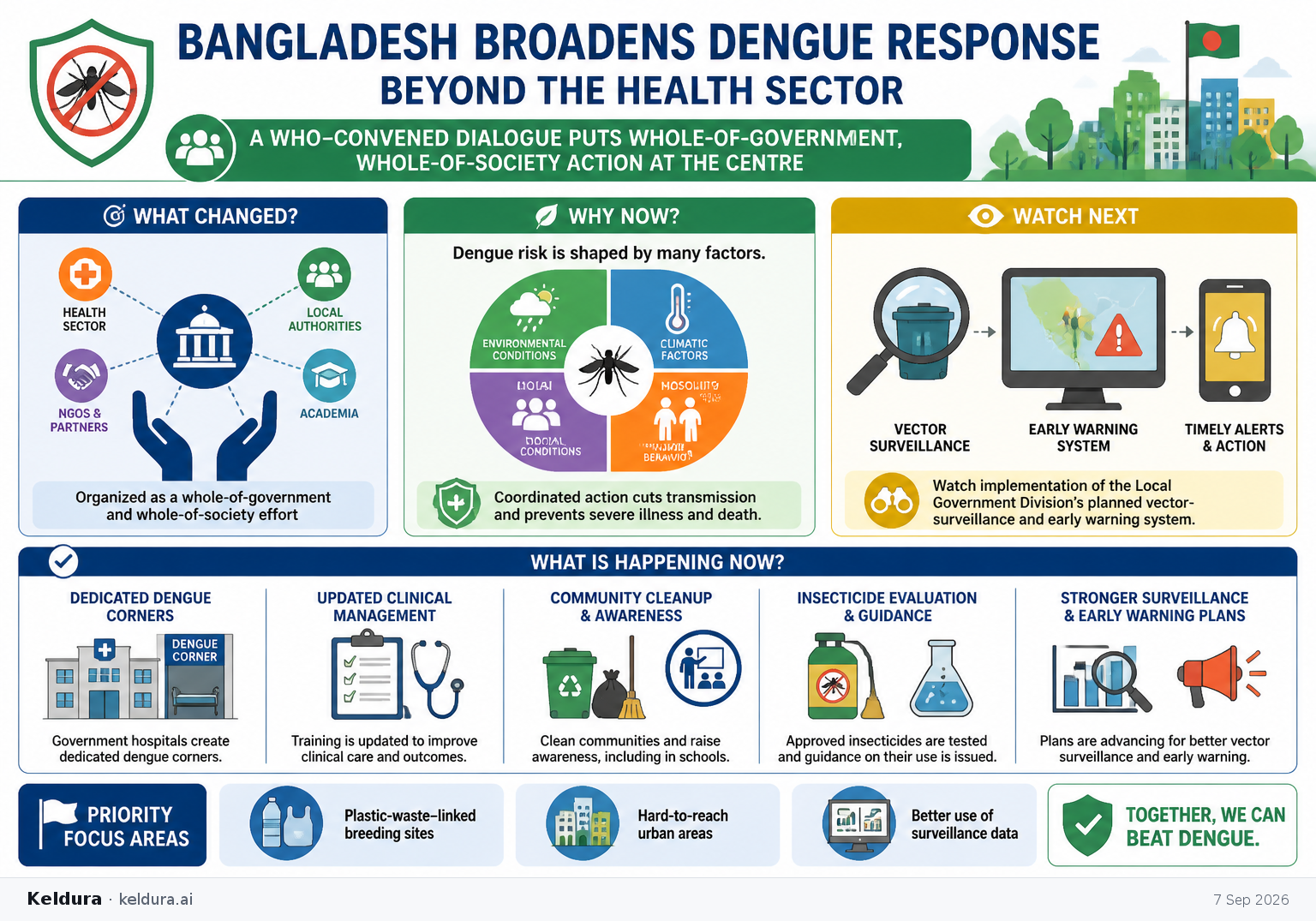
WHO convened Bangladesh government agencies, health and development partners, local authorities, NGOs and academics on August 24 to coordinate dengue prevention and control.[5] Current measures include dedicated dengue corners in government hospitals, updated clinical-management training, community cleanup, insecticide evaluation and plans for stronger vector surveillance and an early warning system.[5]
Why it matters: Dengue transmission reflects interactions among the virus, Aedes mosquitoes, people and environmental, climatic and social conditions, making health-sector action alone insufficient.[5] Coordinated surveillance, clinical care and removal of breeding sites can address both transmission and the risk of severe illness and death.[5]
Key insights: Bangladesh’s Directorate General of Health Services instructed government hospitals to maintain clean environments, create dedicated dengue corners and increase awareness work, including in schools.[5] | The Institute of Epidemiology, Disease Control and Research tested approved insecticides for biological efficacy and issued recommendations on their use.[5] | Participants prioritized plastic-waste-linked breeding sites, hard-to-reach urban areas and better use of surveillance data.[5]
Cheatsheet facts: What changed: Bangladesh’s dengue response is being organized as a whole-of-government and whole-of-society effort rather than solely a clinical campaign.[5] | Why now: Officials describe dengue as a major public-health concern shaped by environmental, climatic and social factors as well as mosquito and human behavior.[5] | Watch next: Watch implementation of the Local Government Division’s planned vector-surveillance and early warning system.[5]