Post-training vagus nerve stimulation strengthens motor learning in mice
Tohoku University researchers found that vagus nerve stimulation delivered after training produced stronger motor-learning retention in mice over subsequent days.[3] Because stimulation provided no immediate practice benefit, the researchers concluded that it acted on post-training memory consolida…
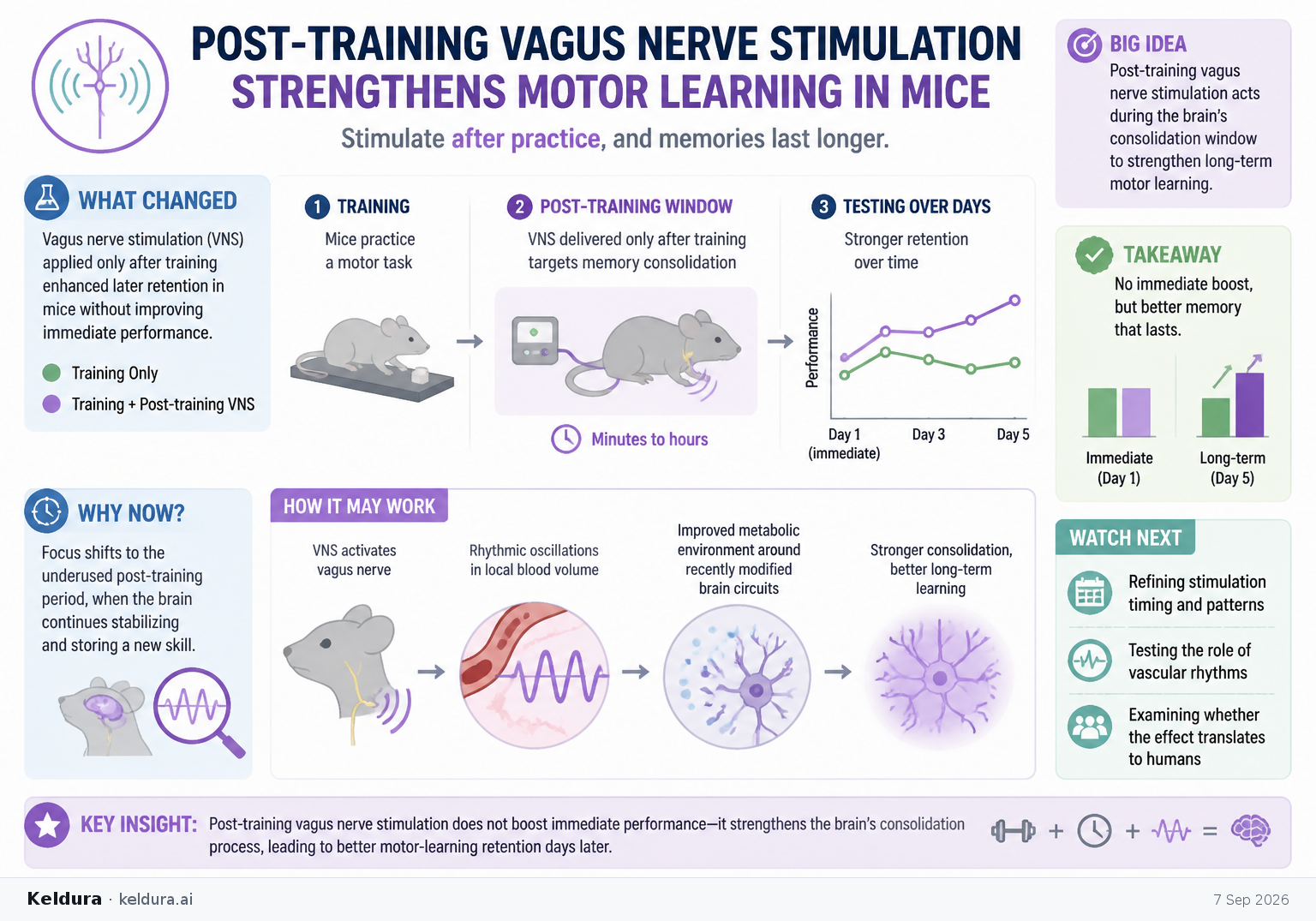
Tohoku University researchers found that vagus nerve stimulation delivered after training produced stronger motor-learning retention in mice over subsequent days.[3] Because stimulation provided no immediate practice benefit, the researchers concluded that it acted on post-training memory consolidation rather than moment-to-moment performance.[3]
Why it matters: The study shifts attention to the biological window after practice, when the brain continues preserving a newly acquired skill.[3] It does not yet demonstrate improved human learning, but it offers a testable route for studying how brain-body signaling and vascular activity influence durable memory.[3]
Key insights: Repeated stimulation generated rhythmic oscillations in local blood volume, and larger oscillations were associated with stronger learning on Day 5.[3] | The findings suggest that vagus nerve stimulation may support consolidation partly by changing the metabolic environment around recently modified brain circuits.[3] | The research was published in iScience as “Vagal nerve stimulation induces vascular oscillations and enhances long-term learning.”[3]
Cheatsheet facts: What changed: Vagus nerve stimulation applied only after training enhanced later retention in mice without improving immediate task performance.[3] | Why now: The results point to a previously underused post-training period in which stimulation may influence long-term plasticity.[3] | Watch next: Watch studies refining stimulation timing and patterns, testing the role of vascular rhythms and examining whether the effect translates to humans.[3]
Tohoku University researchers found that vagus nerve stimulation delivered after training produced stronger motor-learning retention in mice over subsequent days.[3] Because stimulation provided no immediate practice benefit, the researchers concluded that it acted on post-training memory consolidation rather than moment-to-moment performance.[3]
Why it matters: The study shifts attention to the biological window after practice, when the brain continues preserving a newly acquired skill.[3] It does not yet demonstrate improved human learning, but it offers a testable route for studying how brain-body signaling and vascular activity influence durable memory.[3]
Key insights: Repeated stimulation generated rhythmic oscillations in local blood volume, and larger oscillations were associated with stronger learning on Day 5.[3] | The findings suggest that vagus nerve stimulation may support consolidation partly by changing the metabolic environment around recently modified brain circuits.[3] | The research was published in iScience as “Vagal nerve stimulation induces vascular oscillations and enhances long-term learning.”[3]
Cheatsheet facts: What changed: Vagus nerve stimulation applied only after training enhanced later retention in mice without improving immediate task performance.[3] | Why now: The results point to a previously underused post-training period in which stimulation may influence long-term plasticity.[3] | Watch next: Watch studies refining stimulation timing and patterns, testing the role of vascular rhythms and examining whether the effect translates to humans.[3]