Thailand wins verification for eliminating endemic rubella
WHO has verified Thailand as having eliminated rubella as a public health problem, making it the seventh country in the WHO South-East Asia Region to achieve rubella elimination.[1] The decision followed review of surveillance, molecular epidemiology, immunization, outbreak-response and programme-p…
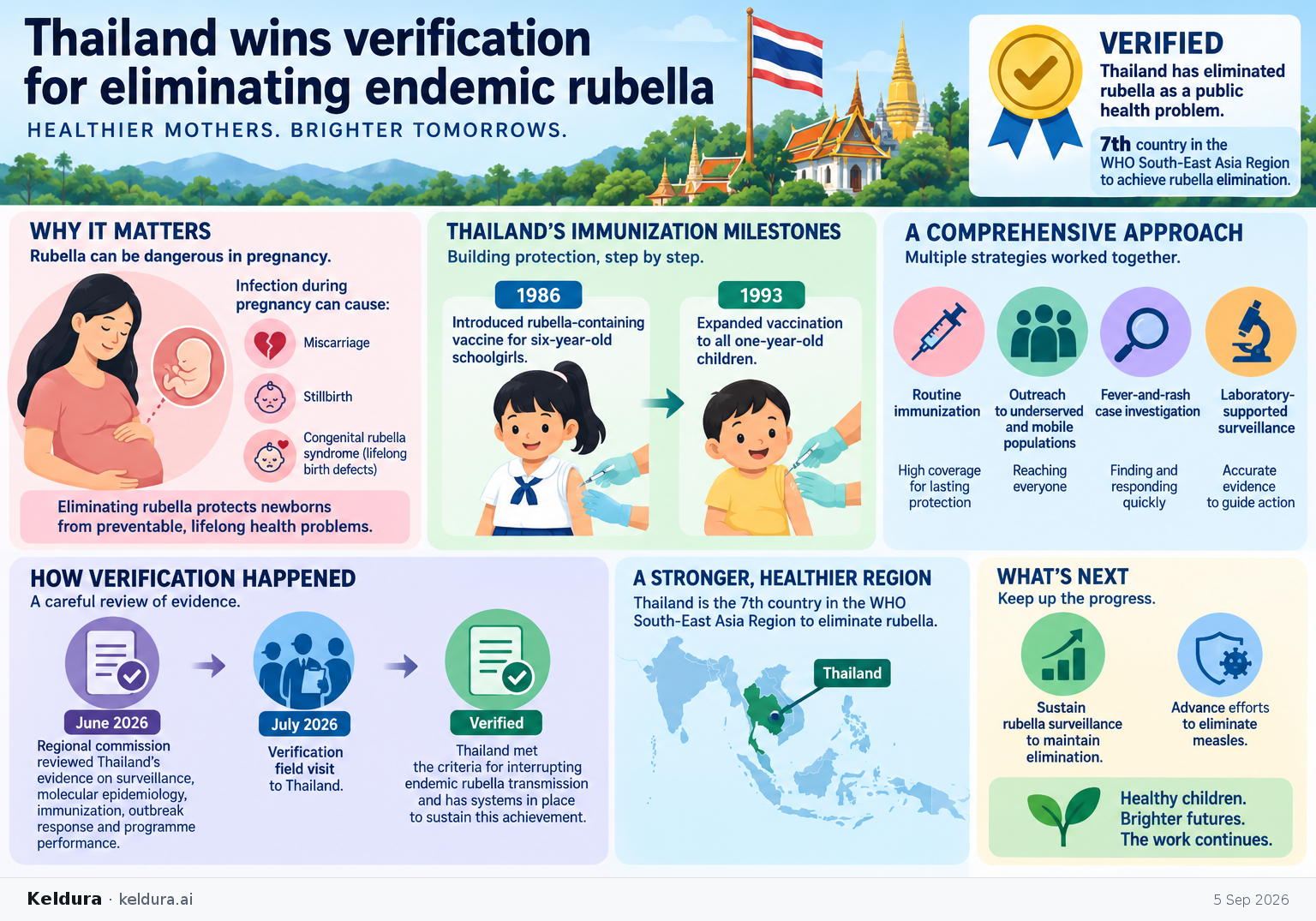
WHO has verified Thailand as having eliminated rubella as a public health problem, making it the seventh country in the WHO South-East Asia Region to achieve rubella elimination.[1] The decision followed review of surveillance, molecular epidemiology, immunization, outbreak-response and programme-performance evidence, plus a field visit in July 2026.[1]
Why it matters: Rubella infection during pregnancy can cause miscarriage, stillbirth or congenital rubella syndrome, so interrupting endemic transmission protects newborns from preventable lifelong birth defects.[1]
Key insights: Thailand introduced rubella-containing vaccine for six-year-old schoolgirls in 1986 and expanded vaccination to all one-year-old children in 1993.[1] | The programme combined routine immunization with outreach to underserved and mobile populations, fever-and-rash case investigation and laboratory-supported surveillance.[1] | Verification means Thailand has met the criteria for interrupting endemic rubella transmission and has systems in place to sustain that achievement.[1]
Cheatsheet facts: What changed: Thailand became the seventh country in the WHO South-East Asia Region verified for rubella elimination.[1] | Why now: A regional commission reviewed Thailand’s evidence in June 2026, followed by a verification field visit in July.[1] | Watch next: Watch whether Thailand sustains rubella surveillance and advances its stated effort to eliminate measles.[1]