WHO opens its first prequalification route for childhood cancer medicines
WHO issued its first invitation for manufacturers of childhood cancer medicines to submit products to the WHO Prequalification Programme.[4] The invitation covers 12 essential medicines: six needing child-friendly formulations and six affected by documented access and supply gaps.[4]
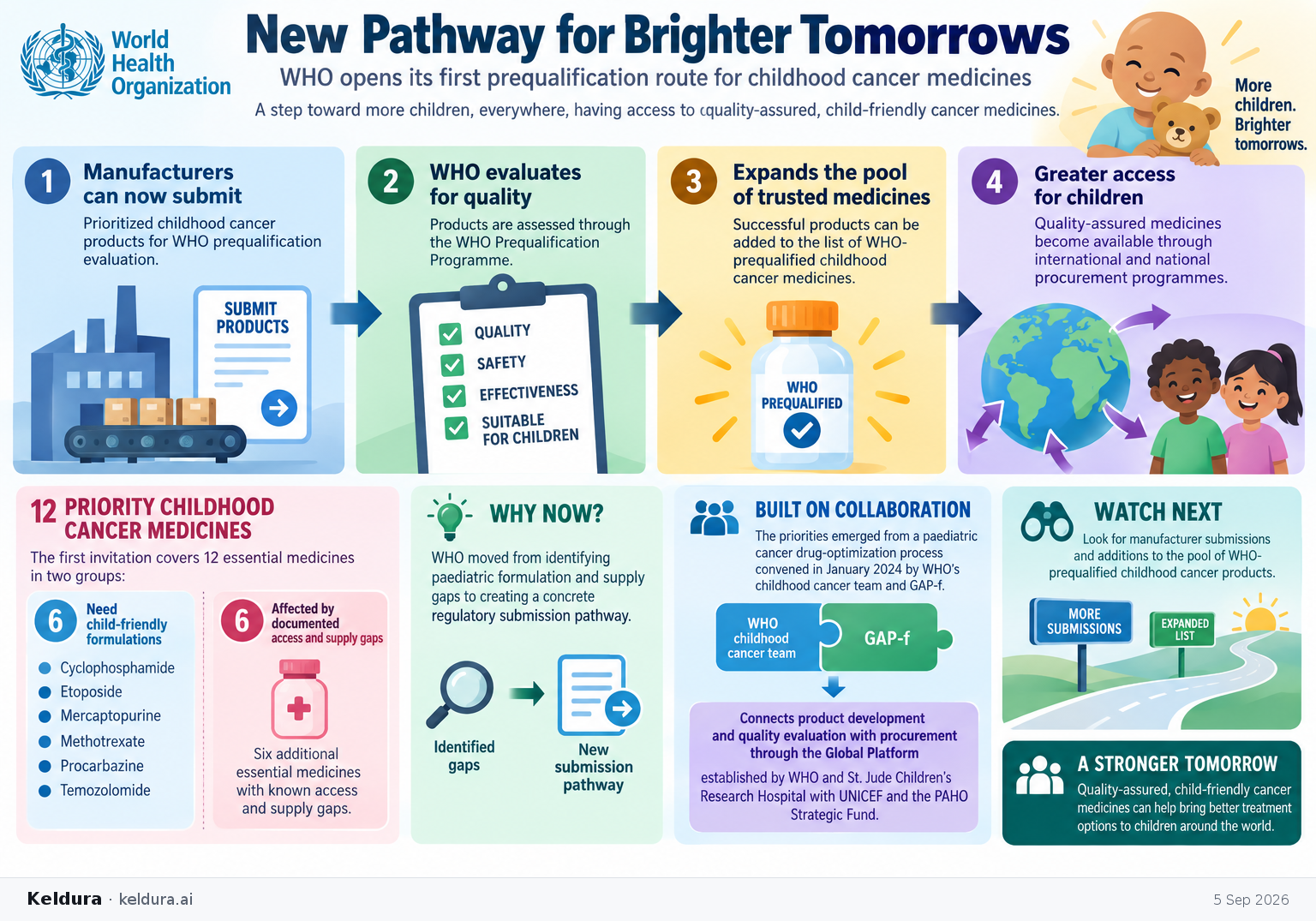
WHO issued its first invitation for manufacturers of childhood cancer medicines to submit products to the WHO Prequalification Programme.[4] The invitation covers 12 essential medicines: six needing child-friendly formulations and six affected by documented access and supply gaps.[4]
Why it matters: The new pathway could enlarge the pool of quality-assured childhood cancer medicines available to international and national procurement programmes.[4]
Key insights: The six medicines lacking suitable child-friendly formulations are cyclophosphamide, etoposide, mercaptopurine, methotrexate, procarbazine and temozolomide.[4] | The priorities emerged from a paediatric cancer drug-optimization process convened by WHO’s childhood cancer team and GAP‑f in January 2024.[4] | The initiative connects product development and quality evaluation with procurement through the Global Platform established by WHO and St. Jude Children’s Research Hospital with UNICEF and the PAHO Strategic Fund.[4]
Cheatsheet facts: What changed: Manufacturers can now submit prioritized childhood cancer products for WHO prequalification evaluation.[4] | Why now: WHO moved from identifying paediatric formulation and supply gaps to creating a concrete regulatory submission pathway.[4] | Watch next: Watch for manufacturer submissions and additions to the pool of WHO-prequalified childhood cancer products.[4]