Suno music gets a defense case: AI output that doesn’t sound like slop
The Verge says 1010Benja’s song “Semiramis’ Dream” on the EP Time Has Nothing To Do With What You Choose… shows Suno can be more than a “slop engine” in the right hands [1]. The piece says Benja wrote the lyrics, recorded vocals, worked with collaborators, and then iterated with Suno and Ableton hu…
The Verge says 1010Benja’s song “Semiramis’ Dream” on the EP Time Has Nothing To Do With What You Choose… shows Suno can be more than a “slop engine” in the right hands [1]. The piece says Benja wrote the lyrics, recorded vocals, worked with collaborators, and then iterated with Suno and Ableton hundreds of times, with the result marked as AI-generated in Deezer [1].
Why it matters: The story matters because it complicates the common framing of generative music as either fully synthetic junk or fully human art; here, the process is hybrid, iterative, and openly labeled [1]. It also suggests the quality debate around AI music may hinge as much on artistic direction and human input as on the model itself [1].
Key insights: Benja’s workflow involved repeated back-and-forth editing between Suno and Ableton, not a single prompt-and-publish moment [1]. | The song’s most obviously AI-sounding element, the backup choir, was masked by hyperpop-style processing [1]. | The article says Benja is not hiding the AI use; Deezer marks the track as AI-generated [1]. | The piece still notes that the sonic result may be achievable without AI, underscoring that the novelty is partly production workflow, not only sound [1].
Cheatsheet facts: What changed: A Verge review argues one Suno-made track is genuinely enjoyable and not easily dismissed as generic AI output [1]. | Why now: The track is part of a new EP built through a highly iterative human-plus-AI workflow, and the artist is openly acknowledging that process [1]. | Watch next: Whether more artists adopt similarly hybrid, transparently labeled Suno workflows [1].
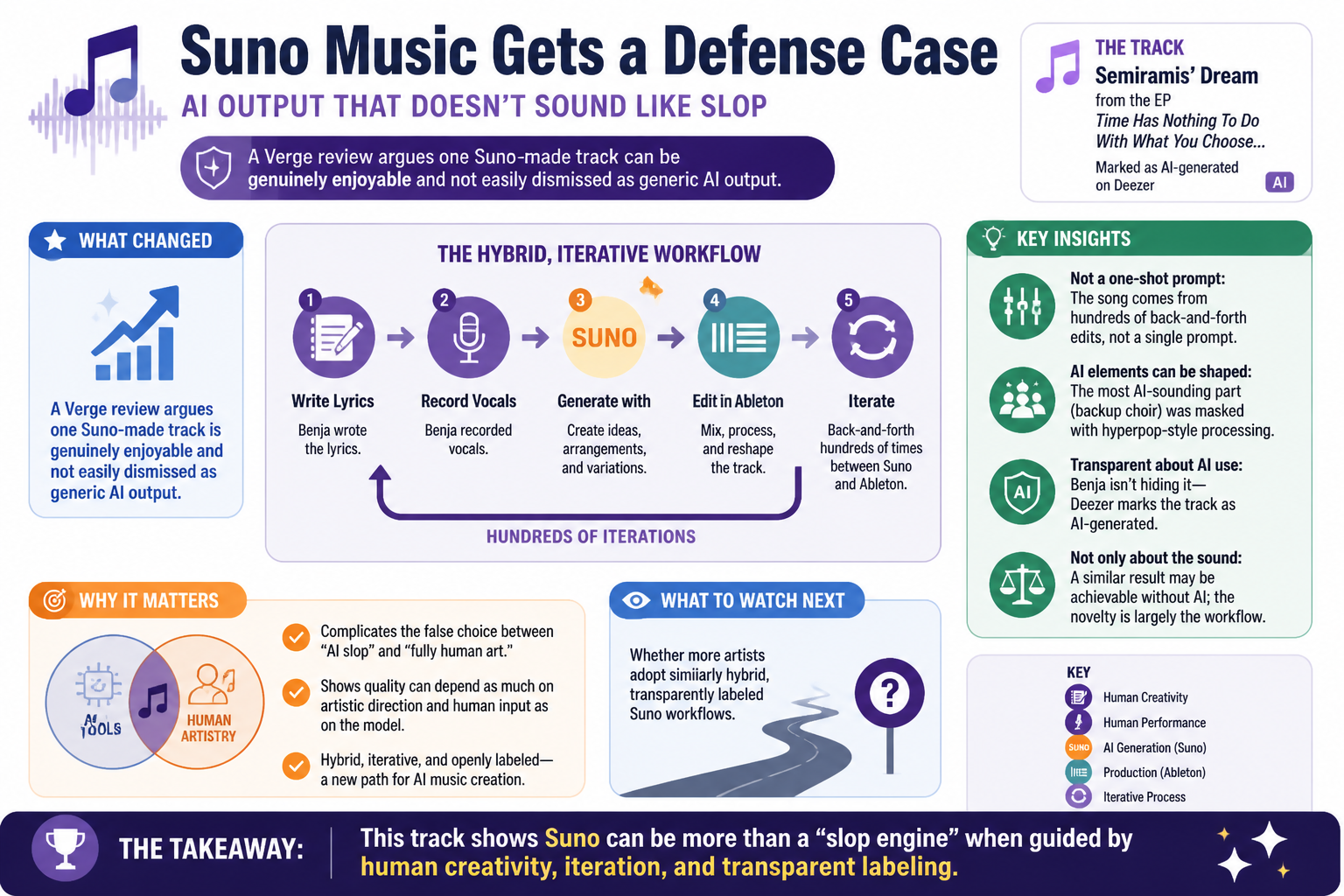
The Verge says 1010Benja’s song “Semiramis’ Dream” on the EP Time Has Nothing To Do With What You Choose… shows Suno can be more than a “slop engine” in the right hands [1]. The piece says Benja wrote the lyrics, recorded vocals, worked with collaborators, and then iterated with Suno and Ableton hundreds of times, with the result marked as AI-generated in Deezer [1].
Why it matters: The story matters because it complicates the common framing of generative music as either fully synthetic junk or fully human art; here, the process is hybrid, iterative, and openly labeled [1]. It also suggests the quality debate around AI music may hinge as much on artistic direction and human input as on the model itself [1].
Key insights: Benja’s workflow involved repeated back-and-forth editing between Suno and Ableton, not a single prompt-and-publish moment [1]. | The song’s most obviously AI-sounding element, the backup choir, was masked by hyperpop-style processing [1]. | The article says Benja is not hiding the AI use; Deezer marks the track as AI-generated [1]. | The piece still notes that the sonic result may be achievable without AI, underscoring that the novelty is partly production workflow, not only sound [1].
Cheatsheet facts: What changed: A Verge review argues one Suno-made track is genuinely enjoyable and not easily dismissed as generic AI output [1]. | Why now: The track is part of a new EP built through a highly iterative human-plus-AI workflow, and the artist is openly acknowledging that process [1]. | Watch next: Whether more artists adopt similarly hybrid, transparently labeled Suno workflows [1].