Meta rolls out Content Seal, but AI watermarking still looks fragmented
Meta introduced Content Seal, an invisible watermarking system for images generated by its Muse model, but the feature is currently limited and is being tested through a dedicated web tool [7]. The system is intended to help flag AI-generated images even after cropping, compression, resizing, or sc…
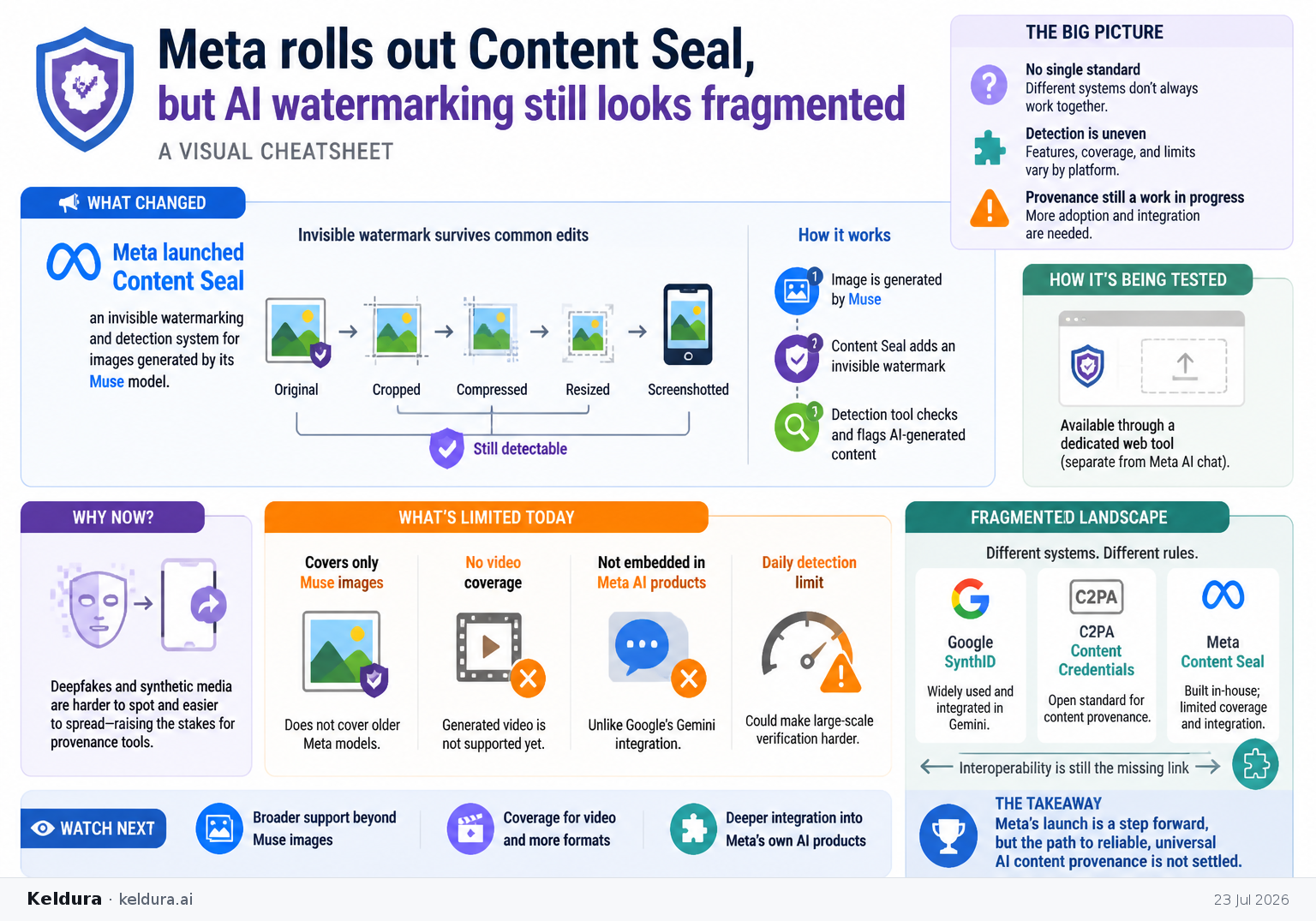
Meta introduced Content Seal, an invisible watermarking system for images generated by its Muse model, but the feature is currently limited and is being tested through a dedicated web tool [7]. The system is intended to help flag AI-generated images even after cropping, compression, resizing, or screenshots, but it currently does not cover older Meta models or generated video [7].
Why it matters: AI provenance tools matter because deepfakes and synthetic media are becoming harder to spot and easier to distribute. Meta’s launch shows the industry still lacks a clean, interoperable standard, leaving detection uneven across platforms and workflows [7].
Key insights: Meta had a mandate from its Oversight Board to use its own tools to reduce deceptive generative AI content, which helps explain the launch [7]. | The Verge notes that existing standards like C2PA Content Credentials and Google’s SynthID were already available, raising questions about why Meta built its own system [7]. | Detection is not yet embedded in Meta AI chat experiences the way Google integrates SynthID detection in Gemini [7]. | Meta’s daily limit on detection checks could make large-scale verification harder than more open alternatives [7].
Cheatsheet facts: What changed: Meta launched Content Seal, an invisible watermarking and detection system for Muse-generated images [7]. | Why now: Pressure for better labeling of AI-generated content has increased as deceptive synthetic media spreads [7]. | Watch next: Look for broader support beyond Muse images, including video coverage and integration into Meta’s own AI products [7].
Meta introduced Content Seal, an invisible watermarking system for images generated by its Muse model, but the feature is currently limited and is being tested through a dedicated web tool [7]. The system is intended to help flag AI-generated images even after cropping, compression, resizing, or screenshots, but it currently does not cover older Meta models or generated video [7].
Why it matters: AI provenance tools matter because deepfakes and synthetic media are becoming harder to spot and easier to distribute. Meta’s launch shows the industry still lacks a clean, interoperable standard, leaving detection uneven across platforms and workflows [7].
Key insights: Meta had a mandate from its Oversight Board to use its own tools to reduce deceptive generative AI content, which helps explain the launch [7]. | The Verge notes that existing standards like C2PA Content Credentials and Google’s SynthID were already available, raising questions about why Meta built its own system [7]. | Detection is not yet embedded in Meta AI chat experiences the way Google integrates SynthID detection in Gemini [7]. | Meta’s daily limit on detection checks could make large-scale verification harder than more open alternatives [7].
Cheatsheet facts: What changed: Meta launched Content Seal, an invisible watermarking and detection system for Muse-generated images [7]. | Why now: Pressure for better labeling of AI-generated content has increased as deceptive synthetic media spreads [7]. | Watch next: Look for broader support beyond Muse images, including video coverage and integration into Meta’s own AI products [7].