Ukraine opens battlefield drone data to military and commercial AI developers
Ukraine’s Ministry of Defense is making millions of data points from tens of thousands of drone flights available to military contractors and commercial companies; more than 100 companies and the UK government have gained access.[5] The records provide difficult-to-reproduce battlefield training co…
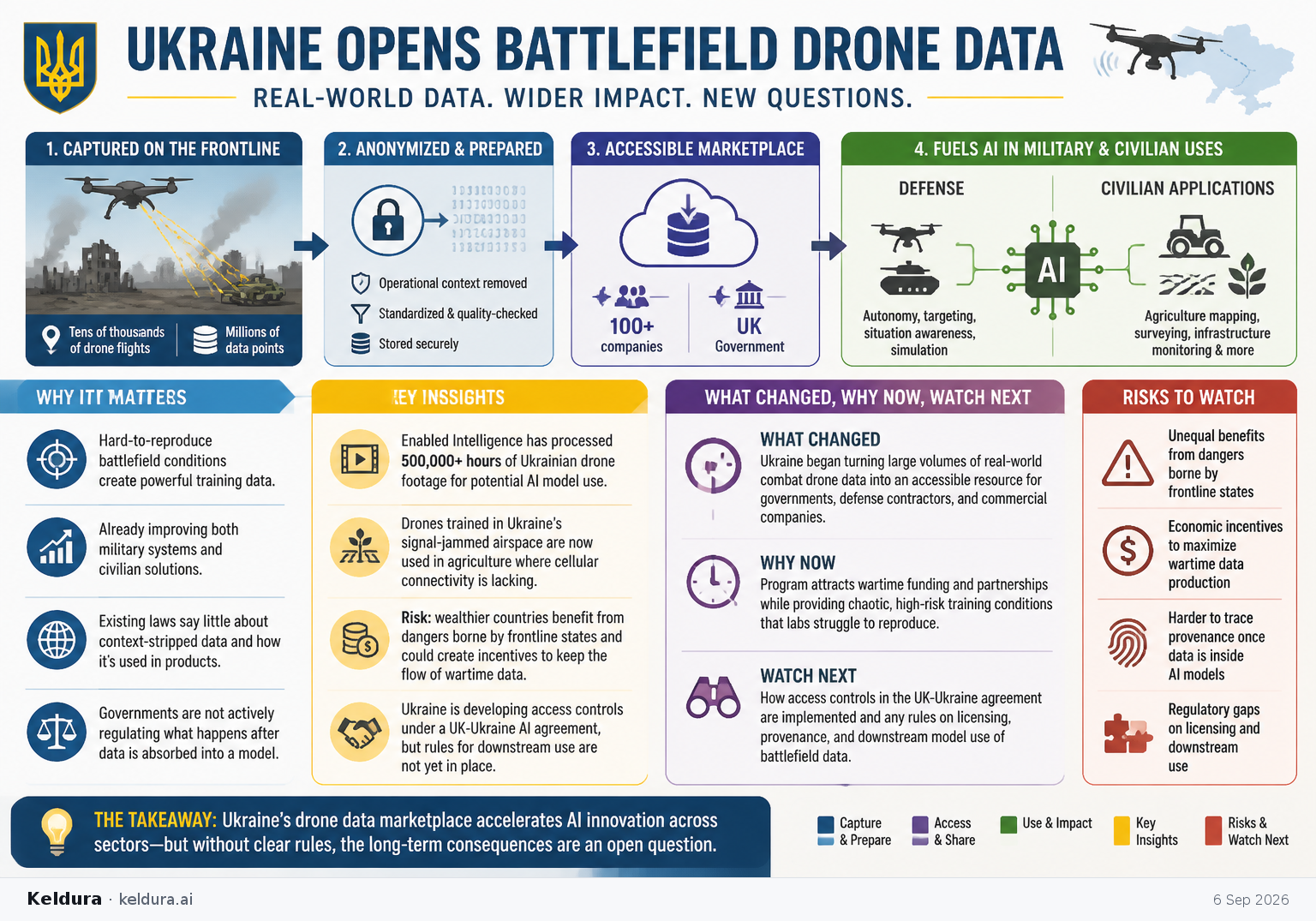
Ukraine’s Ministry of Defense is making millions of data points from tens of thousands of drone flights available to military contractors and commercial companies; more than 100 companies and the UK government have gained access.[5] The records provide difficult-to-reproduce battlefield training conditions and are already feeding both defense and civilian applications, but their commercialization is moving ahead without a settled regulatory framework.[5]
Why it matters: Combat data can improve autonomous systems far beyond the battlefield, yet existing laws say little about records stripped of their operational context and licensed into products whose training-data provenance may become difficult to trace.[5]
Key insights: Enabled Intelligence says it has processed more than half a million hours of Ukrainian drone footage for potential use in military and commercial AI models.[5] | Drones trained in Ukraine’s signal-jammed airspace are being deployed in agriculture to map and survey areas where earlier technology lacked sufficient cellular connectivity.[5] | The marketplace creates a risk that wealthier countries benefit from dangers borne by frontline states and could introduce economic incentives around the continued production of wartime data.[5] | Ukraine is developing access controls referenced in a UK-Ukraine AI agreement, but governments are not actively regulating what happens after the data has been absorbed into a model.[5]
Cheatsheet facts: What changed: Ukraine began turning large volumes of real-world combat drone data into an accessible resource for governments, defense contractors and commercial companies.[5] | Why now: The program can attract wartime funding and partnerships while providing chaotic, high-risk training conditions that laboratories struggle to reproduce.[5] | Watch next: Implementation of the UK-Ukraine agreement’s access controls and any rules governing licensing, provenance and downstream model use of battlefield data.[5]
Ukraine’s Ministry of Defense is making millions of data points from tens of thousands of drone flights available to military contractors and commercial companies; more than 100 companies and the UK government have gained access.[5] The records provide difficult-to-reproduce battlefield training conditions and are already feeding both defense and civilian applications, but their commercialization is moving ahead without a settled regulatory framework.[5]
Why it matters: Combat data can improve autonomous systems far beyond the battlefield, yet existing laws say little about records stripped of their operational context and licensed into products whose training-data provenance may become difficult to trace.[5]
Key insights: Enabled Intelligence says it has processed more than half a million hours of Ukrainian drone footage for potential use in military and commercial AI models.[5] | Drones trained in Ukraine’s signal-jammed airspace are being deployed in agriculture to map and survey areas where earlier technology lacked sufficient cellular connectivity.[5] | The marketplace creates a risk that wealthier countries benefit from dangers borne by frontline states and could introduce economic incentives around the continued production of wartime data.[5] | Ukraine is developing access controls referenced in a UK-Ukraine AI agreement, but governments are not actively regulating what happens after the data has been absorbed into a model.[5]
Cheatsheet facts: What changed: Ukraine began turning large volumes of real-world combat drone data into an accessible resource for governments, defense contractors and commercial companies.[5] | Why now: The program can attract wartime funding and partnerships while providing chaotic, high-risk training conditions that laboratories struggle to reproduce.[5] | Watch next: Implementation of the UK-Ukraine agreement’s access controls and any rules governing licensing, provenance and downstream model use of battlefield data.[5]