Plug-In Solar Gains a Regulatory Foothold in the US
Low-cost plug-in solar systems, already used in Europe, are spreading in the US as states create rules that treat qualifying systems more like household appliances than conventional rooftop installations [8]. Kits can start around $300, compared with roughly $15,000 for contractor-installed rooftop…
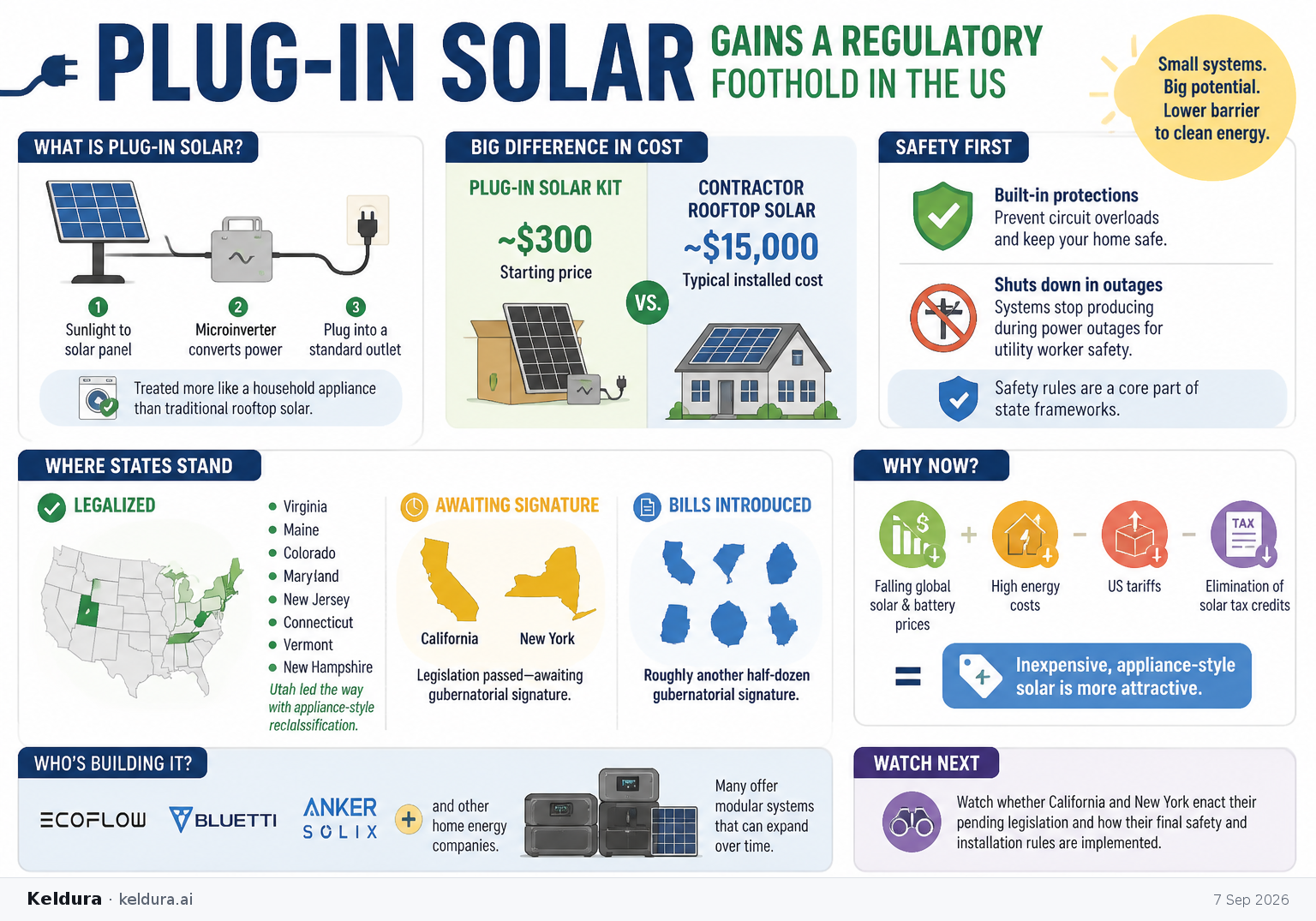
Low-cost plug-in solar systems, already used in Europe, are spreading in the US as states create rules that treat qualifying systems more like household appliances than conventional rooftop installations [8]. Kits can start around $300, compared with roughly $15,000 for contractor-installed rooftop solar, and more than a dozen states have passed legislation or introduced bills addressing their deployment [8].
Why it matters: Plug-in solar could lower the financial and procedural barriers to home energy generation for renters and budget-conscious households, provided systems meet protections against circuit overloads and continue to shut down during outages for worker safety [8].
Key insights: Plug-in solar is legal in Virginia, Maine, Colorado, Maryland, New Jersey, Connecticut, Vermont, and New Hampshire, following Utah’s earlier appliance-style reclassification [8]. | California and New York legislation was awaiting gubernatorial signature, while bills had been introduced in roughly another half-dozen states [8]. | Falling global solar-panel and battery prices are supporting the category, although US tariffs and the elimination of solar tax credits raise domestic costs [8]. | EcoFlow, Bluetti, Anker, and other home-energy companies are pursuing the market, with some offering modular systems that can expand over time [8].
Cheatsheet facts: What changed: Multiple US states have legalized or proposed legal frameworks for small plug-in solar systems that can avoid traditional utility preapproval [8]. | Why now: Lower equipment prices and high energy costs are making inexpensive, appliance-style solar more attractive despite US tariffs and reduced tax support [8]. | Watch next: Watch whether California and New York enact their pending legislation and how their final safety and installation rules are implemented [8].
Low-cost plug-in solar systems, already used in Europe, are spreading in the US as states create rules that treat qualifying systems more like household appliances than conventional rooftop installations [8]. Kits can start around $300, compared with roughly $15,000 for contractor-installed rooftop solar, and more than a dozen states have passed legislation or introduced bills addressing their deployment [8].
Why it matters: Plug-in solar could lower the financial and procedural barriers to home energy generation for renters and budget-conscious households, provided systems meet protections against circuit overloads and continue to shut down during outages for worker safety [8].
Key insights: Plug-in solar is legal in Virginia, Maine, Colorado, Maryland, New Jersey, Connecticut, Vermont, and New Hampshire, following Utah’s earlier appliance-style reclassification [8]. | California and New York legislation was awaiting gubernatorial signature, while bills had been introduced in roughly another half-dozen states [8]. | Falling global solar-panel and battery prices are supporting the category, although US tariffs and the elimination of solar tax credits raise domestic costs [8]. | EcoFlow, Bluetti, Anker, and other home-energy companies are pursuing the market, with some offering modular systems that can expand over time [8].
Cheatsheet facts: What changed: Multiple US states have legalized or proposed legal frameworks for small plug-in solar systems that can avoid traditional utility preapproval [8]. | Why now: Lower equipment prices and high energy costs are making inexpensive, appliance-style solar more attractive despite US tariffs and reduced tax support [8]. | Watch next: Watch whether California and New York enact their pending legislation and how their final safety and installation rules are implemented [8].