DeepMind Maps the Effects of Nine Billion Possible DNA Changes
Google DeepMind unveiled AlphaGenome Atlas, an AI-powered resource containing predictions for how roughly nine billion possible single-letter substitutions in the human genome could affect molecular biology.[5] Researchers can explore the approximately one-petabyte dataset through a web portal, the…
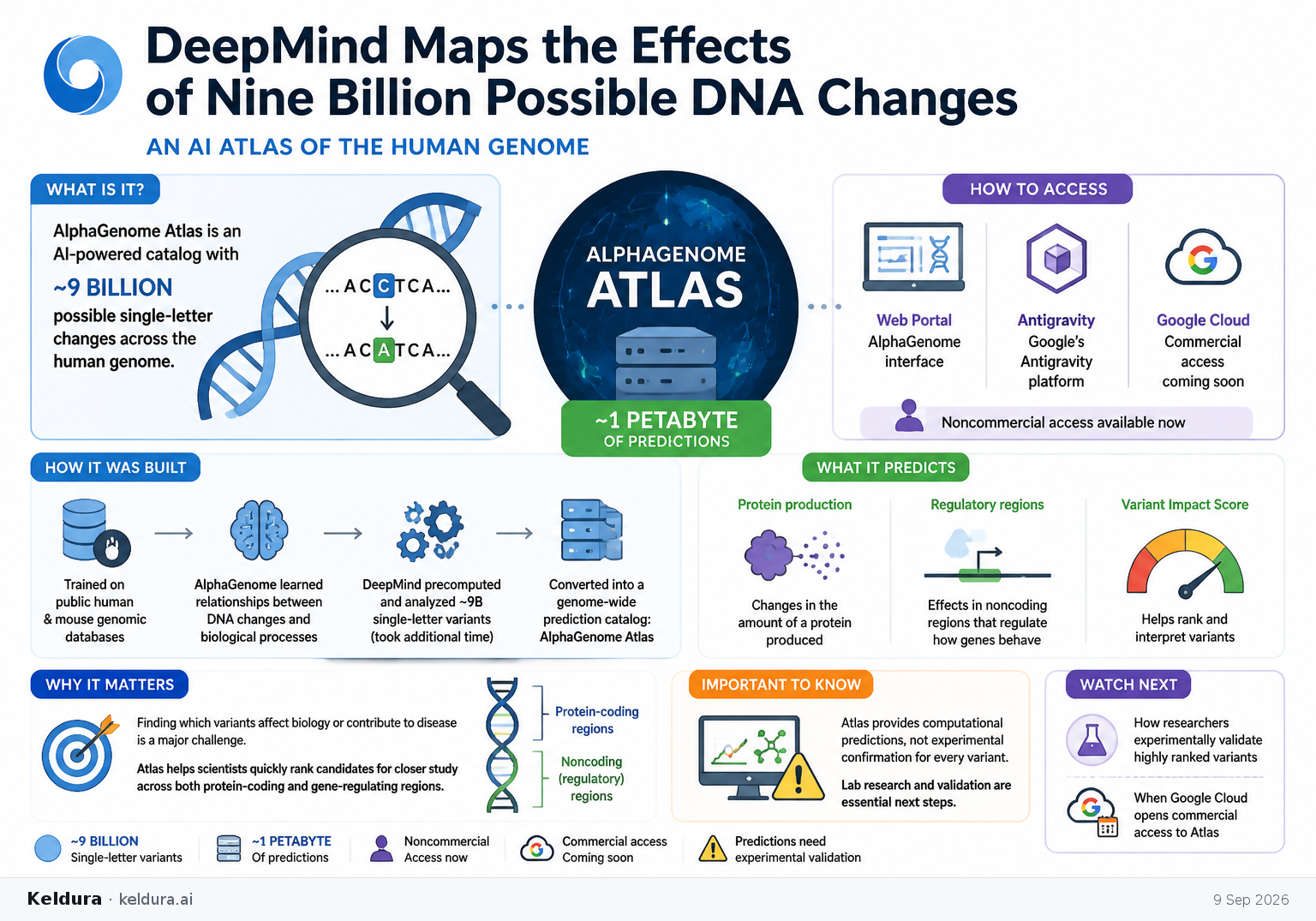
Google DeepMind unveiled AlphaGenome Atlas, an AI-powered resource containing predictions for how roughly nine billion possible single-letter substitutions in the human genome could affect molecular biology.[5] Researchers can explore the approximately one-petabyte dataset through a web portal, the AlphaGenome interface, and Google’s Antigravity platform, with noncommercial access available now and commercial access on Google Cloud planned soon.[5]
Why it matters: Determining which genetic variants alter biological processes or contribute to disease is a major research challenge, and Atlas could help scientists rank candidates for closer study across both protein-coding and gene-regulating regions of the genome.[5]
Key insights: Atlas predicts molecular effects such as changes in the amount of a protein produced and includes a Variant Impact Score designed to help researchers rank and interpret variants.[5] | The resource builds on AlphaGenome and extends predictions across the genome, including large noncoding regions that can regulate how genes behave.[5] | AlphaGenome learned relationships between DNA changes and biological processes from public human and mouse genome databases.[5] | The catalog provides computational predictions rather than reported experimental confirmation for every variant, making subsequent research and validation central to its use.[5]
Cheatsheet facts: What changed: DeepMind converted AlphaGenome’s predictive capabilities into a genome-wide catalog covering approximately nine billion potential single-letter variants.[5] | Why now: DeepMind said precomputing and analyzing the enormous variant space took additional time after the underlying AlphaGenome model was released last year.[5] | Watch next: Watch how researchers experimentally validate highly ranked variants and when Google Cloud opens the promised commercial access to Atlas.[5]
Google DeepMind unveiled AlphaGenome Atlas, an AI-powered resource containing predictions for how roughly nine billion possible single-letter substitutions in the human genome could affect molecular biology.[5] Researchers can explore the approximately one-petabyte dataset through a web portal, the AlphaGenome interface, and Google’s Antigravity platform, with noncommercial access available now and commercial access on Google Cloud planned soon.[5]
Why it matters: Determining which genetic variants alter biological processes or contribute to disease is a major research challenge, and Atlas could help scientists rank candidates for closer study across both protein-coding and gene-regulating regions of the genome.[5]
Key insights: Atlas predicts molecular effects such as changes in the amount of a protein produced and includes a Variant Impact Score designed to help researchers rank and interpret variants.[5] | The resource builds on AlphaGenome and extends predictions across the genome, including large noncoding regions that can regulate how genes behave.[5] | AlphaGenome learned relationships between DNA changes and biological processes from public human and mouse genome databases.[5] | The catalog provides computational predictions rather than reported experimental confirmation for every variant, making subsequent research and validation central to its use.[5]
Cheatsheet facts: What changed: DeepMind converted AlphaGenome’s predictive capabilities into a genome-wide catalog covering approximately nine billion potential single-letter variants.[5] | Why now: DeepMind said precomputing and analyzing the enormous variant space took additional time after the underlying AlphaGenome model was released last year.[5] | Watch next: Watch how researchers experimentally validate highly ranked variants and when Google Cloud opens the promised commercial access to Atlas.[5]