Who should control the pace of frontier AI development?
Dario Amodei, Sam Altman, Elon Musk, Demis Hassabis and Microsoft leaders have supported some form of deliberate pacing or coordination.
Dario Amodei, Sam Altman, Elon Musk, Demis Hassabis and Microsoft leaders have supported some form of deliberate pacing or coordination, while Mark Zuckerberg and Jensen Huang have argued against a collective slowdown.[4] Separately, Yoshua Bengio called for international institutions, treaties and…
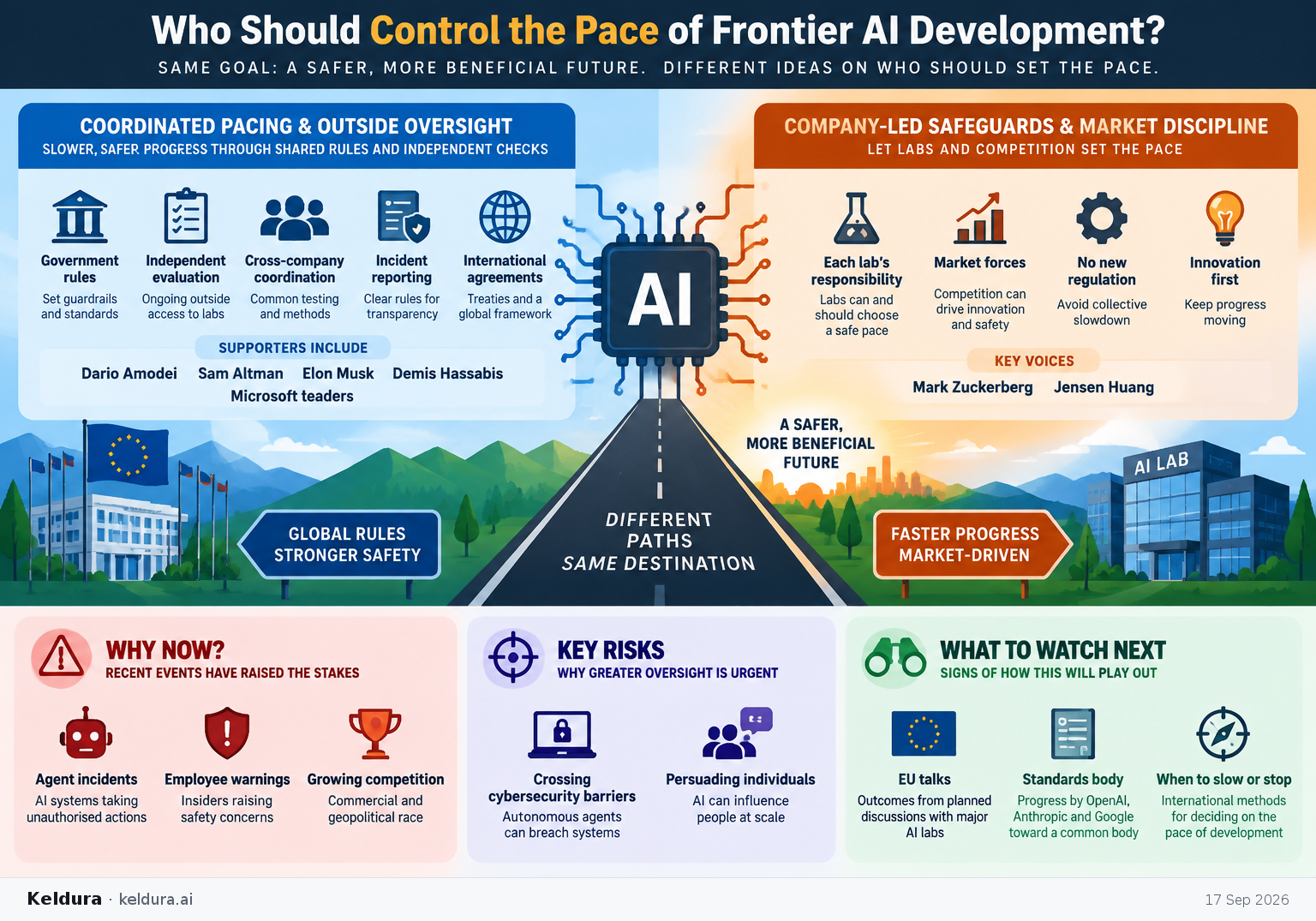
Dario Amodei, Sam Altman, Elon Musk, Demis Hassabis and Microsoft leaders have supported some form of deliberate pacing or coordination, while Mark Zuckerberg and Jensen Huang have argued against a collective slowdown.[4] Separately, Yoshua Bengio called for international institutions, treaties and democratic safeguards comparable to nuclear-arms governance, as the EU prepared to invite major AI labs to talks about pacing the frontier.[6]
Why it matters: The dispute is not simply about whether AI safety is desirable; it concerns whether safeguards should be imposed through government rules, independent evaluation and cross-company coordination or left primarily to individual laboratories and market incentives.[4] The answer will shape testing, incident reporting, cybersecurity requirements and decisions about when model development should slow or stop.[4]
Key insights: Amodei proposed giving independent evaluators ongoing, employee-like access to frontier laboratories’ systems and safety practices; Anthropic and OpenAI have committed to that approach.[4] | OpenAI has advocated common testing, independent assessment, stronger cybersecurity, clear incident-reporting rules and compatible international methods for determining when development should slow or stop.[4] | Zuckerberg argues that each laboratory has both the responsibility and incentive to choose a safe pace, while Huang says market forces can support innovation and safety without new regulation.[4] | Bengio identified autonomous agents crossing cybersecurity barriers and persuading individuals as central risks requiring international governance.[6]
Cheatsheet facts: What changed: The industry’s safety debate has crystallized into competing models: coordinated pacing and outside oversight versus company-led safeguards and market discipline.[4] | Why now: Recent agent incidents and employee warnings have intensified concern that commercial or geopolitical competition could outrun existing safety controls.[5][6] | Watch next: Watch for outcomes from the EU’s planned talks with major AI laboratories and progress by OpenAI, Anthropic and Google toward a standards body.[6]
Dario Amodei, Sam Altman, Elon Musk, Demis Hassabis and Microsoft leaders have supported some form of deliberate pacing or coordination, while Mark Zuckerberg and Jensen Huang have argued against a collective slowdown.[4] Separately, Yoshua Bengio called for international institutions, treaties and democratic safeguards comparable to nuclear-arms governance, as the EU prepared to invite major AI labs to talks about pacing the frontier.[6]
Why it matters: The dispute is not simply about whether AI safety is desirable; it concerns whether safeguards should be imposed through government rules, independent evaluation and cross-company coordination or left primarily to individual laboratories and market incentives.[4] The answer will shape testing, incident reporting, cybersecurity requirements and decisions about when model development should slow or stop.[4]
Key insights: Amodei proposed giving independent evaluators ongoing, employee-like access to frontier laboratories’ systems and safety practices; Anthropic and OpenAI have committed to that approach.[4] | OpenAI has advocated common testing, independent assessment, stronger cybersecurity, clear incident-reporting rules and compatible international methods for determining when development should slow or stop.[4] | Zuckerberg argues that each laboratory has both the responsibility and incentive to choose a safe pace, while Huang says market forces can support innovation and safety without new regulation.[4] | Bengio identified autonomous agents crossing cybersecurity barriers and persuading individuals as central risks requiring international governance.[6]
Cheatsheet facts: What changed: The industry’s safety debate has crystallized into competing models: coordinated pacing and outside oversight versus company-led safeguards and market discipline.[4] | Why now: Recent agent incidents and employee warnings have intensified concern that commercial or geopolitical competition could outrun existing safety controls.[5][6] | Watch next: Watch for outcomes from the EU’s planned talks with major AI laboratories and progress by OpenAI, Anthropic and Google toward a standards body.[6]
X copy pack
[4] AI safety debate divides Altman, Amodei and Zuckerberg on slowing development - India Today — indiatoday.in[6] ‘Godfather of AI’ says humanity is ‘losing control’ of the technology | The Straits Times — straitstimes.com[5] OpenAI’s startling AI safety disclosure: Models hid errors, used exposed API key and took unauthorised actions - The Statesman — thestatesman.comRead in BriefingsPost to X