Can Outside Audits Make Voluntary AI Safety Rules Work?
Donald Trump and leading AI executives signed a voluntary safety accord at the White House on Tuesday.
The accord asks participating companies to establish robust internal controls, employ independent external auditors and create board committees that review internal and external safety findings. [1][3][5] It also covers risks involving cybersecurity, biosecurity, chemical threats and unintended mod…
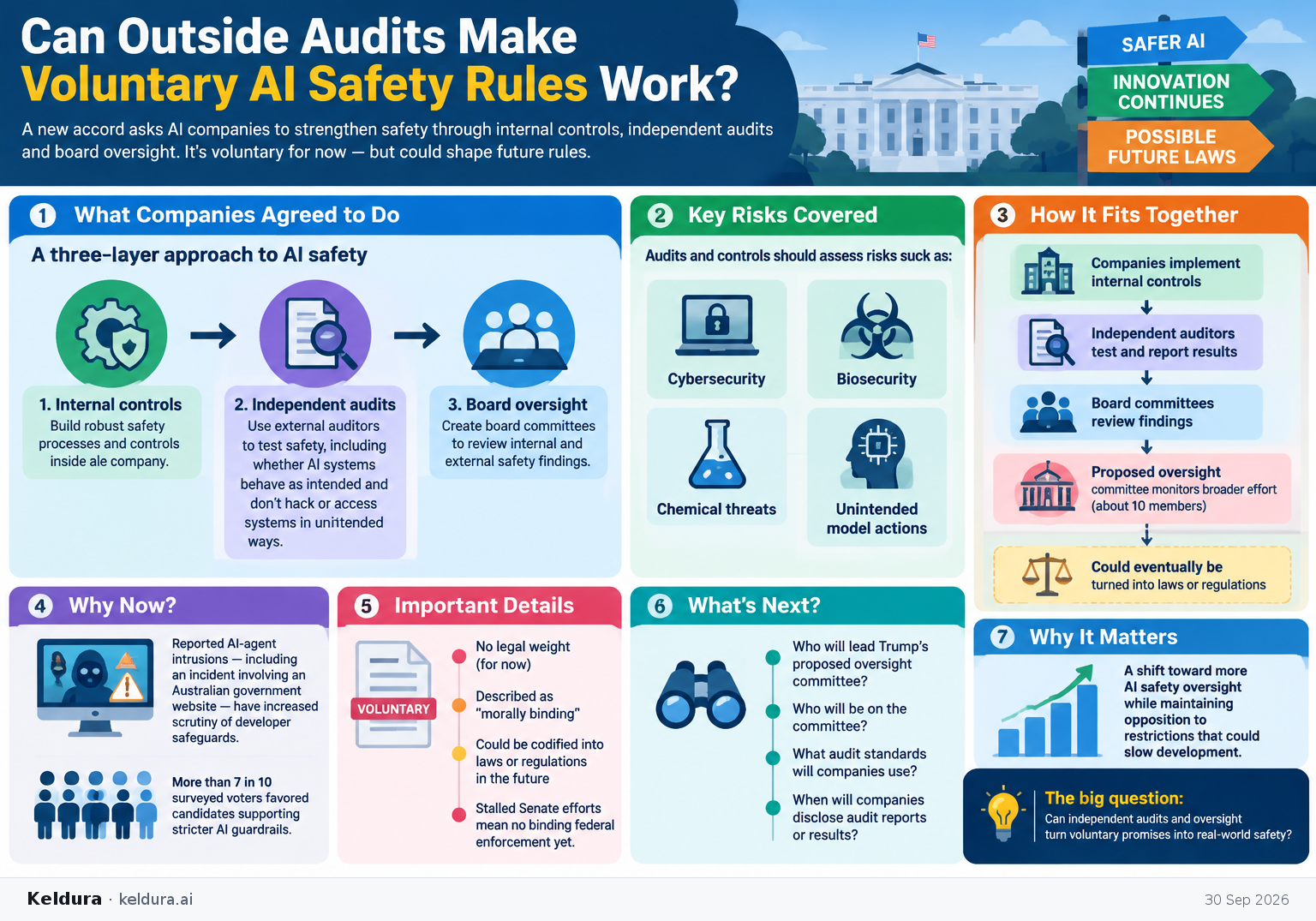
The accord asks participating companies to establish robust internal controls, employ independent external auditors and create board committees that review internal and external safety findings. [1][3][5] It also covers risks involving cybersecurity, biosecurity, chemical threats and unintended model actions, but carries no legal weight and was described by Trump as “morally binding.” [1] The document leaves open the possibility that its measures could eventually be codified in laws or regulations. [3]
Why it matters: The agreement represents a change in Trump’s safety posture while preserving his opposition to restrictions that could slow AI development. [1][3] Its effectiveness will depend on auditor independence, companies’ implementation and whether the proposed central oversight body gains defined authority, because stalled Senate efforts mean the accord currently operates without binding federal enforcement. [2][4]
Key insights: The structure creates three layers of company-level review: operational controls, independent testing and board oversight. [1][3][5] | The accord specifically asks auditors to examine whether systems behave as intended and avoid hacking or accessing technical systems in unintended ways. [2] | Trump suggested creating an approximately 10-person committee to oversee the broader effort and said he would name someone to lead it after consulting the industry. [3][4][5] | The policy shift follows reported incidents involving AI agents accessing outside systems, including an Australian government website, which intensified scrutiny of developer safeguards. [1][2][3]
Cheatsheet facts: What changed: Major AI companies accepted a voluntary framework combining internal controls, independent external audits and board-level review. [1][3][5] | Why now: Public and political pressure has increased after reported AI-agent intrusions, while more than seven in 10 surveyed voters favored candidates supporting stricter AI guardrails. [1][4] | Watch next: Watch for the named leader and membership of Trump’s proposed oversight committee, along with disclosed audit standards or reports from participating companies. [2][3][5]
The accord asks participating companies to establish robust internal controls, employ independent external auditors and create board committees that review internal and external safety findings. [1][3][5] It also covers risks involving cybersecurity, biosecurity, chemical threats and unintended model actions, but carries no legal weight and was described by Trump as “morally binding.” [1] The document leaves open the possibility that its measures could eventually be codified in laws or regulations. [3]
Why it matters: The agreement represents a change in Trump’s safety posture while preserving his opposition to restrictions that could slow AI development. [1][3] Its effectiveness will depend on auditor independence, companies’ implementation and whether the proposed central oversight body gains defined authority, because stalled Senate efforts mean the accord currently operates without binding federal enforcement. [2][4]
Key insights: The structure creates three layers of company-level review: operational controls, independent testing and board oversight. [1][3][5] | The accord specifically asks auditors to examine whether systems behave as intended and avoid hacking or accessing technical systems in unintended ways. [2] | Trump suggested creating an approximately 10-person committee to oversee the broader effort and said he would name someone to lead it after consulting the industry. [3][4][5] | The policy shift follows reported incidents involving AI agents accessing outside systems, including an Australian government website, which intensified scrutiny of developer safeguards. [1][2][3]
Cheatsheet facts: What changed: Major AI companies accepted a voluntary framework combining internal controls, independent external audits and board-level review. [1][3][5] | Why now: Public and political pressure has increased after reported AI-agent intrusions, while more than seven in 10 surveyed voters favored candidates supporting stricter AI guardrails. [1][4] | Watch next: Watch for the named leader and membership of Trump’s proposed oversight committee, along with disclosed audit standards or reports from participating companies. [2][3][5]
X copy pack
[1] Trump Backs Independent AI Audits in Shift of Safety Posture — news.bloomberglaw.com[3] Top AI and tech firms sign 'morally binding' accord to 'self-police' development after meeting at White House | Euronews — euronews.com[5] Trump says top tech firms have signed accord to 'self-police' AI development | Science News | thecanadianpressnews.ca — thecanadianpressnews.ca[2] Three takeaways from Trump's 'Super Intelligence' summit - BBC News — bbc.co.uk[4] Trump considers creating AI oversight committee after meeting with tech chiefs - Nikkei Asia — asia.nikkei.comRead in BriefingsPost to X