Google chooses air cooling for its contested India AI hub
Google says air cooling will avoid local water shortages, but how will its planned AI hub affect power demand and livelihoods?
On October 11, Google told AFP its planned AI data centre in Visakhapatnam would use air cooling amid residents' concerns about local resources.
Residents have opposed construction of Google's planned AI hub in Visakhapatnam over potential environmental and livelihood impacts. Google said the gigawatt-scale facility, part of a $15 billion investment and scheduled to operate in 2028, would use advanced air cooling rather than water cooling b…
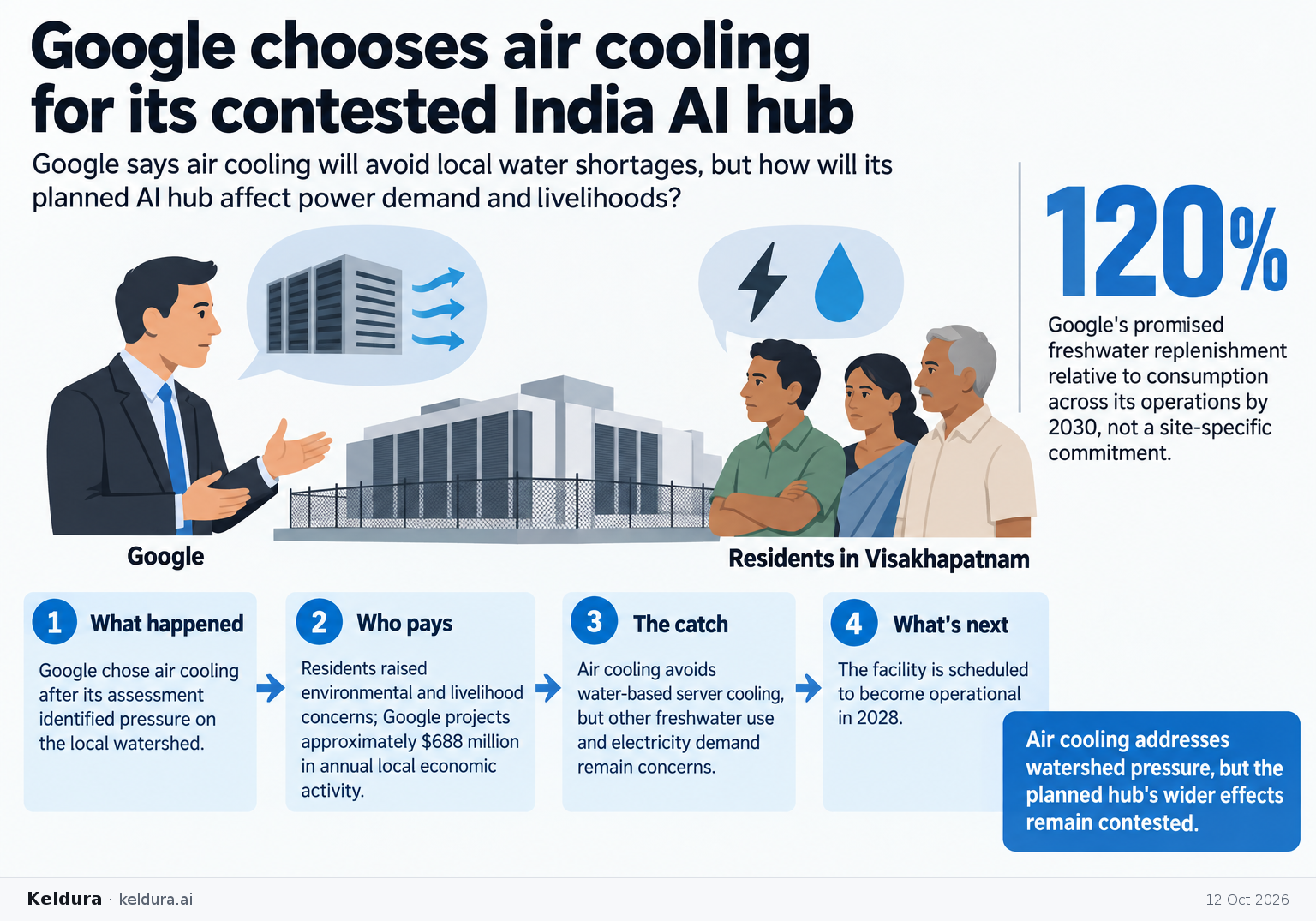
Residents have opposed construction of Google's planned AI hub in Visakhapatnam over potential environmental and livelihood impacts. Google said the gigawatt-scale facility, part of a $15 billion investment and scheduled to operate in 2028, would use advanced air cooling rather than water cooling because its assessment identified pressure on the local watershed. [7]
Why it matters: Choosing air cooling addresses one resource constraint, but the project also brings electricity demand to a region where data-centre expansion raises questions about fossil-fuel-dependent grids. Google presents the development as an economic opportunity, projecting approximately $688 million in annual local economic activity. [7]
Key insights: Google said the watershed assessment shaped its cooling choice from the outset; the design is a response to local conditions, not a claim that the facility will consume no freshwater. [7] | For freshwater used outside cooling, Google cited a commitment to replenish 120 percent of consumption across its operations by 2030, rather than a stated site-specific replenishment guarantee. [7] | Google's employment figures describe typical developments: about 4,200 construction workers annually over three to five years, followed by hundreds of specialist on-site roles. [7]
Cheatsheet facts: What happened: Google said its planned Visakhapatnam AI facility would use air cooling, responding to pressure on the local watershed. [7] | Who pays: Residents have raised environmental and livelihood concerns; Google projects approximately $688 million in local economic activity each year. [7] | The catch: Air cooling avoids water-based server cooling, but freshwater is still needed for other facility uses and electricity demand remains a concern. [7] | What's next: The facility is scheduled to become operational in 2028, providing a concrete milestone for checking delivery of the project. [7]