Monsoon forecasting is improving, but the service gap remains
WMO says better monsoon forecasts are helping communities prepare for floods, droughts and heatwaves, while also showing the need for stronger international cooperation [1]. The piece says monsoon science has advanced through better understanding of ENSO, the Indian Ocean Dipole and the Madden-Juli…
WMO says better monsoon forecasts are helping communities prepare for floods, droughts and heatwaves, while also showing the need for stronger international cooperation [1]. The piece says monsoon science has advanced through better understanding of ENSO, the Indian Ocean Dipole and the Madden-Julian Oscillation, and that seasonal outlooks are already informing agriculture, water management and disaster preparedness in places like Myanmar, India and Afghanistan [1].
Why it matters: Monsoons affect more than two-thirds of the world’s population, so even modest gains in forecast skill can translate into major public-safety and economic benefits [1]. The article argues that the remaining bottleneck is not just science, but getting coordinated observations, reliable models and warnings into practical services across borders and into vulnerable regions such as Small Island Developing States [1].
Key insights: Pakistan’s 2022 monsoon season is used as a warning example: one station in Sindh recorded more than 1,600 millimetres of rain in a single day, and around 12 million people were severely affected after the country received 175% of normal annual rainfall [1]. | Scientists still struggle with monsoon onset and withdrawal, and extending reliable skill into subseasonal-to-seasonal ranges remains a priority [1]. | AI is opening new forecasting possibilities, but the article says current AI-based models tend to underpredict extreme events and should complement, not replace, physical understanding [1]. | Operational limits remain serious, including sparse surface networks, uncertain ocean fluxes, mid-latitude model bias in the tropics, and even nonfunctioning automatic weather stations in some countries [1].
Cheatsheet facts: What changed: Seasonal monsoon forecasts and regional services are becoming more useful for planning and warnings [1]. | Why now: Extreme monsoon impacts are cascading across floods, droughts, heatwaves and landslides, raising the stakes for better preparedness [1]. | Watch next: Whether countries expand coordinated observations, improve subseasonal-to-seasonal forecast skill, and share targeted data more openly across borders [1].
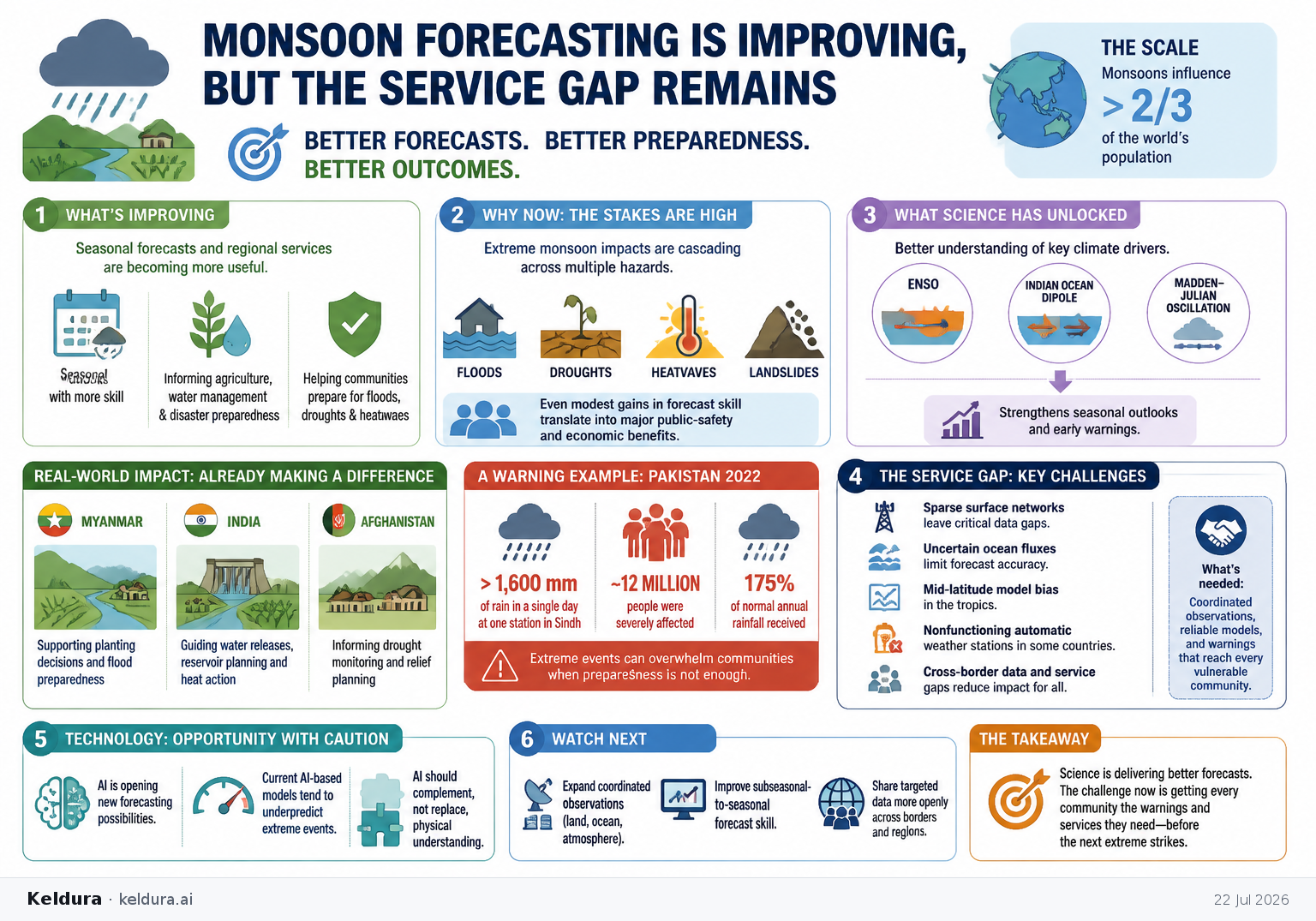
WMO says better monsoon forecasts are helping communities prepare for floods, droughts and heatwaves, while also showing the need for stronger international cooperation [1]. The piece says monsoon science has advanced through better understanding of ENSO, the Indian Ocean Dipole and the Madden-Julian Oscillation, and that seasonal outlooks are already informing agriculture, water management and disaster preparedness in places like Myanmar, India and Afghanistan [1].
Why it matters: Monsoons affect more than two-thirds of the world’s population, so even modest gains in forecast skill can translate into major public-safety and economic benefits [1]. The article argues that the remaining bottleneck is not just science, but getting coordinated observations, reliable models and warnings into practical services across borders and into vulnerable regions such as Small Island Developing States [1].
Key insights: Pakistan’s 2022 monsoon season is used as a warning example: one station in Sindh recorded more than 1,600 millimetres of rain in a single day, and around 12 million people were severely affected after the country received 175% of normal annual rainfall [1]. | Scientists still struggle with monsoon onset and withdrawal, and extending reliable skill into subseasonal-to-seasonal ranges remains a priority [1]. | AI is opening new forecasting possibilities, but the article says current AI-based models tend to underpredict extreme events and should complement, not replace, physical understanding [1]. | Operational limits remain serious, including sparse surface networks, uncertain ocean fluxes, mid-latitude model bias in the tropics, and even nonfunctioning automatic weather stations in some countries [1].
Cheatsheet facts: What changed: Seasonal monsoon forecasts and regional services are becoming more useful for planning and warnings [1]. | Why now: Extreme monsoon impacts are cascading across floods, droughts, heatwaves and landslides, raising the stakes for better preparedness [1]. | Watch next: Whether countries expand coordinated observations, improve subseasonal-to-seasonal forecast skill, and share targeted data more openly across borders [1].