A total solar eclipse will cross Europe, Greenland, Iceland, and parts of North America on Aug. 12, 2026
NASA says a total solar eclipse will sweep across Greenland, Iceland, northern Russia, the Atlantic Ocean, Spain, and a small corner of Portugal on Aug. 12, 2026 [3]. Many other places in the Northern Hemisphere will see a partial eclipse, including parts of the northern U.S., most of Canada, much…
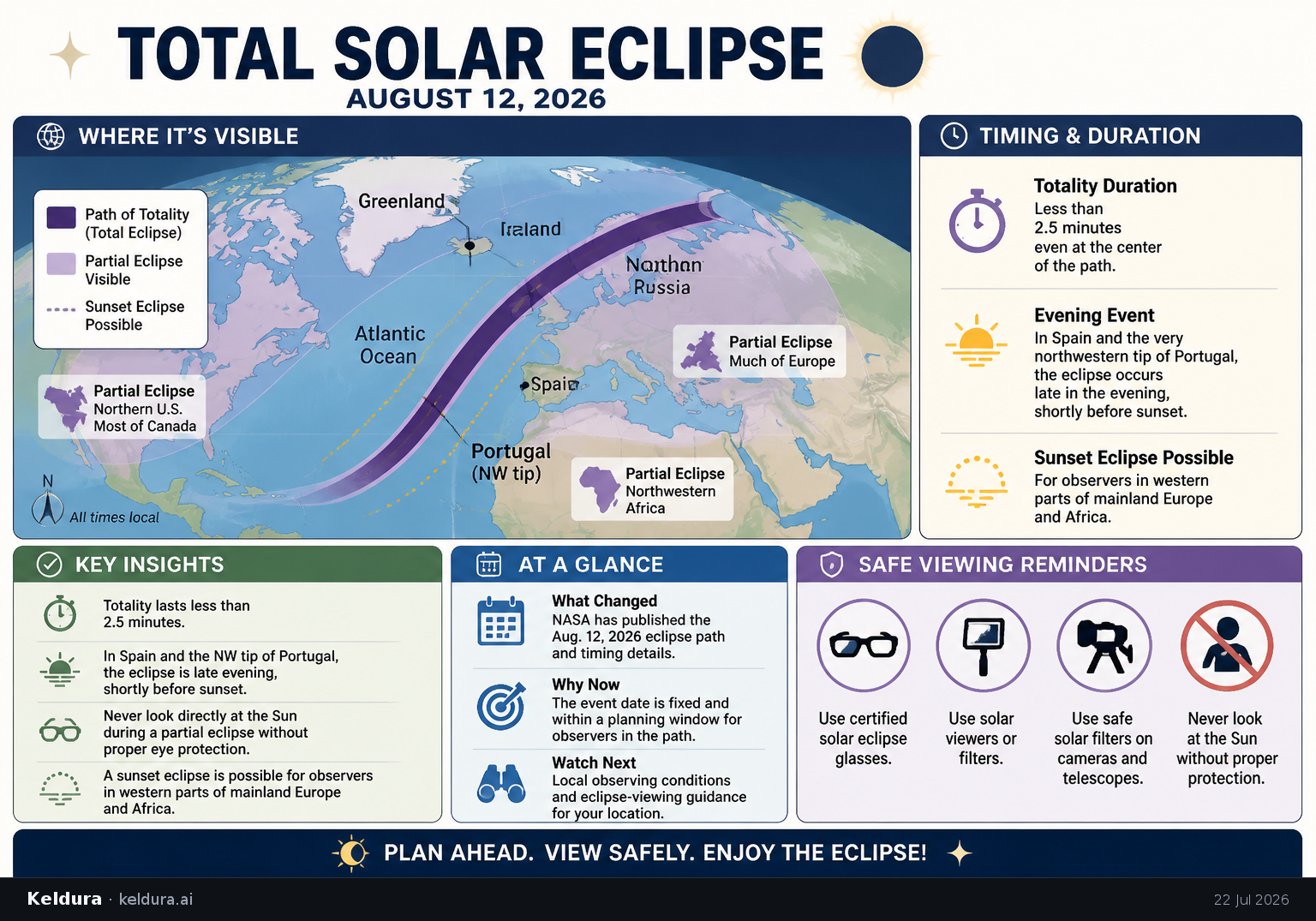
NASA says a total solar eclipse will sweep across Greenland, Iceland, northern Russia, the Atlantic Ocean, Spain, and a small corner of Portugal on Aug. 12, 2026 [3]. Many other places in the Northern Hemisphere will see a partial eclipse, including parts of the northern U.S., most of Canada, much of Europe, and northwestern Africa [3].
Why it matters: This is a clearly mapped, time-specific celestial event that will be visible across a wide set of regions, creating public viewing opportunities and local scientific interest [3]. NASA’s visibility details and timing guidance are directly useful for eclipse planning and safe observation [3].
Key insights: NASA says totality will last less than two and a half minutes even near the center of the path [3]. | In Spain and the very northwestern tip of Portugal, the eclipse will occur late in the evening, shortly before sunset [3]. | NASA warns that partial-eclipse viewers should never look directly at the Sun without proper eye protection [3]. | The eclipse path includes a possible sunset eclipse for observers in western parts of mainland Europe and Africa [3].
Cheatsheet facts: What changed: NASA has published the Aug. 12, 2026 eclipse path and timing details [3]. | Why now: The event date is fixed and within a planning window for observers in the path [3]. | Watch next: Local observing conditions and eclipse-viewing guidance for areas inside the path of totality and partial-eclipse zones [3].
NASA says a total solar eclipse will sweep across Greenland, Iceland, northern Russia, the Atlantic Ocean, Spain, and a small corner of Portugal on Aug. 12, 2026 [3]. Many other places in the Northern Hemisphere will see a partial eclipse, including parts of the northern U.S., most of Canada, much of Europe, and northwestern Africa [3].
Why it matters: This is a clearly mapped, time-specific celestial event that will be visible across a wide set of regions, creating public viewing opportunities and local scientific interest [3]. NASA’s visibility details and timing guidance are directly useful for eclipse planning and safe observation [3].
Key insights: NASA says totality will last less than two and a half minutes even near the center of the path [3]. | In Spain and the very northwestern tip of Portugal, the eclipse will occur late in the evening, shortly before sunset [3]. | NASA warns that partial-eclipse viewers should never look directly at the Sun without proper eye protection [3]. | The eclipse path includes a possible sunset eclipse for observers in western parts of mainland Europe and Africa [3].
Cheatsheet facts: What changed: NASA has published the Aug. 12, 2026 eclipse path and timing details [3]. | Why now: The event date is fixed and within a planning window for observers in the path [3]. | Watch next: Local observing conditions and eclipse-viewing guidance for areas inside the path of totality and partial-eclipse zones [3].