Probabilistic cyclone forecasts are gaining ground, but user training lags
WMO says it is working with weather services to expand probabilistic tropical cyclone forecasting so early warnings and disaster preparedness are more effective [2][4]. The article cites Typhoon Haiyan as a case where forecast information did not translate cleanly into local decisions, and says ser…
WMO says it is working with weather services to expand probabilistic tropical cyclone forecasting so early warnings and disaster preparedness are more effective [2][4]. The article cites Typhoon Haiyan as a case where forecast information did not translate cleanly into local decisions, and says services such as PAGASA are moving toward probabilistic storm surge forecasts that show a range of scenarios rather than a single track [2][4].
Why it matters: Probabilistic forecasts can turn uncertainty into action, but only if forecasters, emergency managers and the public understand them [2][4]. The evidence shows a clear implementation gap: the science is strong, yet training, communication and decision-focused products are still limiting uptake in many countries [2][4].
Key insights: A WMO survey of 78 countries found only 43% currently use probabilistic forecasts operationally, while more than half are either not using them or still transitioning [2][4]. | Even among countries already using probabilistic forecasts, only 56% have trained their users to interpret them, and fewer than half include uncertainty information in public warnings [2][4]. | The Hong Kong Observatory reduced tropical cyclone track forecast errors by more than 30% at four- and five-day lead times after introducing AI weather prediction models [2][4]. | Workshop participants called for hands-on training, multilingual e-learning and peer-to-peer mentoring, especially for smaller services facing similar hazards [2][4].
Cheatsheet facts: What changed: Forecast centres are moving from single-track cyclone forecasts toward probabilistic tools such as dynamic cones, strike probability maps and storm surge scenarios [2][4]. | Why now: Recent storm impacts and improving AI/model capabilities are pushing services to make uncertainty more usable for decisions [2][4]. | Watch next: Whether more forecast centres adopt operational probabilistic products and whether public-warning systems start carrying uncertainty information more consistently [2][4].
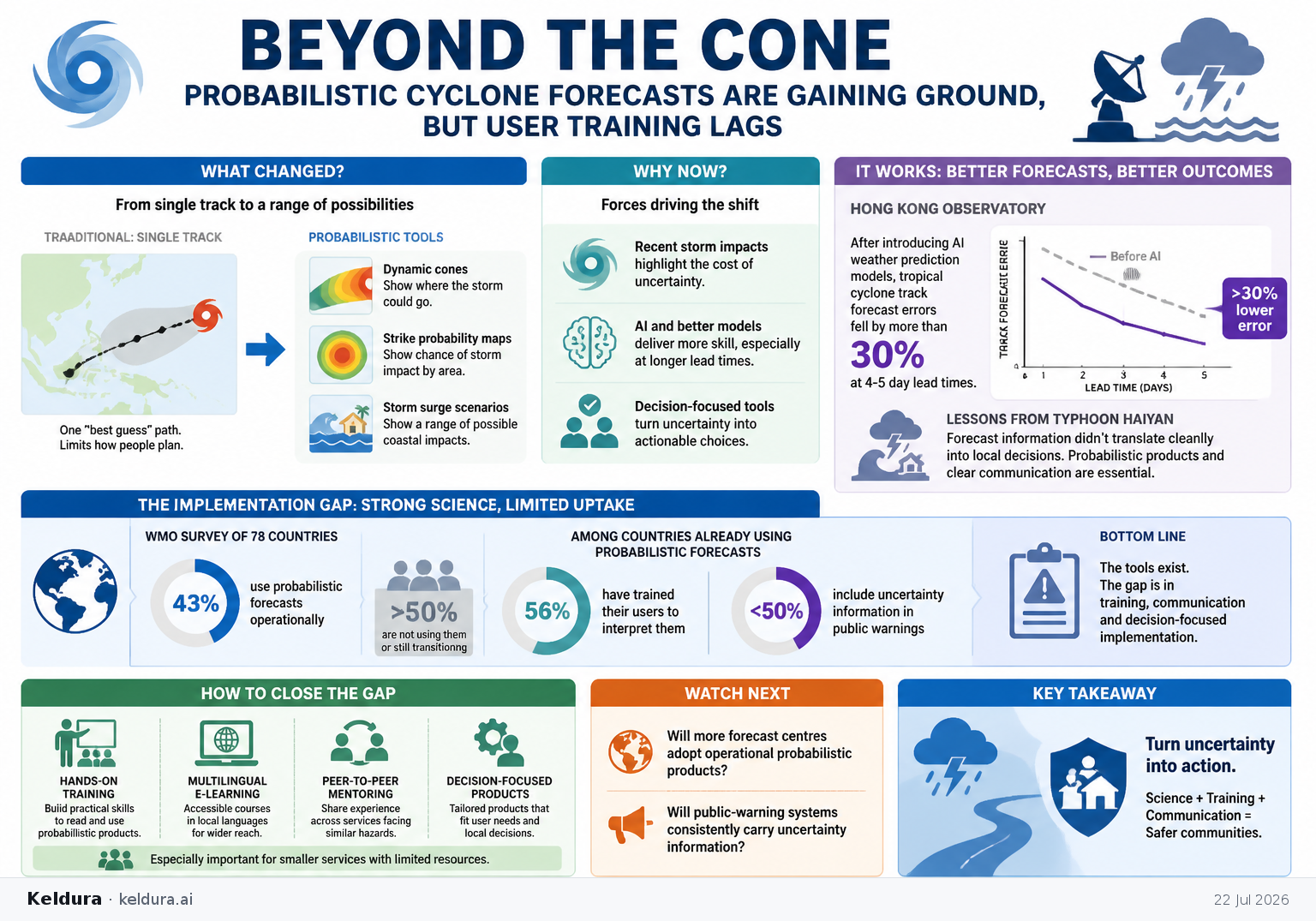
WMO says it is working with weather services to expand probabilistic tropical cyclone forecasting so early warnings and disaster preparedness are more effective [2][4]. The article cites Typhoon Haiyan as a case where forecast information did not translate cleanly into local decisions, and says services such as PAGASA are moving toward probabilistic storm surge forecasts that show a range of scenarios rather than a single track [2][4].
Why it matters: Probabilistic forecasts can turn uncertainty into action, but only if forecasters, emergency managers and the public understand them [2][4]. The evidence shows a clear implementation gap: the science is strong, yet training, communication and decision-focused products are still limiting uptake in many countries [2][4].
Key insights: A WMO survey of 78 countries found only 43% currently use probabilistic forecasts operationally, while more than half are either not using them or still transitioning [2][4]. | Even among countries already using probabilistic forecasts, only 56% have trained their users to interpret them, and fewer than half include uncertainty information in public warnings [2][4]. | The Hong Kong Observatory reduced tropical cyclone track forecast errors by more than 30% at four- and five-day lead times after introducing AI weather prediction models [2][4]. | Workshop participants called for hands-on training, multilingual e-learning and peer-to-peer mentoring, especially for smaller services facing similar hazards [2][4].
Cheatsheet facts: What changed: Forecast centres are moving from single-track cyclone forecasts toward probabilistic tools such as dynamic cones, strike probability maps and storm surge scenarios [2][4]. | Why now: Recent storm impacts and improving AI/model capabilities are pushing services to make uncertainty more usable for decisions [2][4]. | Watch next: Whether more forecast centres adopt operational probabilistic products and whether public-warning systems start carrying uncertainty information more consistently [2][4].