Trump escalates pressure on Iran after US troop deaths as Strait of Hormuz tensions rise
President Donald Trump said Iran would pay “many times over” for the deaths of US soldiers, following recent American fatalities in attacks linked to the confrontation with Tehran.[3] The US military said it struck military and communications sites for a ninth consecutive night, while Iranian offic…
President Donald Trump said Iran would pay “many times over” for the deaths of US soldiers, following recent American fatalities in attacks linked to the confrontation with Tehran.[3] The US military said it struck military and communications sites for a ninth consecutive night, while Iranian officials described attacks on sites in Bahrain, Syria, and Jordan and warned the Strait of Hormuz would not be safe if US strikes continue.[3]
Why it matters: The exchange signals a sharp worsening in U.S.-Iran confrontation with direct implications for regional force posture and maritime security.[3] Because the Strait of Hormuz is a critical energy chokepoint, any sustained threat there could quickly affect global shipping and markets.[3]
Key insights: The US said the strikes were meant to further diminish Iran’s attacks on shipping in the Strait of Hormuz, tying military action directly to maritime security.[3] | Iran’s IRGC said the strait would not be safe for petrochemical and energy transit while US strikes continue, making shipping risk a central lever in the dispute.[3] | Marco Rubio said the US remains open to diplomacy, but the article notes that a mid-June ceasefire deal has unravelled and peace talks have made little progress.[3] | The deaths of three US soldiers in Jordan and Iraq are being used publicly by Trump to justify additional pressure on Iran.[3]
Cheatsheet facts: What changed: Trump vowed retaliation as the US and Iran continued exchanging strikes and threats.[3] | Why now: Recent US military deaths and ongoing attacks on shipping have intensified the confrontation.[3] | Watch next: Whether the US expands strikes, Iran follows through on threats to shipping, or diplomacy resumes through public or back-channel contacts.[3]
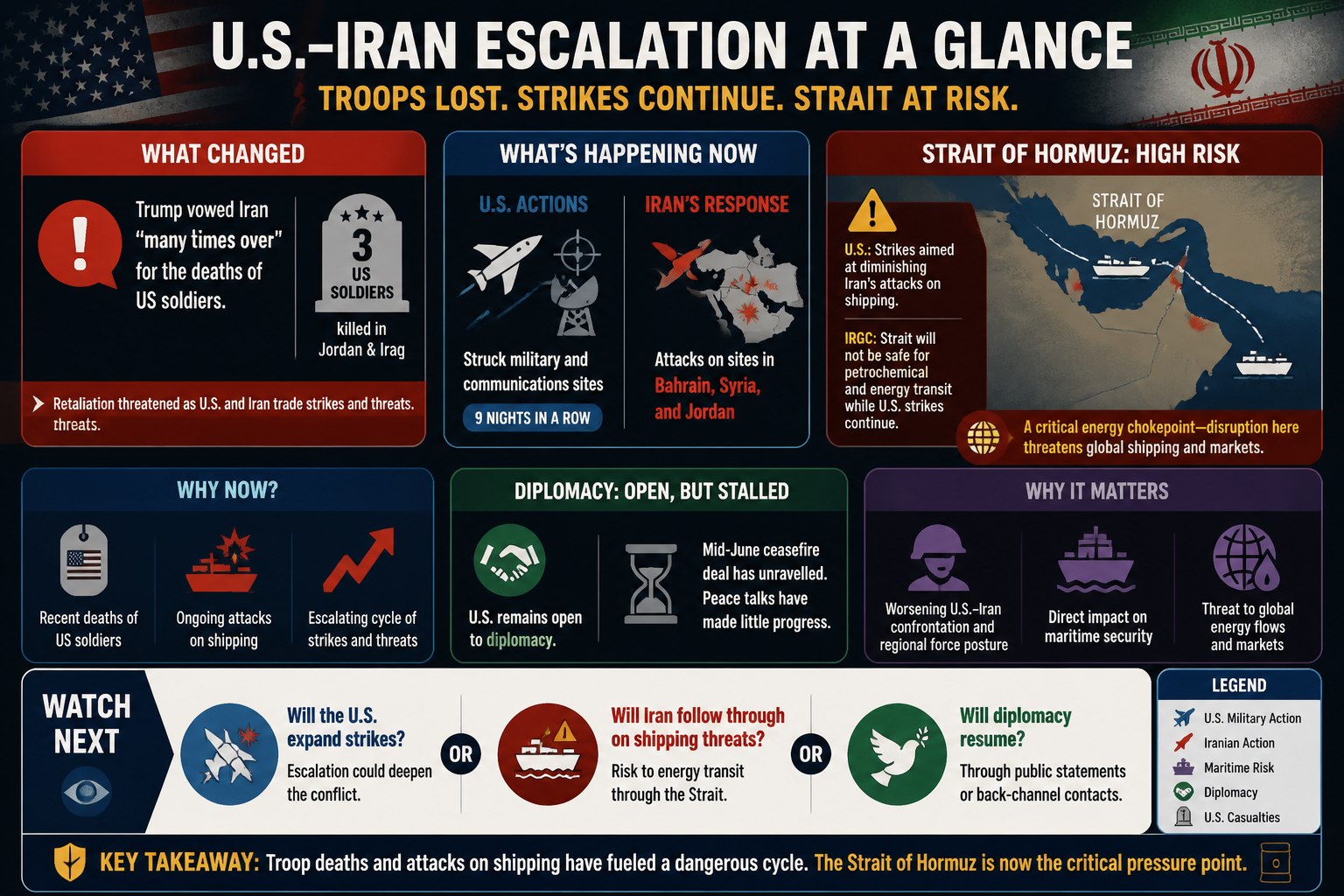
President Donald Trump said Iran would pay “many times over” for the deaths of US soldiers, following recent American fatalities in attacks linked to the confrontation with Tehran.[3] The US military said it struck military and communications sites for a ninth consecutive night, while Iranian officials described attacks on sites in Bahrain, Syria, and Jordan and warned the Strait of Hormuz would not be safe if US strikes continue.[3]
Why it matters: The exchange signals a sharp worsening in U.S.-Iran confrontation with direct implications for regional force posture and maritime security.[3] Because the Strait of Hormuz is a critical energy chokepoint, any sustained threat there could quickly affect global shipping and markets.[3]
Key insights: The US said the strikes were meant to further diminish Iran’s attacks on shipping in the Strait of Hormuz, tying military action directly to maritime security.[3] | Iran’s IRGC said the strait would not be safe for petrochemical and energy transit while US strikes continue, making shipping risk a central lever in the dispute.[3] | Marco Rubio said the US remains open to diplomacy, but the article notes that a mid-June ceasefire deal has unravelled and peace talks have made little progress.[3] | The deaths of three US soldiers in Jordan and Iraq are being used publicly by Trump to justify additional pressure on Iran.[3]
Cheatsheet facts: What changed: Trump vowed retaliation as the US and Iran continued exchanging strikes and threats.[3] | Why now: Recent US military deaths and ongoing attacks on shipping have intensified the confrontation.[3] | Watch next: Whether the US expands strikes, Iran follows through on threats to shipping, or diplomacy resumes through public or back-channel contacts.[3]